
Jack the Ripper: The Silence That Never Left...
An Investigation into Whitechapel, Anonymity, and the Legacy of a Killer Who Proved the Dark Could Hide in Plain Sight.

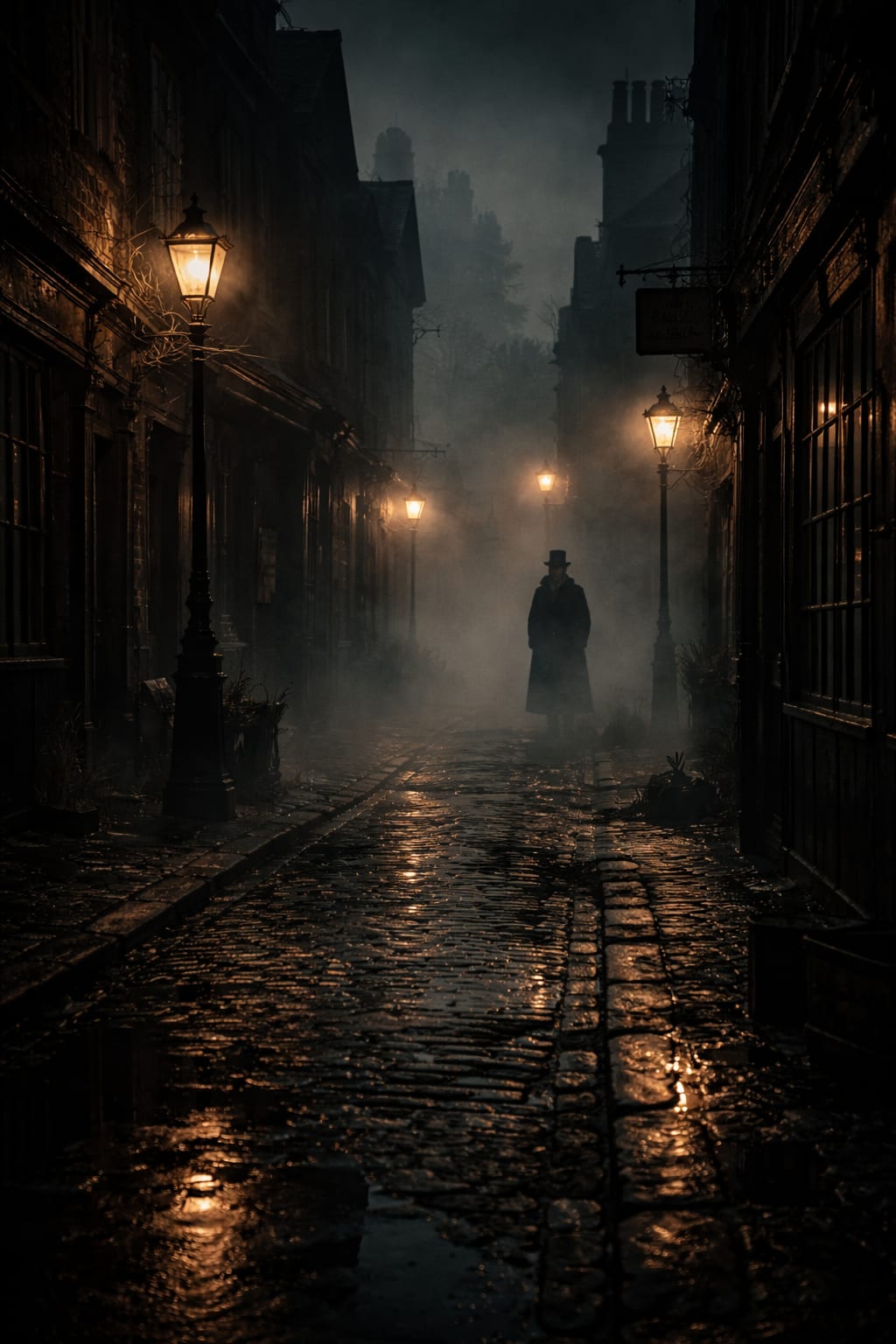
London, 1888... At night, the city did not sleep; it thinned.
Gas lamps cast weak halos that failed to reach the corners of the streets. Sound behaved strangely in Whitechapel. Footsteps overlapped. Voices blurred. A single cry could vanish into brick and fog before it fully formed. Thousands of people moved through the same narrow corridors each evening, close enough to brush past one another, distant enough to remain unknown.
Whitechapel was not hidden. It was crowded. Overfilled. Loud by day and strangely subdued by night. Lodging houses churned with temporary lives, men and women who arrived, stayed briefly, and disappeared without a record. Anonymity was not suspicious here. It was necessary.
This is critical to understand. Because what would later be called terror did not arrive with ceremony. There was no singular moment of realization. No alarm rang across the city announcing that something monstrous had arrived. Instead, there were gaps. Delays. Silences. Incidents that failed to register as connected until the pattern was already complete.
When the name Jack the Ripper entered public consciousness, it did not bring clarity. It brought shape to absence. A label where certainty should have been. A mask created as much by newspapers as by the unknown hand behind the crimes.
And even then, the city continued...
Markets opened. Factories ran. Trains departed. The streets that hosted horror by night returned to routine by morning. London did not freeze in fear; it absorbed shock and adapted. That adaptability would prove to be the most unsettling legacy of all.
The Victims' History Almost Forgot
Before they were reduced to case numbers and newspaper headlines, the canonical victims were women struggling at the edges of Victorian society. Poor. Often homeless. Frequently transient. They lived in a part of London where survival required invisibility and where violence against women was tragically common even before the murders began. This mattered...
Whitechapel’s residents were accustomed to danger. Assaults were not unusual. Deaths were not rare. When the first body was found, it did not immediately signal a new kind of threat; it looked like another grim entry in a long list of suffering that rarely received attention.
This delay is crucial to understanding how the killer operated. The women were not targeted because they were unseen. They were targeted because society had already decided not to see them.
By the time authorities recognized that something distinct was happening, valuable time had already passed. Patterns had already formed. Confidence had already grown.
The Crimes Without the Theater
Much has been written about the brutality of the murders. Enough, in fact, that repetition risks becoming distortion. What matters is not the gore, but the conditions under which the crimes occurred.
The attacks were swift. They occurred in public or semi-public spaces. The killer operated with startling confidence, suggesting either familiarity with the area or an understanding that intervention was unlikely.
Whitechapel at night offered cover not through isolation, but through density. Too many people. Too many sounds. Too many assumptions that someone else would notice, someone else would act.
This was not a predator hiding in shadows. This was someone moving comfortably through routine.
Each crime escalated not just in severity, but in audacity. And yet, no witness ever emerged who could clearly identify the killer. No reliable description survived scrutiny. No decisive physical evidence was found.
The city was full of eyes. None of them saw clearly enough.
The Media Creates a Mask
If the crimes revealed the limits of policing, the letters revealed the power of narrative. The emergence of letters signed “Jack the Ripper” changed everything. Whether written by the killer or opportunists remains debated, but the effect was undeniable. The murders gained a persona. A voice. A mythology.
The press amplified fear, speculation, and fascination in equal measure. Headlines raced ahead of facts. Rumors hardened into beliefs. The killer, real or constructed, became a figure larger than the acts themselves.
This was unprecedented. For the first time, a murderer existed simultaneously as an unknown individual and a public character. The mask mattered more than the man beneath it. Attention became currency. Silence became strategy.
Whether the killer authored the letters or simply benefited from them is almost irrelevant. The lesson was taught either way.
Why the Investigation Failed
The failure to identify Jack the Ripper was not due to a single oversight. It was systemic.
Policing in Victorian London was fragmented. Jurisdictions overlapped. Communication lagged. Forensic science was primitive. Evidence handling was inconsistent at best.
But the deeper failure was cultural. Class bias shaped suspicion. Witnesses were dismissed. The victims’ lifestyles were scrutinized more harshly than the circumstances of their deaths. The assumption that danger came from outside the community prevented serious consideration that the killer might be entirely ordinary.
And perhaps most importantly, there were too many people. In a city this dense, anonymity becomes their armor. Someone seen briefly is not remembered. Someone who remembers vaguely cannot be identified. Someone unremarkable leaves no impressions...
The killer did not need to disappear. He simply blended in.
Suspects and the Illusion of Closure
Over the decades, suspects have accumulated like sediment. Artists. Doctors. Immigrants. Royals. Each theory says less about the killer than about the era proposing it.
Evidence decays. Documents are lost. Memories distort. Certainty recedes rather than sharpens. This is not a failure of effort; it is the nature of historical absence.
Every suspect ultimately collapses under scrutiny, leaving behind a familiar frustration: the sense that the truth is just out of reach. But perhaps that frustration misunderstands the case entirely.
Jack the Ripper is not unsolved because the right suspect hasn’t been named. He is unsolved because the conditions that protected him worked perfectly.
The Legacy That Matters
The most enduring impact of Jack the Ripper is not the murders themselves. It is the proof... Proof that a person can commit extreme violence without supernatural cunning. Proof that anonymity is not an accident of darkness, but a feature of crowds. Proof that attention can be weaponized, and silence can be more effective than secrecy.
Most disturbingly, proof that such a figure does not need to be extraordinary to succeed. This is where the danger lies. Not in the myth, but in the lesson.
The Ripper demonstrated a method of erasure. A way to exist briefly, violently, and then dissolve into normalcy so completely that history cannot retrieve him. That lesson does not expire.
The Copycat Shadow
It is important to say this carefully... Jack the Ripper did not create followers. He created permission. Permission for those who crave recognition without identity. Permission for those who believe that fear multiplies when answers are withheld. Permission for those who understand that silence can be louder than confession.
Modern systems have evolved. Technology has advanced. Surveillance has multiplied, but the underlying truth remains unchanged. Anonymity is still possible, especially where crowds gather and systems strain under their own weight.
The shadow is not historical. It is structural.
Why the Silence Still Works
Perhaps the most unsettling aspect of the case is not what we don’t know, but how comfortable we are with that absence. Jack the Ripper did not vanish into legend; he vanished into the ordinary.
Into neighbors who noticed nothing. Into routines that resumed without comment. Into a city that learned to carry on. That is the silence that never left. Not the silence of ignorance, but the silence of accommodation.
The understanding, unspoken but persistent, that life continues even when something terrible passes through it. And that understanding, once learned, is never unlearned.
The Final Veil
Jack the Ripper is dead. Of that, there is little doubt. But the conditions that allowed him to exist remain intact. Possibly, the most unsettling aspect of it all is that anyone could be the next Ripper. Most killers rely on the ability to seem average... normal.
Crowds still protect anonymity. The media still amplifies violence. Silence still follows shock and awe. And somewhere in that space, between attention and neglect, the lesson endures.
The most frightening possibility is not that Jack the Ripper was a monster. It’s that he was ordinary enough to disappear forever. And that the dark does not need hiding places, it only needs crowds. The sheep are safe as long as the wolf isn't hungry...
About the Creator
Veil of Shadows
Ghost towns, lost agents, unsolved vanishings, and whispers from the dark. New anomalies every Monday and Friday. The veil is thinner than you think....
Keep reading
More stories from Veil of Shadows and writers in Horror and other communities.
The Devil's Cut
“Comrade, finally you’re awake.” The voice was smooth, sensual. A flickering incandescent bar was all that lit the white, sterile room. All Vladimir remembered was everything going black. He tried to move his arms and found them strapped to the gurney.
By Matthew J. Fromm5 days ago in Fiction


Comments
There are no comments for this story
Be the first to respond and start the conversation.