

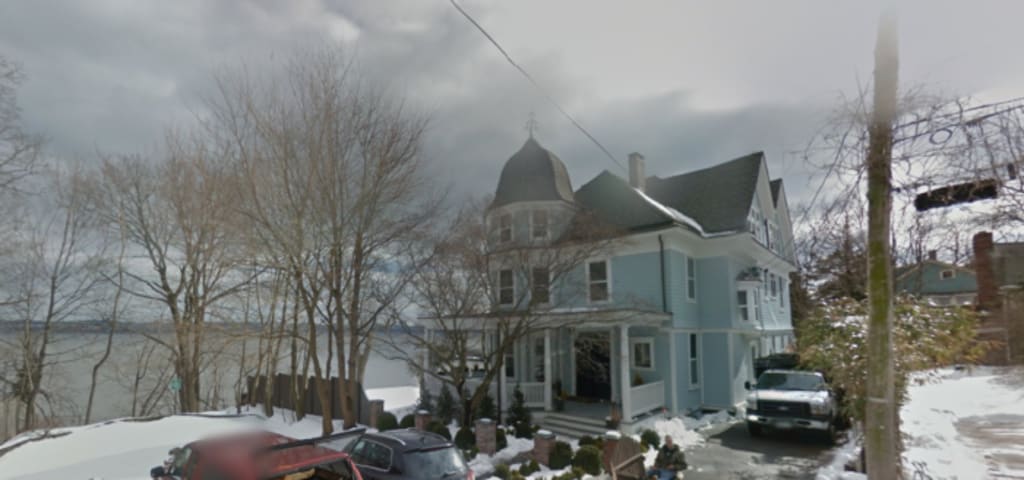
She was pregnant with her first child; he was a successful bonds tradesman on Wall Street. It was 1989, a successful man with a budding new family needed to find an emblem of his success. It wouldn’t be gold cuff links or a new Rolex watch, this time he would search for a house. A house to accommodate his first-born child and beautiful young bride but also show the world how well he’d done. And he had certainly done well. But he hadn’t heard the rumors, knew nothing of the local lore in Nyack, New York, he was perfectly oblivious and blissfully unaware when he stroked a check for 32,500 on a down payment for the stately mansion overlooking the Hudson. Perhaps he wouldn’t have minded if he knew, perhaps he would have dismissed the stories of poltergeists and hostile ghosts. In fact, it was likely he would, but he sued because he wasn’t given the option to.
Nyack, New York is no stranger to ghost stories. The area surrounding the Hudson is home to some famously sinister secrets. Just 20 minutes east is Sleepy Hollow, New York, home to Washington Irving’s infamous headless horsemen. The Hudson Valley is dotted with famously haunted Churches and Inns built on grounds soaked in the blood of American revolutionaries and cursed with the haunt of Native Americans evicted from their ancestral lands to make room for Dutch Shipping Merchants and other enterprising foreigners.
Perched atop small hill overlooking the Hudson is a beautiful Victorian mansion. Powder blue with stained glass windows and an elegant modesty despite its size. The home features 4600 sqft of living space, 18 rooms and 4 ½ baths. Built in the early 1890s but not clear by who the home was eventually inhabited by the Ackley family in 1960.
George Ackley had been living in the home for some time before Helen and her children joined him from Maryland. When Helen arrived, he surveyed her new home and immediately decided it needed some improvements. The roof had quote, gone awry, it needed a coat of paint and some other general maintenance to spruce it up and bring it back to its former Victorian glory. Helen was not shrinking socialite and did not mind getting her hands dirty making necessary improvements.
As she did, the unassuming strangeness of the home began to unfold unto her like an old down comforter being taken down from the top shelf of the linen closet to be shaken out before winter.
Many paranormal experts and enthusiasts alike suggest that when a new homeowner begins to make material changes or upgrades to a home it can and often will incite ghostly inhabitants out of postmortem slumber. Apparently, a fresh coat of paint or new tile on the kitchen counter disturbs any spectral roommates from slumber. In Helen Ackley’s case, her impulse to change things about the home likely drew out the reported spirits and directed their attention on her.
The oddities began on the very first night when the couple was preparing for bed, Helen learned that George had been sleeping with the lights on saying “I don’t want to discuss it” and rolled over to go to sleep. Helen confused but not concerned went to sleep prioritizing the tasks and work to be done in her head until he drifted off to sleep without incident.
As days turned to weeks and months the paranormal encounters experienced by Helen and her children increased. Cynthia, Helen’s 10-year-old daughter complained of being woken up every morning with an invisible force shaking her bed. Windows and doors flew open suddenly even in the clear absence of wind and items would go missing only to be found later and in unusual places. Though inconvenient the incidents were amounted to minor inconveniences. Nobody in the house had witnessed an apparition so the forces at play remained unseen until one day while Helen was painting one of the Mansion’s expansive walls. Helen describes her encounter with a man dressed in a Revolutionary War Era coat in an article she wrote for Reader’s Digest in 1977 entitled Our Haunted House on the Hudson.
What did he look like? He was the most cheerful and solid-looking little person I’ve ever seen. A cap of white hair framed his round, apple-cheeked face, and there were piercing blue eyes under thick white eyebrows. His light-blue suit was immaculate, the cuffs of the short-unbuttoned jacket turned back over ruffles at his wrists. A white ruffled stock showed at his throat. Below breeches cut to his kneecaps he wore white hose and shiny black pumps with buckles.
Helen goes on to ask the man if he approved of the changes she was making to the house, the man seemed to give his blessing then just abruptly as he came, he was gone.
The Ackley’s would often describe their spectral roommates as pleasant and remarkably considerate. When asked to stop waking Cynthia up by shaking the bed the poltergeists complied. As the family became more and more acquainted with the ghosts, they became easier to live, almost like part of the family. Aside from the Revolutionary soldier the Ackley’s claimed there was a total of three poltergeists in the home.
Everybody in the neighborhood knew about the hauntings and by the time the Reader’s Digest article was published the Ackley mansion became a routine stop on Ghost Tours and attracted paranormal enthusiasts.
It was for all intents and purposes a livable situation. It was no Amityville Horror and the family seemed to live comfortably and normally. That is, with the exception of the deaths, the two abrupt deaths that took the lives of two people prematurely. One of those deaths was George Ackley, the other a young dinner guest. George was only 53 with he died abruptly, and the young dinner guest suffered a brain aneurysm leading some to believe that the two may have perished with unfinished business adding to the growing collection of undead inhabiting the house.
Helen remained in the home alone, for 10 years. Her husband had died, her children had grown up and now all Helen was left with to keep her company were her three poltergeist roommates Lady Margaret, Sir George and The Revolutionary Naval Captain.
It is assumed but not known why Helen finally made the decision to depart from Nyack mansion. She put the house on the market in 1988 and not long after she found a prospective buyer in the Stambvoskys.
Jeffrey Stambvosky was a young, presumably successful bonds tradesman on Wall Street. He looked and dressed the part of the 1980s power broker but now that he had a child on the way him and his wife, Patrice felt it was necessary to leave the big city and settle into the outreached arms of the quiet suburbs.
The sale of the house went without incident, the home was placed on the market for 650,000, nearly 1.4 million dollars today and put down the requisite 20% down payment which amounted to 32,500.
Helen never mentioned her ghostly roommates. Neither did her well aware real estate agent. And so, it began one of the most bizarre cases of caveat emptor in New York history.
Prior to moving in. Jeff and Patrice visited the home to scope the lay of the land, while in the driveway a neighbor arrived to greet them. The neighbor greeted them with “So you’re the couple that bought the haunted house”. Jeff didn’t know how to respond. Haunted house? What did he mean haunted house? The neighbor proceeded to tell Jeff and Patrice about the long-standing lore that surrounded their new purchase. To Jeff’s amazement and Patrice’s shock they discovered their home was the centerpiece of local macabre fascination.
Jeff contacted his lawyer and his real estate agent to rescind the contract and have his 32,500 returned to him. Helen refused and the parties went to court. Initially the trial court cited the rule of Caveat Emptor, otherwise known as Let the Buyer Beware. This rule did not best a duty of disclosure on the seller for patent defects, including a patent defect of a haunting.
Jeff appealed the decision insisting that the undisclosed paranormal notoriety of the home would adversely impact the property value. This was a risky argument asking the court to recognize, as a matter of law that a house is haunted. The more rational argument could have relied on the attention and disruption drawn to the property by curious gawkers or thrill-seeking vandals, but the argument called on the court to make a legal determination about the paranormal. And a legal determination is exactly what Jeff got.
Caveat Emptor relies on the ability of the buyer to reasonable uncover, through their own faculties, research and perception any defect inherent in the purchase. Which inevitably invited the question, is asking the buyer to conduct a séance to uncover the condition of a haunting a reasonable request? It was on this basis that the majority opinion deferred the rule of Caveat Emptor and stated this
“While I agree with Supreme Court that the real estate broker, as agent for the seller, is under no duty to disclose to a potential buyer the phantasmal reputation of the premises and that, in his pursuit of a legal remedy for fraudulent misrepresentation against the seller, plaintiff hasn’t a ghost of a chance, I am nevertheless moved by the spirit of equity to allow the buyer to seek rescission of the contract of sale and recovery of his down payment. In the interest of avoiding such untenable consequences, the notion that a haunting is a condition which can and should be ascertained upon reasonable inspection of the premises is a hobgoblin which should be exorcised from the body of legal precedent and laid quietly to rest.”
An exception made to Caveat Emptor to accommodate the paranormal was and still is a remarkable departure from conventionally held norms in real estate law. Declaring a home legally haunted may be somewhat of a legal novelty but the decision was not without widespread impact. As a result of the ruling many states implemented their own statutory rules for home sellers to disclose whether a house is notably haunted or if a murder was committed in the home’s history. In New York, New Jersey, Massachusetts and Minnesota the seller must disclose if a home is known to be haunted while in Connecticut, Delaware, Georgia, New Hampshire, New Jersey and South Carolina, sellers must disclose a death on the property but only if asked.
Since the historic ruling in 1990, 1 Laveta Place has been occupied by some famous residents that did not seem averse to having paranormal squatters. Film director Adam Brooks occupied the home then sold it to singer/song writer Ingrid Michaelson the home changed owners one final time when it was purchased by Rapper Matisyahu for 1.9M. None of them have reported any paranormal activity leading to a possible conclusion that perhaps the 3 poltergeists were so fond of Helen that they followed her. 1 Laveta Place remains the only house in New York ever declared ‘legally haunted’ .
About the Creator
Sarah Arena
Podcaster and writer of Trial by Ordeal. Practicing Tarot Reader and Legal Enthusiast
Keep reading
More stories from Sarah Arena and writers in Horror and other communities.
To Kill A Ghost
Witnesses described it as an icy cold night, moonless and pitch dark with the air so thick and suspended it was one of those nights where anything could happen to anyone at any moment. Anxiety was circulating as the whispers grew to worry and the worry grew to near panic primed perfectly for a violent climax. A malevolent and rather physically engaging specter had begun to appear around the small neighborhood of Hammersmith, London. The men, good men, good honest hardworking men became frustrated with their inability to protect their wives and daughters. Wives and daughters tittered nervously, apprehensive to move about freely as they were previously accustomed to. It had been a harrowing two months for the residents of Hammersmith, a harrowing two months that would end in murder on that icy, moonless night in January, a murder punctuated with the haunt of a question mark for centuries.
By Sarah Arena5 years ago in Horror
"Scream 7" (2026): Running out of Fresh Screams
This is the seventh time we’ve had a Ghostface crisis. Scream 7 is the latest edition of the Scream franchise. Sydney Prescott and her family are under attack by another anonymous killer dressed in a Ghostface costume. While having issues with her daughter, Tatum, they run from the bloody murders, trying to determine who is behind it all.
By Marielle Sabbag8 days ago in Horror
The Secret Society That Became a Global Conspiracy Legend
The word “Illuminati” instantly evokes images of shadowy meetings, powerful elites, secret handshakes, and hidden symbols controlling the fate of nations. Over time, the idea of the Illuminati has evolved from a short-lived Enlightenment-era society into one of the most famous conspiracy theories in the world. But what is the truth behind this mysterious name, and how did it grow into a global obsession?
By Irshad Abbasi 7 days ago in Horror
The BAFTA Awards
By now, in a stunning departure from recent years, most of the world is aware of what happened at the BAFTA film awards. Social Media Headlines will tell you the bare bones: that John Davidson, a Tourette's Syndrome advocate, shouted a racial slur at two Actors of Colour, Michael B Jordan and Delroy Lindo.
By Natasja Rose5 days ago in Psyche

Comments
There are no comments for this story
Be the first to respond and start the conversation.