
Freddy's Nightmares
Pilot and Season 1, Episode 3: "Killer Instinct"


What can you say about Freddy Krueger?
He was the nightmare-a-holic's go-to man when I was around eleven or twelve—a real-life boogeyman, Hat Man, and trickster figure who seemed ripped from the pages of a pop-culture splatter movie fanzine and delivered straight to the videocassette shop of your uneasy sleep.
Created by the late horror auteur Wes "Last House on the Left" Craven, Freddy was inspired by mysterious "death dreams" experienced by men who had immigrated from East Asian countries—men for whom political tyranny and torture left psychological scars that returned in blackly nightmarish "dream stalking" by an unknown force. That force may have also been inspired by legends of the Aswang and other vampiric bedroom visitors. Craven's interest was piqued, and thus, horror movie history was born.
Freddy Fandom
Freddy (Robert Englund, who had hitherto distinguished himself as the gentle alien in the mini-series V) was a night-stalking dream invader with a razor-tipped glove and a wisecracking sensibility—a sheer departure from the slasher genre’s usual mute, brooding psychopaths. His loquacious, comedic flair, paired with the films' and show's surrealistic dream set-pieces that flipped from normal to 360 degrees in a heartbeat, made for a franchise that eventually collapsed into self-parody.
In concept, Freddy is a child-killing reprobate lynched by an angry mob of post-war, Eisenhower-era, white-picket-fence suburbanites. They were outraged—homicidally so—when Freddy was let go by the bumbling, stumbling cops and court system. So they tracked him down to his grimy boiler room/power plant lair and torched him. That’s the concept in the original film.
Updated to 1988 and the television spin-off "Freddy's Nightmres," it doesn’t quite land the same way. Even with the late, great Tobe "Texas Chainsaw" Hooper directing the pilot episode, the setup is bungled. Freddy is dropped into a backdrop of upscale 1980s suburbia, and the cop, Lt. Timothy Blocker, played by Ian Patrick Williams, who failed to Mirandize him (thus, indirectly responsible for him walking free) joins a group of Stepford-y neighbors—not exactly a lynch mob—to track Freddy to his lair (maybe that boiler room again, maybe the weirdly lit “Nightmare House”). Freddy, bizarrely, seems perfectly happy to be burned alive, standing back and exulting as it happens.
Strangely, the pilot isn’t all that memorable. The cop gets a chipped tooth, has increasingly worse nightmares (though I just watched it yesterday, I can’t for the life of me recall what they were), and dies in a dentist’s chair after a scantily clad seductress—a mix of death-wish and sex-embarrassment hallucination—turns into Freddy. Then comes the gore.
The show pushed the envelope on sex and extreme violence, making Freddies of all of us—or at least turning us into rubbernecking Romans, eager for a glimpse of naked tit or bloody stump. Hear, hear.
“The Kill of Victory… The Agony of Dead Meat!”
Now that’s Freddy’s energy.
Episode three, "Killer Instinct," starring the ever-magnetic Lori “Tank Girl” Petty, was far more memorable and said much more than the hackneyed pilot, where not much of any note happens over forty-five minutes.

Petty plays a teenage girl whose mother is dead and who gets kicked off the track team because, as Coach (Lee Kessler) puts it, she “doesn’t want to win.” In the Eighties teen-suicide epidemic, winning was everything—to some kids, to many parents. The fact that her mother is already dead in this episode implies some inherited “taint,” some flaw or rot she can’t scrub out.
She inherits a strange crystal charm from her mother (via Coach), and soon finds that by visualizing violent endings for her enemies, they suffer horrific fates. A bitchy, competitive track mate (Yvette Nipar) dies grotesquely. A fat, perverted school cook shaves off extra fingers. A hated teacher vomits a bale of cotton. (Yeah, spoilers.) It’s all straight out of a warped 1950s horror comic—but somehow, it works.
Petty doesn’t get a happy ending. Her rival steals the charm, and her trophies begin to vanish. She spirals into a deteriorating mental state, unable to separate dream from waking life. The episode is a bleak allegory for teen suicide and the impossible standards society sets for youth. It's just as relevant—if not more so—nearly forty years later.
Freddy's Nightmares - Intro (HD)
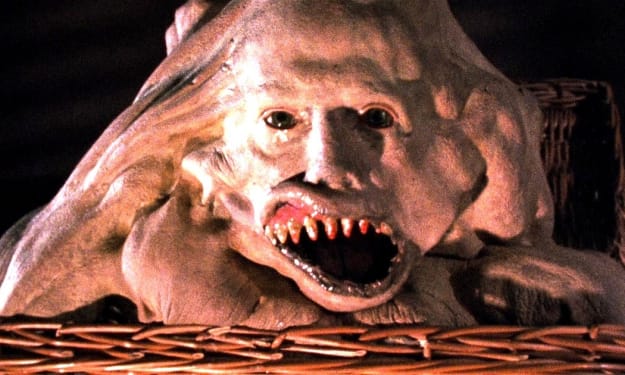
In the episode, Freddy rips his way out of a laundry sack to deliver flavorful one-liners like:
"The KILL of VICTORY! The agony of... DEAD MEAT! Har-har!"
In this series, Freddy isn’t a character so much as a horror-host prop. But unlike the Crypt Keeper—who, despite his grotesqueness, had a weird charm—Freddy is too dour, too sardonic. Too ugly, too mean-spirited. Too frightening for primetime unless he's played for laughs. But too unpleasant to ever be fully embraced.

The pilot episode did feature a strangely memorable pair of identical twins, played by Gry and Hili Park. In the second half of the episode (each one was structured in two parts, with a dreamlike narrative shift between them), one twin is revealed to be mute—until she becomes “possessed” by Freddy and starts singing the familiar jump-rope chant:
“One, two... Freddy’s coming for you.”
Moments like that—and the track-meet beheading—are more eye-roll than scream.
Ultimately, the show didn’t thrive because it leaned on the crutch of camp. The opening credits swooped past the Springwood town sign and into Freddy’s boiler room, superimposed with screaming faces and that clunky logo. Freddy gave his monologues from a warped Expressionist set with Caligari windows, like some dark cabaret parody. The quips were weak. The tone was grim and unpleasant. It just wasn’t fun.
Some films—and TV spin-offs—feel cursed. Freddy Krueger, as conceived by Craven, might have been the Boogeyman of the 1980s. But as a horror host for syndicated television?
He came up short as the Man of Our Dreams.
Freddys Nightmares S01 E01 Freddy's Death | 4K
Follow me on Twitter/X: @BakerB81252
My book: Cult Films and Midnight Movies: from High Art to Low Trash Volume 1
Ebook
About the Creator
Tom Baker
Author of Haunted Indianapolis, Indiana Ghost Folklore, Midwest Maniacs, Midwest UFOs and Beyond, Scary Urban Legends, 50 Famous Fables and Folk Tales, and Notorious Crimes of the Upper Midwest.: http://tombakerbooks.weebly.com
The Voice That Waited
Seen (1) At the edge of a quiet town stood an abandoned radio station, forgotten by time and avoided by locals. The building had been shut down for over twenty years, yet people claimed that at exactly 2:17 a.m., a faint broadcast could still be heard on an old frequency. No music. No news. Just a voice. Daniel was a small content creator who specialized in audio storytelling. He didn’t believe in rumors, but he believed in stories. When he heard about the mysterious broadcast, he decided to investigate—not for views, but for curiosity. One cold night, Daniel entered the radio station with his recorder and headphones. Dust covered the equipment, and spider webs hung from the ceiling. Everything looked dead. Silent. At exactly 2:17 a.m., the old transmitter crackled. A voice broke through the static. “Hello… is anyone listening?” Daniel froze. The voice was calm but tired, like someone who had been waiting for a long time. “My name is Arthur,” the voice continued. “I used to work here. If you can hear me, please don’t turn this off.” Daniel whispered into his microphone, “I’m listening.” The voice seemed relieved. “For years, I spoke into this microphone, hoping someone would hear me. When the station shut down, everyone left. Everyone except me.” Daniel’s heart raced. “Are you… alive?” There was a pause. Then a soft laugh. “That depends on what you mean by alive,” Arthur said. “I passed away in this building many years ago. But my voice stayed. This place remembers me.” Arthur explained that he had been a late-night radio host, speaking to lonely people, travelers, and insomniacs. The night the station closed, he stayed behind to record one final message—something meaningful. But no one ever aired it. He died alone, with his words unheard. “So I kept talking,” Arthur said. “Night after night. Waiting for someone to listen.” Daniel felt a heavy silence fill the room. “What do you want from me?” Daniel asked. Arthur answered gently, “I don’t need fear. I don’t need fame. I just want my message to reach someone. Anyone.” Daniel nodded, even though Arthur couldn’t see him. “I’ll share your story.” For the first time, the static disappeared. Arthur’s voice became clear. “Tell them this,” he said. “You are not invisible. Someone, somewhere, needs your voice—even if you don’t know it yet.” The broadcast ended. The room fell silent. Daniel left the station before sunrise and spent the next day editing the audio. He uploaded the recording as a simple podcast episode titled *The Voice That Waited*. He didn’t add music. He didn’t add effects. Just the truth. Within days, thousands of messages poured in. People said the voice helped them through loneliness, grief, and dark nights. Some cried. Some found comfort. Some found hope. Daniel returned to the radio station one last time. At 2:17 a.m., there was no broadcast. The transmitter stayed silent. But Daniel smiled. Because he understood something important: Some voices don’t fade because they are loud. They survive because someone finally listens.
By Do bol ho jaaye 6 days ago in Horror


Comments
There are no comments for this story
Be the first to respond and start the conversation.