
The Basket and Belial
The Unsubtle Subtexts of Frank Hennenlotter's "Basket Case (1982)"

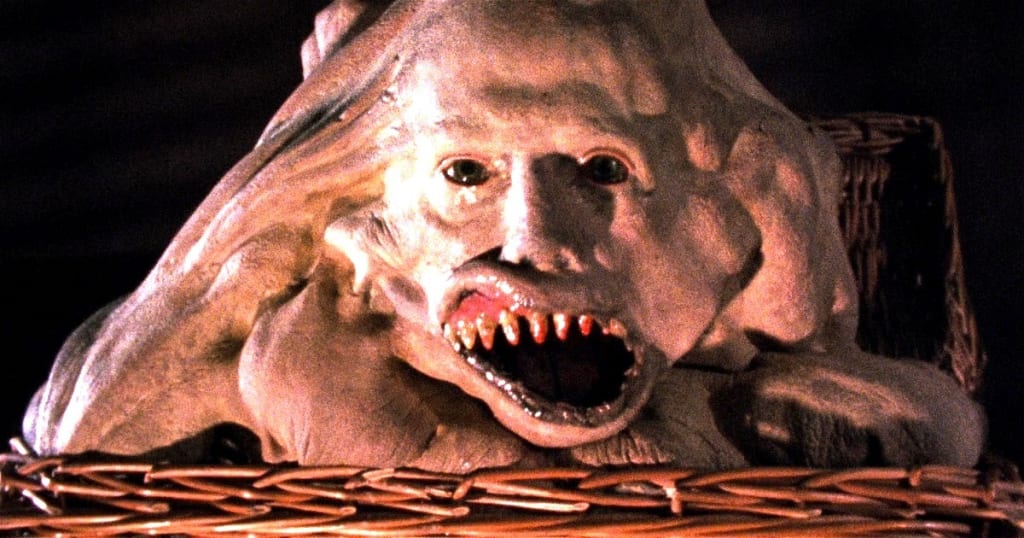
To read my review of Basket Case from several years ago, click below.
I’ve written of this film before, and since childhood, its gritty, ugly, and shocking sleaze has been with me. I first chanced to see it on cable television in the same year it was released (or shortly thereafter). It undoubtedly imprinted troubling psychological traumas in my developing brain, and though I saw only a few minutes of it, I well remember—mostly—the bloody Dr. Kutter (Diana Browne) with surgical scalpels sticking out of her face. That’s an image that’s stayed with me all my life, and, much as the opening few minutes of Time After Time (1979) went a long way toward framing my life later—or informing my conscious self of the individual I was—so too did the mutant of the movie: the small, greenish, pudgy lump of flesh known as “Belial,” whom I’ve mutated into over the decades.
Basket Case is the story of Duane (Kevin Van Hentenryck), a tall and skinny young nebbish with a Seventies shock of white-boy 'fro and a curious wicker basket with a lock on it. We first meet him traversing the filthy peep shows, adult sex shops, triple-X theaters, and grindhouses of Times Square—a lost, lonely soul whom even the dealers and pimps can't attract. Duane checks into the filthy flophouse “Hotel Broslin,” presided over by a fat, suspenders-wearing stereotype from a bad TV cop show. We’re introduced to the other tenants—a low-rent gaggle of flotsam, alcoholics, crazy old ladies, and a black prostitute (“Casey,” played by Beverly Bonner).
Duane keeps the awful secret of his life—his deformed, homicidal brother Belial—like a dirty secret in the otherwise homey-looking wicker basket. Belial is a ravenous, monstrous mutant—Duane’s buried and corrupt sexuality made whole. His guilt, personified, but as the thing it actually represents: the hideous Id, the submerged self, kept away in the wicker casket, a symbol of family get-togethers and traditional innocence. But the basket is also symbolic in other ways.
As a space in which the hideous “thing,” the ravenous appetite without legs, scoots across the floor on its deformed, hideous, lumpy flesh (in stop-motion scenes that are rather comical but still quite grotesque and effective), it is the mental space of Duane made manifest in the material. It is also the sacred space—the box, even the vulva—of his dead mother, who died giving birth to Duane. His father demands separation of the conjoined twins, and the result is a successful surgery. Belial, the hideous mutant, is thrown unceremoniously in the garbage. He survives, and a strong psychic connection is indicated between himself and Duane, much like the old urban legend of the suicided Edward Mordake, who supposedly had a demoniac infant twin growing from his head that “spoke” to him blasphemies, until it drove him mad.
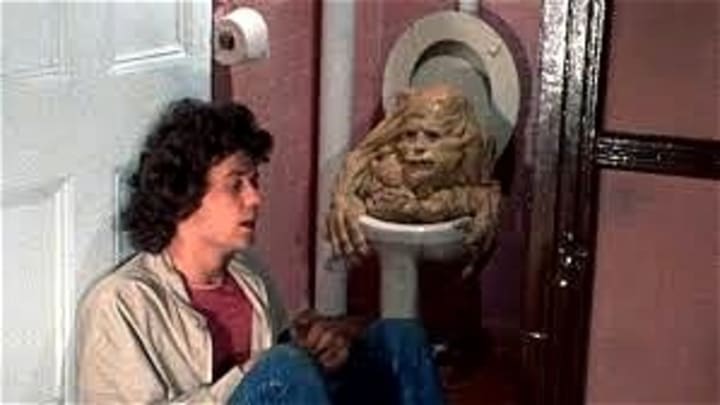
That old legend undoubtedly served as the basis for the material that comprises Basket Case. The father (Richard Pierce) is dispatched with a grotesque Rube Goldberg-style saw contraption, and one would think that Belial must serve as symbolic stand-in for the Oedipal urge. His twisted, hideous deformity, his inarticulate, savage rage, and his containment within a box that is the mind, the vulva, and a casket all at once, hint at the depths of the psychosexual aberration experienced by Duane—whose corrupt sexuality is kept secret, hidden—in the allegorical “Pandora’s Box,” in which, to let out the repressed urge—so mutated and dangerous—is to let loose the “demon brother,” who will take his revenge upon the world of the “norms.”
Belial’s Revenge
A significant portion of the film is focused on Duane and Belial’s revenge against the medical team that separated the two brothers. Dr. Lifflander (Bill Freeman), Needleman (Lloyd Pace), and eventually Kutter, are all murdered by the mutant Belial in gory, splatter-movie fashion. Other killings involve those who attempt to rob Duane of his basket or cash—and pay the price for their transgression. This is all bloody and excellent as entertainment.
The hotel where Duane and Belial are staying, the Hotel Broslin, is a walk-up flophouse slum—a liminal space arising from the filth and decadence of Times Square, presided over by a gatekeeper of repugnant proportions. It features stairs in place of a lift—the denizens, who seem not quite as if they belong there but are in a semi-permanent state of surrealistic purgatory, are forced to ascend to the upper tiers of Duane’s unconscious. This building, presumably, is his liminal state of being—as he grapples with the secret hidden away in his box, the mutant brother-monster who, as a parasitic twin, was once an extension of the Self.
And it is his secret, perverse self that is let loose, at the end, when—running naked in a dream-state down the street—Duane comes upon his girlfriend Sharon (Terri Susan Smith), asleep in bed, as if she were dead (his real mother, of whom this is a necrophilious substitute or stand-in, is of course dead). He reaches out a hand—but it is Belial’s hand—and this is a dream-like psychic connection. He wants to fondle the huge breasts—his mother’s, symbolically—but the necrophilious object of desire awakes and screams.
Following Duane back to the hotel, Sharon watches in horror as Duane falls from a window after Belial attacks him. Hanging from the sign (a sign?), he falls to his death with his brother, who was his connection to this personal hell, represented by the story of Basket Case. Around them both, bystanders swarm—like souls or “flies to wanton boys,” as Shakespeare might say.
The basket of Oedipal, necro-incestuous longing is empty now, and the Dirty Secret of the buried past of Duane and brother Belial has now been revealed. And like all other secrets, once so revealed, it can never be put back where it came from again.
Hence… our sequels.
Written and directed by Frank Henenlotter.
Basket Case (1982) | Twisted Cult Horror Ft. Kevin VanHentenryck | @ScreamboxFree
Follow me on Twitter/X: @BakerB81252
My book: Cult Films and Midnight Movies: From High Art to Low Trash Volume 1.
Ebook
About the Creator
Tom Baker
Author of Haunted Indianapolis, Indiana Ghost Folklore, Midwest Maniacs, Midwest UFOs and Beyond, Scary Urban Legends, 50 Famous Fables and Folk Tales, and Notorious Crimes of the Upper Midwest.: http://tombakerbooks.weebly.com
The Girl in the Car
I was eight when I saw myself in the back of a stranger's car. Not a girl who looked like me. Me. It was a Marfa afternoon. The kind where heat makes the air thick and time stops mattering. Sally and I were running through the sprinkler, burning ourselves on hot concrete, bored and perfect.
By Leslie L. Stevens 7 days ago in Horror


Comments
There are no comments for this story
Be the first to respond and start the conversation.