
Echoes in the Rose-Red Stone: Petra’s Haunted History as Jordan’s Desert Mirage
From Ancient Nabatean Curses to Phantom Guardians—Unraveling the Supernatural Secrets of the Lost City

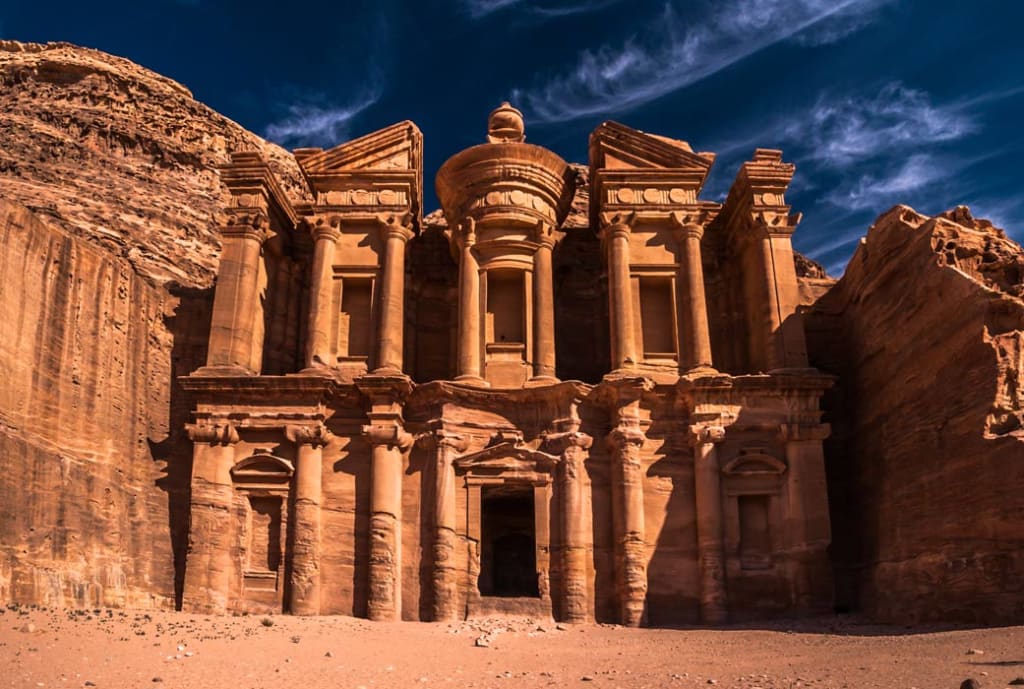
Petra, Jordan: A Crossroads of Ancient History and Otherworldly Secrets
Located in the desert canyons of Jordan, ancient Petra is a testament to human ingenuity and the march of centuries. Nicknamed the "Rose City" due to the rose-red sandstone cliffs that enclose it, this UNESCO World Heritage Site is also famous for its archaeological beauty and for its ghostly reputation as one of Jordan's most haunted sites. From its Nabatean origins to ghostly reports of haunted spirits, Petra's allure is that it is able to exist on the boundary between the material world and the paranormal.
The Rise and Fall of a Desert Empire
Founded by the Nabateans, a master-trading desert Arab tribe, in about 300 BCE, Petra was a commercial center for incense, spices, and silk. The Nabateans carved out intricate tombs, temples, and theaters from the living rock, and Petra proved to be a thriving capital. The city's hydraulic engineering wonders, including dams and water pipes, sustained its 20,000 inhabitants in a desert environment.
The Romans conquered Petra around 106 CE, which stamped their imprint on the city's architecture. The city began its decline with the catastrophic earthquake in 363 CE that sent buildings to ruin and cut off trade. When sea routes became the rival of caravans on land, Petra declined, lost but for oral retellings among Bedouin tribes until Swiss explorer Johann Ludwig Burckhardt "discovered" it once more in 1812. Today it is visited by over one million tourists annually, its ruins whispering with secrets of the past.
Whispers in the Shadows: Petra's Haunted Legacy
Petra's landscape drama—a labyrinth of tombs, canyons, and worn façades—naturally lends itself to mystery. But for other people, the site's aura is on another plane than sight. Local and visitor legend whispers of stubborn specters, whose stories are invested in the very stone.
The Treasury's Eternal Guardian
Al-Khazneh, the enchanted Treasury, is alive with legend. Bedouin folklore asserts it contains a treasure belonging to a pharaoh under the protection of a curse. Tourists mention the sudden coolness of an unseasoned breeze, a phantom procession up and down in front of its entrance, and the sound of disembodied whispers from within its halls. There are guides speaking of an otherworldly Nabatean priestess, with an aura of incense at her heels, who haunts the site.
The Siq: A Corridor of Echoes
The mile-long Siq, a wending gorge that leads into Petra, is part of its unsettling atmosphere. Tourists have heard ghostly footsteps, distant drums, and anguished screams—sounds that are explained by Nabatean merchants or young Roman legionnaires who died. In 1963, a sudden flood here killed 23 Lebanese schoolgirls, and others claim their spirits linger, their laughter or screams echoing after nightfall.
Djinn Blocks and the Watchman of the Monastery
Down the Street of Facades, three huge obelisks known as "Djinn Blocks" bear Islamic legend. Djinn, supernatural beings made of "smokeless fire," are said to occupy the blocks, appearing sometimes as flash lights or blowing whirls of wind. Higher still on the land, the Monastery (Ad-Deir) is reported to hold legend of a ghost guard. Trekkers glimpse a figure in ancient robes disappear behind walls as a Nabatean monk protecting sacred ground.
Between Legend and Perception
Skeptics attribute Petra's ghostly reputation to wind patterns, acoustics, and suggestion, but the stories persist. Bedouin guides with multi-generational families there report encounters with ancestors crossing spirits, and with restraint in evening solitary visits. Paranormal investigators in recent decades, including producers working for television productions, have documented phenomena such as inexplicable lights and EVPs (electronic voice phenomena), but evidence is anecdotal.
Conclusion: Where History and Mystery Converge
The beauty of Petra is not just in its carved front facades but in the capacity to bring out the uncanny. With the tragedy of lives lost to ill-fortune, the awe of ancient ritual, or the raw violence of its inaccessibility, the site encourages one to reflect on the unseen. Although sunlight colors cliffs rose and amber, tourists are cautioned Petra is less a ruin than a living tale, where whispers of the past might be more than metaphor.
In the end, therefore, Petra's ghosts, should there be any, add the mystique to the point that each step upon its sands is softened by centuries—and perhaps by the presence of those who never left.
About the Creator
Kyrol Mojikal
"Believe in the magic within you, for you are extraordinary."
Keep reading
More stories from Kyrol Mojikal and writers in Horror and other communities.
The Haunted Plague Chapel of Weilheim: Echoes of Death and Restless Spirits
The Weilheim Plague Chapel: A Disquieting Legacy of Tears and Ghosts Concealed in the little Bavarian village of Weilheim, amidst rolling hills and medieval ambiance, is a location that has spooked and terrorized visitors for centuries: the Plague Chapel (Pestkapelle). This diminutive, nondescript building, overshadowed by the elegance of the adjacent St. Peter and Paul Church, is purported to be one of the most haunted places in Germany. A dark history of despair, death, and unrestful spirits behind its weathered walls.
By Kyrol Mojikal10 months ago in Horror
One to See, One to Speak, One to Listen
Contains gore and horror some readers may find disturbing. Rated 14+ Author's Intro: This story is meant to revive the Gothic literature so famously crafted by one of my favourite writer's, Edgar Allen Poe, and as such, the language and style is deliberately antiquated. Thank you for reading my all time favourite work of horror - Les
By Call Me Les19 days ago in Horror
Stories Told At Twilight
A 300-word flash fiction regarding the above image: She never realized the pale blue of her eyes until now. Pressing the palm of her hands against the cold porcelain sink, she sank deeper into her own gaze. Her eyes were not only pale but striking.
By JB Inglandabout 16 hours ago in Horror



Comments
There are no comments for this story
Be the first to respond and start the conversation.