
Don’t Look at the Stars
When the heavens opened, the town of Elridge Falls learned that some lights are better left unseen


It started with the lights.
At first, people thought it was beautiful—the way the stars shimmered brighter than they ever had before. The night sky over the small town of Elridge Falls had always been dull, washed out by streetlamps and factory smoke. But on that particular October evening, it looked alive.
The news called it a cosmic event, something about radiation and solar winds colliding in the upper atmosphere. Scientists said it was harmless, a spectacle of nature. People came out with blankets and cameras, holding their breath under the vast, glowing sky.
But then, they began to disappear.
The first was a teenage boy named Daniel Price. He was last seen lying on the hood of his car, staring up at the stars with his headphones on. When his mother came looking for him, all she found was the car door wide open and the faint hum of a song still playing through the speakers.
By the next week, three more were gone.
No one saw anything. No struggle. No trace. Just empty spaces where people should have been.
It didn’t take long before people started to notice a pattern—the ones who vanished were always the ones who had been outside too long, gazing at the sky as if hypnotized.
That’s when people started saying it:
“Don’t look at the stars.”
At first, I thought it was small-town panic. Rumors grow fast when fear takes root. But then I saw it myself.
It was just after midnight. I was standing by the old gas station on Highway 12 when I noticed Mrs. Crowley across the road, her head tilted back, eyes wide open. The stars reflected in her pupils like tiny, trembling mirrors. I called out to her, but she didn’t move. She didn’t blink.
And then—she was gone.
No sound. No movement. Just gone, as if the night had swallowed her whole.
After that, no one went out after dark. The streets turned into ghost roads. Curtains stayed drawn. We moved through the world like shadows, whispering about what was happening but never daring to look up.
Still, some people couldn’t help themselves. Curiosity is a dangerous thing in the hands of fear.
One evening, I found my brother, Sam, sitting on the porch with a beer, eyes fixed upward.
“Don’t,” I said quietly.
He didn’t turn to me. “They’re so bright tonight,” he murmured. “Almost like they’re watching.”
I grabbed his arm. “Sam, stop!”
But he didn’t blink. His lips parted, like he wanted to say something else—but no sound came out. For a second, his pupils dilated until they were nothing but black circles reflecting the starlight.
Then he vanished, leaving behind only the beer can rolling across the wooden floorboards.
That was the night I stopped believing this was something human.
The stars had changed. They moved differently now—too slow, too deliberate, as if adjusting their positions to see us better. Some nights, I could swear I saw shapes shifting between them, dark outlines like enormous wings or limbs stretching across the sky.
Whatever it was, it wasn’t just light.
Some said it was aliens. Others said angels, demons, or something older. But to me, it felt more like the universe itself had opened its eyes and realized we were staring back.
Days turned into weeks. The town emptied. Those of us who survived barricaded ourselves indoors, covered our windows, and destroyed every reflective surface we could find. No mirrors. No glass. No reason to catch even a sliver of starlight.
The radio stations went silent. The power grid flickered out. The world outside grew darker, quieter, as if sound itself had been erased.
Now, only a few of us remain. We communicate in whispers, in letters slid under doors. Some of us have started hearing things—a soft humming, like a voice buried beneath static. When I close my eyes, I can almost make out words, something like:
We see you.
I haven’t looked up in weeks. I keep my head down, even when I step outside during the day. But the sky feels different now, heavier somehow. Like it’s pressing down, waiting for someone to slip.
Two nights ago, I heard my neighbor, Ellie, screaming. I ran to her house, covering my head with my jacket. When I got inside, she was standing in her living room, trembling, her hands clutching her eyes.
“They’re in the light,” she whispered. “Not the stars. The space between them.”
Before I could ask what she meant, the lights in her house flickered—and she was gone.
Now it’s just me.
I’m writing this by candlelight, with the curtains pinned shut. I don’t know how much longer I’ll last. Every night, I feel it stronger—the pull to look, to see what’s really up there.
Sometimes, I hear my brother’s voice outside the window, calling my name softly, the way he used to when we were kids.
I know it’s not him. I know it’s them.
The stars aren’t supposed to move, but they do now. Slowly. Patiently. Like eyes adjusting to the dark.
If anyone ever finds this, take this one piece of advice—
Don’t look at the stars.
Because they’re looking back.
About the Creator
LUNA EDITH
Writer, storyteller, and lifelong learner. I share thoughts on life, creativity, and everything in between. Here to connect, inspire, and grow — one story at a time.
Keep reading
More stories from LUNA EDITH and writers in Horror and other communities.
Man in black
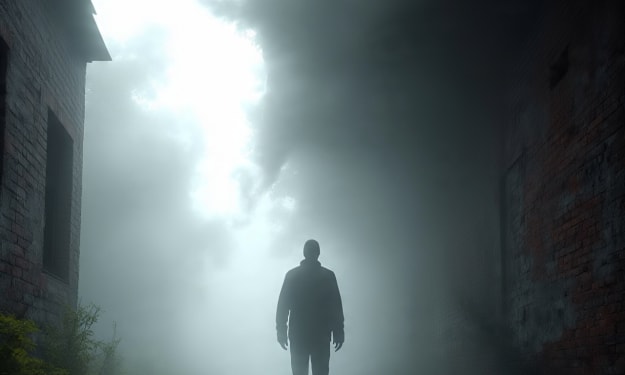
Every town has its whispers, and ours was about the man in black. Some said he was a shadow, others swore he was flesh and bone. All I knew was that he appeared when the streets grew quiet, when the lamps flickered low, and when curiosity outweighed caution.
By LUNA EDITH5 months ago in Horror
"Scream 7" (2026): Running out of Fresh Screams
This is the seventh time we’ve had a Ghostface crisis. Scream 7 is the latest edition of the Scream franchise. Sydney Prescott and her family are under attack by another anonymous killer dressed in a Ghostface costume. While having issues with her daughter, Tatum, they run from the bloody murders, trying to determine who is behind it all.
By Marielle Sabbag6 days ago in Horror
My Life Under CIA Control
How the CIA Used My Mind as a Battlefield—and How I Won It Back In the summer of my sixteenth year, while my peers were learning to drive and obsessing over prom dresses, I was being taught how to disappear. Not physically, but mentally. I was being dismantled, piece by piece, by men in white coats and gray suits who viewed my consciousness not as a human soul, but as a territory to be conquered.
By Irshad Abbasi 5 days ago in Horror

Comments
There are no comments for this story
Be the first to respond and start the conversation.