

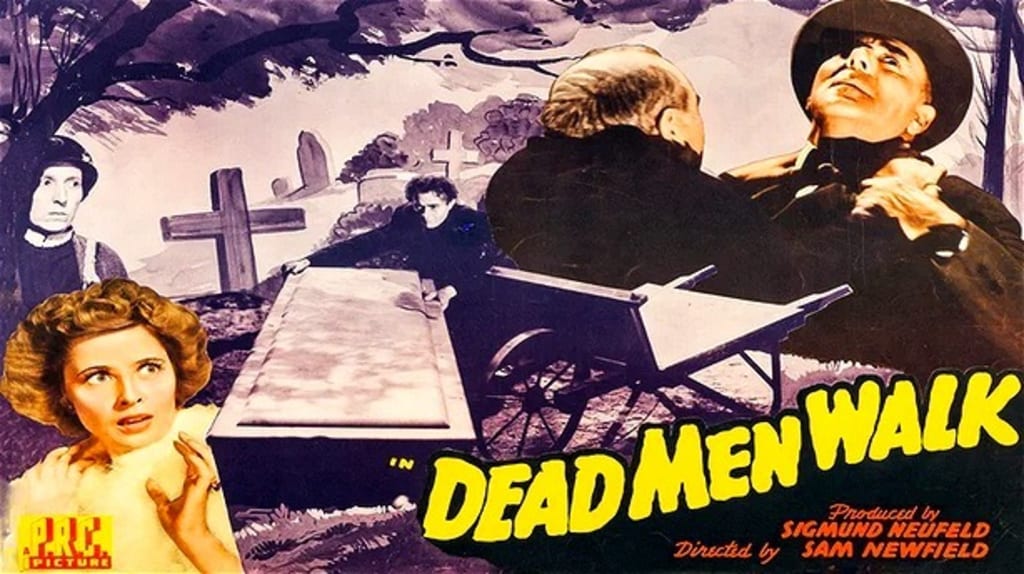
During the Middle Ages—and continuing well beyond—numerous apocryphal tales emerged of men who, meeting death through some strange misadventure, would later be seen walking the streets of their local village or hamlet. These eerie appearances often coincided with mysterious deaths, frequently involving the loss of blood. When authorities investigated, they allegedly discovered the bodies in their coffins, remarkably preserved, some even bloated as though they had transformed into grotesque, bloodsucking creatures, feeding on the living. These "undead" were quickly dealt with by decapitation, stuffing their mouths with garlic, sealing their jaws with stone blocks, hammering spikes into their hearts, and various other gruesome measures. The last of these vampire exhumations, it is said, took place in New Hampshire during the 1890s.
Dead Men Walk, a Poverty Row production from 1943, comes courtesy of the same team behind The Mad Monster—producer Sigmund Neufeld and star George Zucco. Neufeld, ever the opportunist when it came to reusing horror tropes, once again falls back on familiar formulas, with Zucco assuming a dual role. Zucco, known for playing sinister scientists and satanic figures, brings an odd dignity to his portrayal of both Dr. Lloyd Clayton and his malevolent brother, Elwyn. Tragically, Zucco’s own life ended as bizarrely as many of his onscreen roles: stricken with dementia and haunted by hallucinations, according to Kenneth Anger, writing in Hollywood Babylon 2, he reportedly believed he was being pursued by “The Great God Cthulhu”—a detail so eerily fitting that it feels as though his final role never truly ended. It’s difficult not to view his performances with a tragic lens, even in the most campy of contexts.
In Dead Men Walk, Zucco’s Dr. Clayton kills his brother Elwyn, who has ventured too far into the realms of black magic, devil worship, and the kind of unwholesome pursuits that inevitably lead to one being staked, burned, or both. Elwyn, of course, doesn’t stay down for long. With the help of his graveyard ghoul companion Zolarr (played by Dwight Frye in his final film appearance, aged and hunched like never before), Elwyn rises from the grave—vengeful, looking as though he’s just spent the night in a coffin, which, to be fair, he has. It’s a role Frye was born to play, channeling his earlier Renfield mania into something even more unhinged and desperate, tinged with the sorrow of a career that was nearly spent.
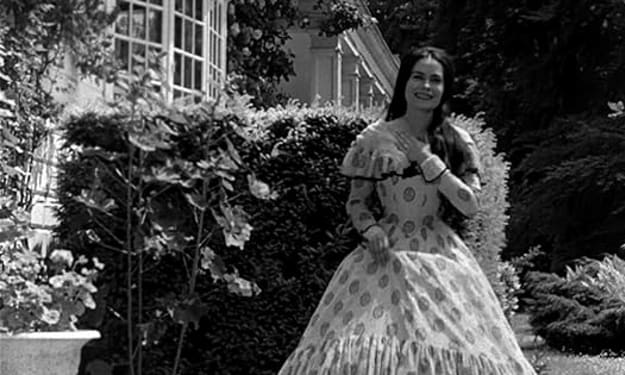
Zolarr performs the Herculean task of digging up a coffin buried under six feet of hard-packed earth, with no shovel, no backhoe, and no assistance—just sheer horror movie determination. Meanwhile, local doctor Bentley (Nedrick Young) grows fond of Gayle, Clayton’s charming niece (Mary Carlisle), a wholesome beauty with enough gumption to weather the mounting terror besieging the town. She’s the classic '40s heroine—equal parts scream and charm.
As the townspeople begin to fall under mysterious circumstances—drained of blood and marked by strange symptoms—it becomes evident that Elwyn walks among the living again, playing the part of a vampire in all but name. The story unfolds like a low-budget version of Dracula, complete with creaky sets, atmospheric shadows, and ominous monologues about evil and eternal darkness. One can almost smell the dusty curtains and hear the scratchy strains of a gramophone in the background.
And yet, despite—or perhaps because of—its limitations, Dead Men Walk manages to deliver moments of true creepiness. The flicker of firelight casting shadows on a ghostly visage, the echo of distant footsteps in a crypt, the ominous presence of something unholy just beyond the frame—all of it evokes an atmosphere of dread and terror, doing more with less. The film culminates in a flaming finale worthy of Wagner, where evil seems vanquished and order is restored… or is it?
In the end, Dead Men Walk endures not because it’s flawless, but because the gothic is impervious to time. The gothic can’t be “dated”; it exists in a realm all its own, suspended between centuries, much like a bat in flight or a spirit lingering in a drafty castle. It doesn’t rely on scientific plausibility or technological believability; it thrives on atmosphere, suggestion, and the quiet whisper of dread. The gothic is forever hungry—for blood, yes, but also for secrets and the intoxicating allure of forbidden knowledge. Even these modest films continue to speak to us from the shadows, asking that eternal question: what if the dead do not rest?
Dead Men Walk 1943 | George Zucco, Mary Carlisle | Vampiric twin rises from cursed crypt!
Connect with me on Facebook
My book: Cult Films and Midnight Movies: From High Art to Low Trash Volume 1
Ebook
About the Creator
Tom Baker
Author of Haunted Indianapolis, Indiana Ghost Folklore, Midwest Maniacs, Midwest UFOs and Beyond, Scary Urban Legends, 50 Famous Fables and Folk Tales, and Notorious Crimes of the Upper Midwest.: http://tombakerbooks.weebly.com


Comments (2)
I saw the title & wanted to respond, "Dead men may walk, but dead women are smart enough to sit down & enjoy the ride!" A sufficiently enticing review, I fear I have added yet another hour to my watch list, lol.
Wow, how amazing that was.