
Twilight Zone: "An Occurrence at Owl Creek Bridge" (1961)
Season 5, Episode 22

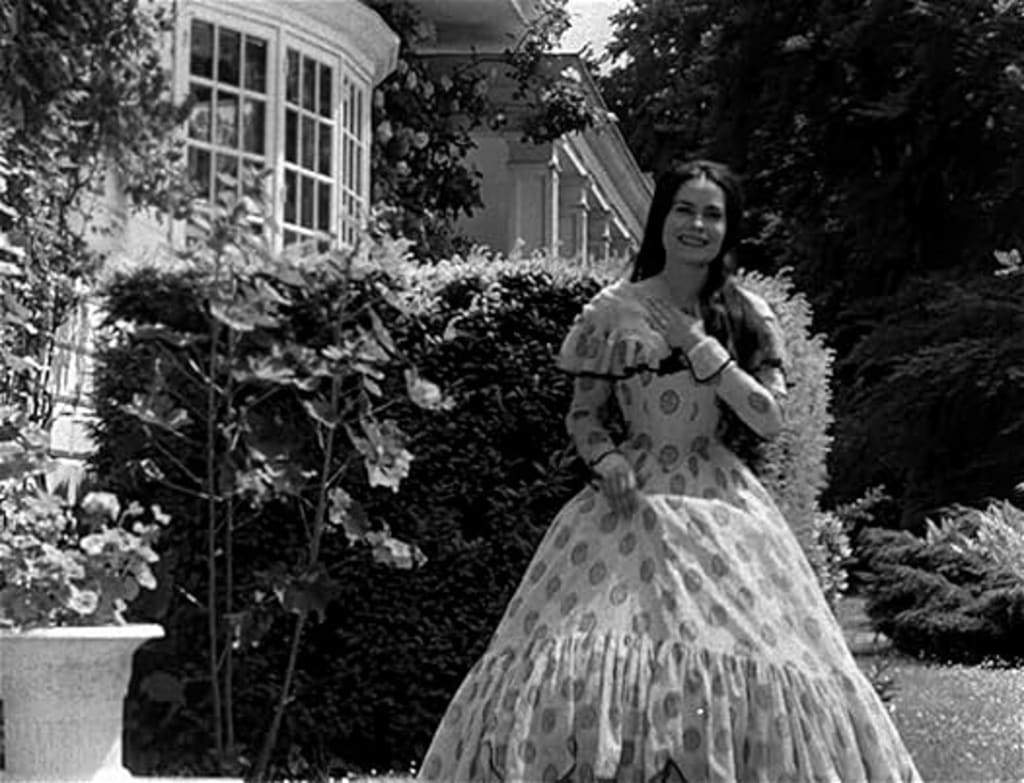
I should preface this essay by recounting an amusing incident from when I was fifteen or sixteen years old. I was touring, of all places, Arlington National Cemetery in Washington, D.C., when, as I walked the pathways through the headstones, I looked over at an old manse in the distance—a place I didn’t know at the time was Robert E. Lee’s house—and saw what I took to be a woman in a Victorian dress standing out front. My vision must have been very sharp in those days, as I could see that she was smiling. I suddenly felt a little uneasy. Was this a ghost I was seeing? Could anyone else see her? Foolish, I know. I later found out it was just a costumed tour guide, but her image has stuck with me all these decades. It is an image reminiscent of Farquhar’s wife in the film I review below.
"An Occurrence at Owl Creek Bridge," based on the 1890 story by Ambrose Bierce, is the only episode of The Twilight Zone not produced by its creators but instead produced in France as an entry for Cannes, where it won a prize ("Best Short Subject"). It eventually won an Academy Award.
I first saw it on a VHS collection of lost episodes, which included the lost episode with Star Trek's George Takei (Season 5, Episode 31: "The Encounter"), which remained unaired due to controversial and potentially inflammatory content. There is none of that in "An Occurrence at Owl Creek Bridge," but there is a singular departure from the typical television film format. "Occurrence" is a dreamlike, somewhat ghostly offering, totally appropriate given the subject matter of the show, but a very different exploration of its theme of disorienting personal experience and extraordinary, O'Henry-style "twists of fate."
Bierce was a war correspondent during the Civil War, traveling through the Federal camps, chronicling the suffering and death, the agony and bitter hell of the Brother's War. Out of this grew his own rampant misanthropy, his cynical, pessimistic anger, and general sneering disgust with the foibles, mishaps, and utter hypocrisy of man in his fallen state, his pitiable and tragi-comic condition.
It begins with the clockwork precision of an execution detail, the Federal Army having mustered on a perilous-looking railroad trestle, "Owl Creek Bridge," that one doubts even Buster Keaton would dare traverse. Farquhar, the wealthy Southern planter accused of being a Confederate spy, is perched on the end of a wooden plank. A sergeant trades places with a common soldier, perched at the other end of the plank, to weight it down until the call should be given to let it drop, thus sending Farquhar, whose neck is "in the hemp," as Bierce put it in his original story, to his death, hanging suspended like the "strange fruit" of Southern infamy from the side of the bridge.
There is virtually no dialog; there is a sense of clockwork precision. Farquhar's watch, which can be heard ticking, even scraping loudly like a baby's heartbeat, is taken from him and thrust into the leather ammo pouch of a soldier. Farquhar's time is up (note: he is not named here). But also, time hangs suspended in the balance. All is silence.
Jean-Paul Sartre, in his story "The Wall," postulates what it must be like for men who are condemned to live those last few hours of life awaiting execution. Did the great existentialist thinker also believe that time, for some men, might seem to stand still? That it might be possible to squeeze an entire new meaning into life in those ticking hours before being shot at dawn? Here, Farquhar is seemingly blessed by the rope breaking, by his plunge into the waters of Owl Creek, submerged beneath the waters.
He quickly and miraculously slips his bonds, then his boots. Reborn in this watery womb, the barefoot condition of him suggests someone journeying in the spirit. He has already had a vision of his wife and child, the child in a swing, the wife a ghostly revenant of the Civil War era, a Southern Belle smiling cryptically, eerily, from her perch in his memory.
He is shot at from above, by men with voices like dragging tires. They are not living in the same expanse of time he is; they seemingly exist apart in a slower dimension, one in which their killing blasts would claim him and leave him a corpse. But he escapes all of them. Exultantly, he surfaces, rolls in the sand of the sandbar upon which he has alighted. His first image a foreshadowing of the trap he has wandered into: it is the web of a spider.
He runs barefoot, exultant again, filthy but determined to be, as the old bluesy folk song on the soundtrack suggests, "a living man." That song, sung by a black man that could almost have been Robert Johnson or Leadbelly, is replaced by a drumroll. He finds himself in the woods. He makes his way through to a wrought-iron gate intersecting his pathway.
It opens for him as if by invisible hands. Very dreamlike, again. He proceeds down it until he is in front of his own palatial manse. Coming toward him, the same eerie smile playing across her beautiful face, is his wife. Reaching out, stretching his arms out, he runs.
Suddenly, we see the side of Owl Creek Bridge. He is dropping from the side. The rope does not break. His neck breaks.
And that's the end of this occurrence, it would seem.
Written and directed by Robert Enrico. Produced by Paul De Roubaix. Starring Roger Jacquet and Ann Cornaly.
The Twilight Zone 1959 S 05 E 22 An Occurrence At Owl Creek Bridge
Connect with me on Facebook
My book: Cult Films and Midnight Movies: From High Art to Low Trash Volume 1
Ebook
About the Creator
Tom Baker
Author of Haunted Indianapolis, Indiana Ghost Folklore, Midwest Maniacs, Midwest UFOs and Beyond, Scary Urban Legends, 50 Famous Fables and Folk Tales, and Notorious Crimes of the Upper Midwest.: http://tombakerbooks.weebly.com
The Devil's Cut
“Comrade, finally you’re awake.” The voice was smooth, sensual. A flickering incandescent bar was all that lit the white, sterile room. All Vladimir remembered was everything going black. He tried to move his arms and found them strapped to the gurney.
By Matthew J. Fromm5 days ago in Fiction


Comments (2)
This is one of the episodes that gets you thinking. (Don't they all?) Great presentation of the story, Tom. If I recall correctly, the movie Jacob's Ladder applied the same theme to an even longer imagined existence.
Sounds like a powerful episode. I shall come back to watch this one.