

Conservation Efforts
There weren't always dragons in the Valley. They came first to Palomar, after some other lizards. Let me start at the beginning.
The Man from the EPA was driving me up to a gated bird sanctuary up in Palomar. He said it was called “Palomar” because of the pigeons that Spanish explorers found there, but if you saw the mountain jutting up into the cloud of fog constantly fed from the sea, and if you were taught to see shapes in clouds as a kid, you’d recognize pretty easily that the cloud was a nest balanced on the peak.
“Palomar,” he said anyway, meant “Pigeon Roost” or “Dove Covey,” but that it had been years since doves had been seen in the area. The species of dove once-local, he explained, still existed, but they moved their migration away from the altitude.
“We thought they were a new species at first, but we found out from ankle tags that the new pigeons in the delta were the same ones from the mountain, they just had different coats. They didn’t molt or anything, and it wasn’t even that big a difference. They were a lighter gray. You know how flamingos are pink from the pigment in the shrimp they eat? It turns out the shade of gray we associated with these pigeons, that sort of ash gray, it turns out that the fog up in Palomar gave them a unique sheen. They looked so much lighter in the valley because the misting they got from the falls of the delta was made of finer droplets,” he held his finger and thumb close together as if to show me. I just nodded.
“And,” the Man from the EPA added, “the fog makes it darker up there, but it’s mostly the water. Anyway, our discovery wasn’t nearly as big as what meteorologists found out from it. See, we’ve known since Spanish geographers recorded the salty flavor of the doves that the permanent fog bank of Palomar comes in from the Pacific, but when we saw that it changed their color as well as their flavor, we couldn’t figure out why it should make the birds that much darker. If it was the same kind of fog that rolled into the coast, they ought to have had a gray-blue sheen. We brought in these meteorologists we usually contract for research on air pollution to look into it.
“They compared the fog to samples of foggy atmospheres from all over California, and you know what they found?” He glanced at me expectantly, barely able to keep his eyes on the road. I shook my head. “Nothing! It wasn’t California fog at all. They expanded their search up and down the West Coast and found out it came from Oregon. I was in the lab when they compared the samples from Palomar and Corvallis. It looked like a guy had blown cigarette smoke into a couple beakers.”
The Man from the EPA pulled his car around a couple of sharp curves, and we were into the fog. “See how much it looks like Oregon up here?” he continued, “How the trees even have the same moss as up north?” He didn’t wait for me to reply, but I wasn’t going to anyway, “There’s an air current that brings the fog from Corvallis to here, a climate transplant we’d never noticed until the doves migrated. Our report on the…” he struggled for a word, “connectedness, I guess, of the two environments let us put better regulations in Corvallis. They would’ve put more crap into the air if it weren’t for the pigeons.”
He didn’t speak any more until we got to the gate, and even then all he said, barely above a whisper, was “Here.” It was like the fog was a soaked cotton ball in our mouths. When I breathed too deeply, it tasted like the Pacific Northwest, but more oppressive. It had the heaviness of Oregon fog, to be sure, but a new unpleasantness. It was more like a steamy shower in an Oregon cabin than it was fog from Oregon.
The Man from the EPA must’ve noticed my discomfort. “It’s thicker in the mornings,” he said, “The current brings it in overnight and it fades a little during the day.” That seemed to take effort to say, so he didn’t add anything else. Instead, he led me to a gate without any signage. There was an old sign leaned up against the chain link, as well as a barely visible rectangle of cleaner metal above it where it used to hang. I leaned the sign toward me and peeked at what it used to show: the outline of a pigeon and the words “Palomar Pigeon Sanctuary” in blocky letters.
The Man from the EPA pulled out a key that quickly sweated with condensation. He almost dropped it when he unlocked the gate.
For a few hours, we followed a path barely visible through the fog. A few times as we walked, I could faintly see a concrete wall of indeterminable size on either side of the path. The Man from the EPA started talking again as we neared the “observation deck,” nothing more than a cabin overlooking a steep hill.
“When the pigeons migrated away from the sanctuary, their numbers started growing again. It turns out that a species of California pigeon is better suited for a California environment. We had a plot of federal land at the top of a mountain and funding that wasn’t going anywhere, so we decided to introduce a new avian species to the area.”
I wasn’t paying attention because I was too focused on the blood and bones on the floor of the observatory.
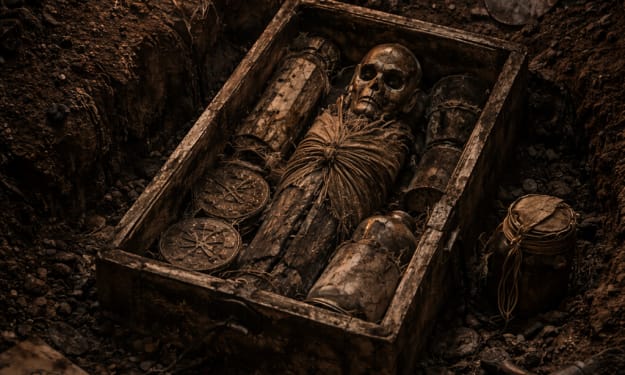
No, they weren’t bones, they were rocks in the shape of bones, but it was definitely blood. The bleeder was probably the eagle crumpled like paper in the corner of the cabin. Or were those rocks fossils? The blood was painted into a circle cut through with letters that weren’t Greek or Roman or Hebrew, but they must have been as old. I couldn’t read what the figures spelled, but I understood what they meant: something that died wasn’t dead.
Once I recognized it, the letters looked like English to me, and congealed into “taxidermy,” but not exactly the word “taxidermy,” more accurately “Y-M-R-E-D-I-X-A-T,” purposefully set down like it was reflected in a mirror.
The Man from the EPA stepped carefully over the blood and bones, but seemed unconcerned that they were here, as if it was glass shattered in a car crash: it was still dangerous, but there’s something bigger broken.
The Man from the EPA stood at the open rail of the observatory, looking down into the fog bank. He cast his eyes around like the beams of a deep-sea submersible, and his fingers wrapped around the rail twitched like grabber arms wanting to take a sample. It was a familiar feeling to me, being a passenger in a car at night. Then, as now, deer darted in and out of view like skittish fish at the bottom of the ocean, hiding their ugliness from being seen for the first time. Impossibly for the time of day, the fog thickened, and I had to catch myself against the rail at the sudden pressure of it. I must’ve imagined it, but it felt like our submersible-observatory settled on the silty bottom and jolted me to my knees at the rail. I hung with locked arms and rubbery legs, barely looking out of the cabin into the fog below.
A great, lean silhouette appeared in the fog, a big shark of a creature with the same waving kind of motion to its hips. It bristled with feathers, or the forefathers of feathers, and it was much bigger than birds had ever been.
I glanced over at the Man from the EPA, who was leaning dangerously far over the rail. You could see the strain in his neck and arms as he tried with his whole body to see the shape better. He’d torn off his coat, and on his goose-bumped arms I saw cuts where he must have used his own blood in the painting of the circle. His forearm was a palette where he had mixed his blood with the air or water, with a gradient of variously oxidized or diluted red splotches running from his elbow to his wrist.
Its coat was gray, but I couldn’t tell you what shade it would look like in a different light. Here, its feathers were forest-fire-ashen. It most closely resembled a heron, if a little stockier and obviously much larger. You couldn’t help but see the raptor in it too, and the eagle would’ve been a grim reminder sitting behind you if you were there. It moved its legs with the carefulness of a crane or heron, but with the purposefulness of a bird of prey. It didn’t have a beak, but a feathered snout. When it stuck out its chest at us, I saw that the sleek down of its body was just as dignified as the slight crest behind its head.
We usually don’t know exactly what an animal’s skeleton looks like beyond a vague idea. Granted, we’re familiar with the form of the human skeleton because of some unnamed, universal obsession, but you’d be hard pressed to imagine the bones of a horse or dog or bird in the same detail. There is a weird feeling of disbelieving recognition when you see the diagram of some animal’s skeleton, like you thought there would be more to it, even with the flesh stripped away. Looking at this animal craning its neck up to look at us, I got that feeling in reverse. I’m sure the Apostles finally seeing Jesus felt the same thing. It was like having lived in a land of the dead, peopled by skeletons, and seeing a man for the first time, in the flesh.
“What is that?” I asked, but I knew.
The tyrannosaur began its ascent.
My fear locked me in place as firmly as glee held the man inclined over the rail. Two billows of steam from the dinosaur’s nostrils mingled with the fog as it struggled up the hill. Finally, I pushed myself away from the rail onto my back. The blood of the circle flaked onto my hands where I touched it. I didn’t bother to dust it off as I crawled out of the observatory door onto the path we’d taken here. By this time in the day, the fog was thin enough that you could see where the sun was, and the concrete walls I thought I’d seen were clearly visible off the path. I couldn’t be sure, but the wall seemed low enough that the tyrannosaur could’ve been watching us with its raptor-sharp eyes the entire time we’d been walking to the observatory.
“Get up,” the Man from the EPA hissed. He was at the door of the observatory now, standing over me but distractedly looking over his shoulder behind him. When I didn’t move, he looked at me.
“What are you doing? Get up.”
When I stood, I could see the tyrannosaur looking at us over the roof the observatory, the talons of one of its feet easily digging into the aluminum panels for an anchor. It pulled itself up onto the roof, which promptly collapsed. I didn’t see what happened to the Man from the EPA. I didn’t even know I had been running until I tripped onto the gravel. I looked back.
The tyrannosaur stepped out from the wood-and-metal wreckage of the cabin, placing a foot on either side of the Man from the EPA. He had apparently been knocked out of the building and there was blood running down from a cut on his head. He was conscious, which made his calmness confusing. The tyrannosaur was looking at me. It couldn’t fly like modern raptors, but its eyes were high enough that it might as well have been soaring. Its mouth hung open in what looked like it should’ve been a roar, but only came out as a hoarse wheezing. The clacking of its dagger-long teeth was louder than what came out of its throat.
“We disabled its vocal cords,” the Man from the EPA explained. I barely understood what he said through the pounding in my ears. I could tell the information was meant to calm me down, but the Man from the EPA felt like a priest giving me Last Rites: I would still die no matter how comfortable I was.
The tyrannosaur was as still as a crane.
“She won’t hurt us,” he said.
I couldn’t say anything. The long-dead dinosaur arched its head down at the Man from the EPA.
“We’ll have to call them ‘princefishers’ now that the Queen of Birds reigns again.” He let his hand fall to the ground. It barely made a difference to the flow of blood. “I don’t know where the name ‘kingfisher’ comes from anyway.”
The Man from the EPA held his hand out to stroke the tyrannosaur’s snout. She gently nuzzled his hand as best as she was able and bit his arm off at the shoulder. He’d already bled out in the short time it took for her to stand over me. The tyrannosaur’s head bending down to examine me was as sharply defined as the grim statue of a martyr in a niche. I did not pray.
She pulled her teeth apart and an arm dropped onto my chest. It was sickeningly light.
The tyrannosaur left me holding the arm to stalk toward the crumpled observatory. She picked through the wreckage as I looked at the arm of the dead Man from the EPA. Through the fresh, unmixed blood, I could see the darker blots of older blood arrayed in a palette. I didn’t have a lot of time to consider this before the tyrannosaur returned and dropped the eagle corpse at my feet. She looked at me, it seemed, expectantly.
I moved by instinct, awkwardly tracing a crooked circle in the gravel with the blood of the eagle on my fingers. I began to write a “T” on the edge of the circle, but the tyrannosaur dashed the whole thing away with her foot, nearly taking my hand off with a talon.
Shaking, I nodded and made another circle, neater, on the gravel. I looked around for a sharp object, but was afraid to move from where I was sitting. The dinosaur lowered her head to my level and bared her armory of teeth. I ran my left hand on one of the serrated edges and, as best I could, tried to mix with air and sweat the color of blood I saw used to write on the circle. When I finally got it, I wiped my right hand clean on my pants and took a dab of color.
“Taxidermy,” I wrote in reverse on the circle.
The body of the Man from the EPA landed next to me. I dug through his pockets until I found two new fossils, two teeth. No, a tooth and a fragment of rib. I put them in the circle.
I didn’t know what else to do. The tyrannosaur walked back over to the observatory and looked down the hill. I don’t know why, but I walked over, picking through the cabin wreckage to stand next to her at a relatively intact part of the rail. Down in the fog bank, I could see a familiar shape coming into focus. The tyrannosaur leaned forward. I could tell she was holding her breath because there was no steam blowing out of her nostrils.
There was a metallic screech as the observatory’s stilts gave under the weight of the whale-heavy dinosaur. She managed to catch herself and stay at the crown of the hill, but I slid down with the broken shack. When I came to rest, I could only see a jagged strip of sky through the bent metal and broken wood, intersected by the rail. I tried to pull myself up with the rail, but my hand slipped off the fog-slicked metal.
A new feathered snout glided into view above me. It wasn’t turned down at me, but up to the tyrannosaur at the top of the hill. His roar was the ancient antecedent of the cry of a hawk. I managed to wrap my elbows around the rail and crawl out of the cabin. Up the hill, the tyrannosaur was choking hoarsely, trying desperately to answer her mate. He roared again, and the echo on the mountain sounded vaguely submerged, muffled by the fog.
Finally, with a thick gout of blood, she managed to roar, weakly at first, and then piercingly. The new tyrannosaur easily made it up the hill. They circled each other, roaring and flicking their feathery tails in what must have been a tyrannical courting dance.
I saw the coat of the Man from the EPA hanging on a wrecked spear of metal and limped over to it. While the dinosaurs shook the earth above me, I desperately looked through the coat for his key.
With key in hand I clambered up the hill, trying to stay as low as I could even if they seemed distracted. The slope was as steep as the dirt was yielding and I was hardly making any ground when new chorus of roars threw me onto my chest. I slid down on the loose dirt. The blood and condensation took the key from my hand and it tumbled, clinking down into the broken shack, where I could no longer see it.
The tyrannosaurs were baying at the noon sun cutting through the fog. I crawled up onto the gravel path, wondering how I was going to manage to make it over the gate to the car.
When I got to the Man from the EPA, his hand grabbed my wrist. His eyes were open, and although they were coated over with thick, coagulated blood, I could tell they were looking at me.
“Their cry echoes through time,” he said, wetly, “And it will be answered.”
I looked up at the sky, at the hot circle of the sun hanging, stuck at noon behind the fog, and saw what he meant. Time rolled in through Palomar like a fog bank, pooling at the top of the mountain and running all together. My vision swam. The sun multiplied and ricocheted wildly over my eyelids. I was sure that, if I knew more than I did, I could reach back and tell myself not to come here. Instead I lay helpless. I was looking at the naked gears of a giant watch and I understood nothing.
There was a new sound, faint at first and then becoming loud enough to silence the tyrannosaurs. It was the roar of a bear, but older than bears, older even than mammals themselves. In a whip of wind, the fog parted around the sun, revealing a red, leathery kite of a creature with a serpentine neck twisting down at the tyrannosaurs. Its claw-footed landing dissipated the fog in a wide circle around it, but when it drew its wings back close to its scaly body, it seemed to bring the mist back in. It must have been the same size as the tyrannosaurs, but it was leaner and more reptilian.
“An ancient enemy,” I heard the Man from the EPA choke out.
The dragon propelled itself at the pair of dinosaurs with a flap of its wings. The sudden gust of air flattened me, and when I could push myself up from the gravel, there was a pool of blood next to me where the Man from the EPA had been and the corpse that left it lay tangled in a bush nearby. By that time, a tyrannosaur had its mouth clamped down on the dragon’s shoulder, where its wing connected to its back, while the other was reeling from being clawed in the face.
The dragon whipped its slender neck around to bite the tyrannosaur in the throat and twist. In a spray of red-black blood, the tyrannosaur drew its teeth out from deep within the dragon. This one was the first dinosaur judging by the raggedness of her cry of pain and the rivulet of blood running out the side of her mouth. She struggled to stay upright when the dragon leapt up and dug into her coat with all four of its clawed feet, its mouth still clamped down on her throat.
She reared up trying to get her neck clear of its jaws, but it seized the opportunity to flap its wings and send the two of them locked together down the hill. It managed to get itself free of her before she went crashing down through the light brush. She landed heavily against an old, tall tree, which cracked in half from the impact and fell over her, almost obscuring her completely in its branches.
The new tyrannosaur leapt onto the dragon’s back while it was turned away. He planted his talons on the bite wound inflicted by his mate and tried to get the dragon’s neck between his jaws. It flapped its wings to throw off the tyrannosaur’s balance and easily shrugged him onto the ground. It twisted around and laid into his exposed stomach with its claws. He tried to kick it away, but a bite and twist from the dragon had his foot hanging limply at the knee. His final cry was cut with gurgling as the dragon tore his throat out and spat it onto the gravel.
The first tyrannosaur had gotten herself back up the hill and pounced on the dragon. It tried to flap itself away on its wings, but the bite on its shoulder had grounded it, for now. She barreled into his side and got his back on the gravel. It barely kept her snapping teeth at bay with its legs while its wings beat against the ground furiously, but uselessly, only managing to kick up gravel and beat whirls into the fog. She might’ve gotten a bite on the dragon if it hadn’t whipped its tail around behind her and lashed her across the back. She arched up away from it, giving it enough room to get its hind legs firmly planted on the ground and its front legs braced against the tyrannosaur’s chest. The dragon pushed with a strained flap of its wings accompanied by a spray of blood from its shoulder.
The toppled tyrant was on her back now, and I expected the dragon to lay into her like it had her mate, but instead it put some distance between them, nearly backing into me. Its body was coiled somewhere between snake and jungle cat, and its wings were drawn so tightly against its body that the wound on its shoulder was gushing blood.
No roar came out of its throat, but that wasn’t the same failure the tyrannosaur experienced earlier. Instead, fire cascaded over the dinosaur. It was so hot that I had to look away, but before I did I saw the Queen’s feathers instantly curl from the heat. When the flames died down, I could see a circle of quickly cooling, red-hot molten rock around the tyrannosaur. Her feathers had been cooked into black barbs and her eyes were glazed over, now shrunk too small for their sockets. She shuddered and I couldn’t tell if that was part of the action of the heat or the last of the life in her until she made a new attempt at roaring. This one wasn’t a wheezing cry, but the kind of steaming gasp you’d expect when cutting into an animal cooked whole. Her scorched chest finally stopped rising and falling.
The dragon remained still for a moment. At last, it started to make its way down the hill. I would never be able to comprehend how it left or where or when it went, but I felt that it had gone. I lay on the gravel of the path for hours looking up at the gap in the fog gradually close over the sun. When night fell, it came in thicker and made the tyrannosaurs look like the carcasses of whales having come to rest on the sea floor.
The government vans came in and with characteristic efficiency set up spotlights and generators to light up the scene. They covered the dinosaurs with tarps and walked up and down the hill, muttering things I couldn’t make out. I saw them put the Man from the EPA in a body bag. I don’t know how I knew, but I understood with absolute certainty that he wouldn’t be in the black bag by tomorrow morning.
When I woke up, I was in the driver’s seat of the car we’d taken up the mountain. The keys were in the ignition and the headlights reflected off a sign on the gate that said “Palomar Raptor Sanctuary.” I waited in silence until noon, when the fog was thin enough to drive down the mountain.
About the Creator
Keep reading
More stories from Mark Thayer and writers in Horror and other communities.



Comments
There are no comments for this story
Be the first to respond and start the conversation.