
Yudhishthira and the Questions of the Yaksha
The story of yaksha prashna
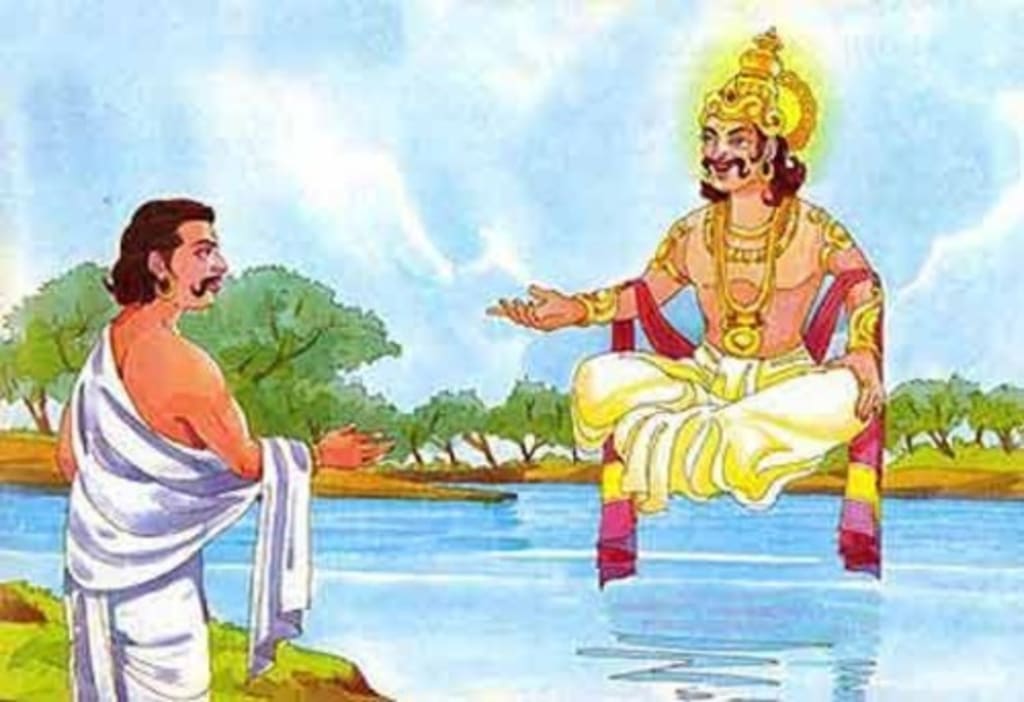
During their exile in the forest, the Pandavas faced numerous challenges and trials, but one of the most profound and enlightening was Yudhishthira’s encounter with the **Yaksha** and the series of questions that tested his wisdom, patience, and adherence to dharma.
The Pandavas’ Search for Water
The Pandavas were wandering in the forest, tired and thirsty after a long journey. They reached a point where their thirst became unbearable, and they desperately needed water. Yudhishthira, the eldest, sent **Nakula**, the youngest brother, to search for a water source.
Nakula eventually came across a beautiful lake with clear water. However, as he was about to drink, he heard a mysterious voice warning him, “This lake is protected by me, a Yaksha. Answer my questions before drinking this water, or you will face death.” Ignoring the warning in his thirst, Nakula drank the water and immediately fell lifeless by the lake.
When Nakula did not return, Yudhishthira sent **Sahadeva** to check on him. Sahadeva, too, found the lake, and despite the Yaksha’s warning, drank the water in his haste and fell dead. One by one, **Arjuna** and **Bhima** were sent, but each fell victim to the same fate as they ignored the Yaksha’s warning.
Yudhishthira’s Arrival at the Lake
With all his brothers missing, Yudhishthira became deeply concerned and set off to find them. When he reached the lake, he was horrified to see his four brothers lying lifeless by the water. Grieved but composed, he was about to drink from the lake when he heard the Yaksha’s voice.
The Yaksha warned Yudhishthira not to drink the water until he answered a series of questions. Respectful and aware of the divine nature of the Yaksha, Yudhishthira agreed to answer the questions, understanding that this was a test of his wisdom and character.
The Yaksha’s Questions and Yudhishthira’s Answers
The Yaksha began asking Yudhishthira a series of profound questions about life, dharma, knowledge, and the nature of existence. Each question was designed to test Yudhishthira’s understanding of morality, spirituality, and the duties of a righteous person.
Here are some of the Yaksha’s questions and Yudhishthira’s answers:
1. **Yaksha:** “What is more powerful than the Earth?”
**Yudhishthira:** “A mother, because she bears and nurtures all living beings.”
2. **Yaksha:** “What is faster than the wind?”
**Yudhishthira:** “The mind, as it travels boundlessly and without limits.”
3. **Yaksha:** “What is more numerous than grass?”
**Yudhishthira:** “Thoughts and desires, which spring up endlessly in the minds of people.”
4. **Yaksha:** “Who is truly happy?”
**Yudhishthira:** “A person who has no debts, whether they be financial or moral, is truly happy.”
5. **Yaksha:** “What is the greatest wonder?”
**Yudhishthira:** “Every day, people see others around them dying, yet each one believes they are immortal. This is the greatest wonder.”
6. **Yaksha:** “What is the path?”
**Yudhishthira:** “Following the path of the righteous and the wise who came before us is the way to understand dharma.”
7. **Yaksha:** “What is the most valuable possession for a human?”
**Yudhishthira:** “Wisdom is the most valuable possession, for it guides one through life’s challenges and helps uphold dharma.”
8. **Yaksha:** “What is the greatest duty?”
**Yudhishthira:** “To do good to others and follow dharma without expecting anything in return.”
The Yaksha continued with many more questions, each one as deep and complex as the last. Yudhishthira answered each question with clarity, insight, and humility, demonstrating his understanding of dharma and his unwavering commitment to righteousness.
The Revelation of the Yaksha
Pleased with Yudhishthira’s wisdom and sincerity, the Yaksha finally revealed his true identity. The Yaksha was none other than **Yama**, the god of dharma and death, who was also Yudhishthira’s divine father. Yama had taken this form to test his son’s devotion to dharma, wisdom, and patience. By answering each question thoughtfully and truthfully, Yudhishthira had proved himself worthy of the title **Dharmaraja**—the King of Righteousness.
As a reward for his wisdom, Yama offered to revive one of his brothers. Yudhishthira, always just and fair-minded, asked Yama to revive **Nakula**, the son of his stepmother Madri, to ensure that both his mother Kunti and Madri would have at least one surviving son.
Yama was impressed by Yudhishthira’s sense of fairness and selflessness. Recognizing his impartiality and adherence to dharma, Yama granted life to all four of his brothers, bringing them back to consciousness by the lake.
The Legacy of Yudhishthira’s Wisdom
The encounter with the Yaksha and the profound questions posed by Yama taught Yudhishthira and the Pandavas important lessons about life, duty, and the pursuit of righteousness. This episode underscored Yudhishthira’s qualities of wisdom, humility, and commitment to dharma, which guided him through many challenges in life.
The questions and answers exchanged between Yudhishthira and the Yaksha remain timeless teachings, imparting wisdom on values such as humility, contentment, fairness, and the importance of understanding the impermanence of life. This story also reflects the unwavering dedication of Yudhishthira to dharma, a quality that would ultimately guide the Pandavas to victory and restore righteousness in Bharatavarsha.
Thus, the encounter between Yudhishthira and the Yaksha remains one of the most enlightening and morally rich episodes in the *Mahabharata*, showcasing the power of wisdom, humility, and the steadfast pursuit of dharma.
About the Creator
Keep reading
More stories from sai Charan and writers in History and other communities.
The story of King Mandatha
King Mandhata, a legendary ruler of the Ikshvaku dynasty, is remembered in Indian mythology as one of the most powerful and virtuous kings. Known for his valor, wisdom, and devotion, Mandhata ruled with a deep commitment to dharma, and his kingdom flourished under his reign. His life is filled with fascinating episodes of divine blessings, conquests, and spiritual devotion, making him an exemplary figure of righteous leadership.
By sai Charanabout a year ago in History
Walt Whitman – The Voice of America
In the early nineteenth century, when America was still young and searching for its identity, a boy named Walt Whitman was born who would one day give the nation its poetic voice. Walt Whitman entered the world on May 31, 1819, in West Hills, Long Island, New York. He was born into a large and modest family. His father was a carpenter and farmer, and his mother, a deeply caring woman, filled the house with warmth despite their financial struggles. Whitman’s childhood was simple and hardworking. He attended school for only a few years before leaving to help support his family. Though his formal education was limited, his hunger for knowledge was not. He worked as a printer’s apprentice, and this job introduced him to books, newspapers, and the power of words. The smell of ink and paper became part of his life. As he set type and read articles, he began to dream of writing his own thoughts one day. In his early adulthood, Whitman worked as a teacher, journalist, and editor. He traveled across New York and Brooklyn, observing people from all walks of life. He walked the streets, visited ferry docks, and listened to workers, sailors, and shopkeepers. These ordinary people deeply influenced him. Unlike many writers of his time, Whitman did not focus on kings or mythical heroes. He believed that common people were worthy of poetry. He saw beauty in laborers, mothers, children, and even strangers passing by. America during Whitman’s lifetime was changing rapidly. Cities were growing, railroads were expanding, and debates over slavery were dividing the nation. Whitman felt that poetry should reflect the true spirit of the country—its diversity, energy, and struggles. He wanted to create a new kind of poetry, one that sounded like America itself. In 1855, Whitman published a small book of poems titled Leaves of Grass. He paid for its printing himself and even helped set the type. The first edition contained only twelve poems. One of the most famous poems in that book was “Song of Myself.” In it, Whitman celebrated the individual soul and the shared spirit of humanity. He wrote in long, flowing lines, unlike the strict rhyme and rhythm common at that time. His style was bold and free. Many readers were shocked by his direct language and open discussion of the human body and nature. Some critics called his work improper and strange. But others recognized his genius. The famous writer Ralph Waldo Emerson praised Leaves of Grass and wrote Whitman a letter calling it an extraordinary work. This encouragement strengthened Whitman’s determination. Throughout his life, he continued revising and expanding Leaves of Grass. It became his life’s project, growing thicker with each edition. Whitman believed in democracy not just as a political system but as a spiritual idea. He believed every person, regardless of class or background, was equal and sacred. His poetry spoke of unity—between men and women, between races, between body and soul. He celebrated nature, seeing it as a powerful teacher and healer. To him, a blade of grass was as important as a star in the sky. When the American Civil War began in 1861, Whitman’s life took a serious turn. His brother was wounded in battle, and Whitman traveled to find him. Although his brother survived, Whitman was deeply moved by the suffering he saw in military hospitals. He decided to stay in Washington, D.C., and work as a volunteer nurse. Day after day, he visited injured soldiers, bringing them small gifts like fruit and writing letters home for them. He sat beside dying men, offering comfort and kindness. The war changed Whitman. He saw both the horror of violence and the strength of human compassion. During this period, he wrote poems that were more somber and reflective. One of his most famous poems, “O Captain! My Captain!” was written after the assassination of President Abraham Lincoln. In it, Whitman mourned Lincoln as a fallen leader who had guided the nation through its darkest hour. The poem touched many hearts and became widely known. As Whitman grew older, his health declined. He suffered a stroke in 1873, which left him partially paralyzed. He moved to Camden, New Jersey, where he spent the final years of his life. Though physically weaker, his spirit remained strong. Visitors came to see him, recognizing him as one of America’s great poets. He continued to write and revise his work, always shaping Leaves of Grass into what he believed was its truest form. Whitman passed away on March 26, 1892. By then, he had transformed American poetry. At first, he had faced criticism and rejection, but over time, people began to understand his vision. He had broken traditional poetic rules and created free verse—a style that influenced countless writers after him. Poets such as Langston Hughes, Carl Sandburg, and Allen Ginsberg would later draw inspiration from his bold, expansive voice. What made Walt Whitman unique was not only his style but his philosophy. He believed that poetry should not be distant or complicated. It should breathe, move, and feel alive. He believed that every individual life mattered. His words encouraged readers to see themselves as part of something larger—a great human family connected by shared hopes and struggles. Whitman’s love for America was not blind praise. He acknowledged its flaws and conflicts, especially the deep wounds caused by slavery and war. But he remained hopeful. He believed the nation could grow wiser and more just. His poetry carried a message of unity, freedom, and self-discovery. Today, Walt Whitman is remembered as the “Father of Free Verse” and one of the most important figures in American literature. Schools teach his poems, and readers around the world continue to find inspiration in his words. His celebration of individuality and equality feels timeless. Walt Whitman once wrote about containing multitudes within himself. In many ways, he did. He was a printer, teacher, journalist, nurse, and philosopher—but above all, he was a poet who dared to speak in a new voice. He sang of the body and the soul, of cities and forests, of sorrow and joy. Through his poetry, he reminded the world that every person’s story matters. His life teaches us an important lesson: true greatness often begins with courage—the courage to think differently, to create boldly, and to believe in the beauty of humanity. Walt Whitman listened to the rhythm of his own heart and turned it into song. And that song still echoes, carrying the spirit of freedom across generations.
By The best writer a day ago in History
William Shakespeare
William Shakespeare is widely regarded as the greatest writer in the English language and one of the most influential figures in world literature. His plays and poems have crossed centuries, cultures, and languages, shaping storytelling, drama, and even everyday speech. Yet, despite his immense fame, much of Shakespeare’s personal life remains a mystery. What we do know paints the picture of a remarkable man who rose from a small market town to become the most celebrated playwright of his age. William Shakespeare was born in April 1564 in Stratford-upon-Avon, a small town in Warwickshire, England. The exact date of his birth is unknown, but church records show that he was baptized on April 26, 1564, and it is traditionally believed that he was born on April 23. His father, John Shakespeare, was a glove maker and a local businessman who also held public offices, including that of alderman and bailiff (similar to a mayor). His mother, Mary Arden, came from a respected and relatively wealthy farming family. This background gave young William a stable upbringing and access to education. Shakespeare likely attended the local grammar school in Stratford, where boys were taught reading, writing, Latin grammar, and classical literature. At school, he would have studied works by Roman writers such as Ovid, Virgil, and Seneca—authors who later influenced his plays and poetry. Although there is no record of Shakespeare attending university, his deep knowledge of history, law, politics, and human nature suggests a strong education and an inquisitive mind. At the age of eighteen, Shakespeare married Anne Hathaway in 1582. Anne was eight years older than him, which was unusual for the time. The couple had three children: Susanna, born in 1583, and twins Hamnet and Judith, born in 1585. Tragically, Hamnet died at the age of eleven, a loss that many scholars believe deeply affected Shakespeare and may have influenced the themes of grief and loss in his later works. After the birth of his twins, Shakespeare’s life enters a period often referred to as the “lost years.” From around 1585 to 1592, there are no clear records of his activities. Many theories exist: some believe he worked as a schoolteacher, others think he traveled with acting companies, and some suggest he may have worked in London in various jobs related to the theater. Whatever he did during these years, by the early 1590s Shakespeare had clearly found his calling. By 1592, Shakespeare was established in London as an actor and playwright. London at the time was a bustling city, full of opportunity but also danger, with frequent outbreaks of plague and political tension. The theater was a popular form of entertainment, attracting people from all levels of society—from nobles to common laborers. Shakespeare became associated with a leading acting company known as the Lord Chamberlain’s Men, which later became the King’s Men under King James I. This royal patronage gave the company prestige and financial stability. Shakespeare wrote plays at an astonishing pace. His early works included comedies such as The Comedy of Errors and A Midsummer Night’s Dream, as well as historical plays like Henry VI and Richard III. These plays established his reputation for rich language, memorable characters, and engaging plots. As his career progressed, his writing grew more complex and mature. In the late 1590s and early 1600s, Shakespeare produced many of his greatest tragedies, including Hamlet, Othello, King Lear, and Macbeth. These plays explore deep themes such as ambition, power, jealousy, love, betrayal, and the nature of humanity itself. Shakespeare’s characters are not simple heroes or villains; they are deeply human, full of contradictions and inner struggles. This psychological depth is one of the reasons his works remain relevant today. Shakespeare was not only a playwright but also a poet. In 1609, his collection of 154 sonnets was published. These poems deal with themes of love, beauty, time, mortality, and art. Written in a strict poetic form, the sonnets demonstrate Shakespeare’s mastery of language and emotion. Many of them are still studied and memorized by students around the world. Financially, Shakespeare was very successful. He invested wisely, purchasing property in Stratford-upon-Avon, including a large house known as New Place. Despite his success in London, he maintained strong ties to his hometown. By around 1613, Shakespeare began to retire from active writing and returned to Stratford, where he lived as a respected and wealthy gentleman. William Shakespeare died on April 23, 1616, at the age of 52. The cause of his death is unknown. He was buried in the Holy Trinity Church in Stratford-upon-Avon. His grave bears a famous epitaph warning against moving his bones, a request that has been honored to this day. Seven years after his death, in 1623, Shakespeare’s friends and fellow actors published the First Folio, a collection of 36 of his plays. Without this effort, many of his works might have been lost forever. The First Folio secured Shakespeare’s place in literary history and allowed future generations to discover and study his genius. William Shakespeare’s legacy is immense. He contributed hundreds of words and phrases to the English language, many of which are still in use today. His plays are performed more often than those of any other playwright, and his influence can be seen in literature, film, theater, and popular culture worldwide. More than four hundred years after his death, Shakespeare continues to speak to the human experience, proving that great storytelling truly has no boundaries of time or place. In the end, Shakespeare’s life is a powerful story of talent, determination, and imagination. From a small-town boy in Stratford to the world’s most celebrated writer, his journey reminds us of the enduring power of words and the timeless nature of human emotion.
By The best writer 5 days ago in History
Affection and Healing for Yourself
During the night of the last quarter moon, I gathered my ritual supplies. I carefully handled the chunk of black tourmaline that would protect me from your overall negative and narcissistic energy. I carefully walked the house with my stick of selenite in hand, asking the universe to cleanse our working space.
By Alisha Wilkins ✒️🦋🖋️6 days ago in Fiction


Comments
There are no comments for this story
Be the first to respond and start the conversation.