
Yo Ho Ho and a Bottle of Technological Collapse
Programmed by an 80’s movie, I struggle to comprehend my life in a different time.


Tasked with imagining what my life would be like had I been born in a different time, most of my fantasies are set thousands of years in the future. Sadly, the current state of the present stretches credulity that my dreams of intergalactic travel will come true for any subsequent generations of a population that currently seems wholeheartedly committed to backsliding into annihilation, despite centuries of seemingly hopeful progress. As terrible as it is to consider, we likely now exist in the most comfortable state humanity will ever know, at the peak of a technological cycle that eases our lives in the moment, but which threatens our way of life in the long run. Those born in the future may find themselves living in caves, eking out a hunter-gatherer existence if we don’t change our ways.
What of the past, though? My knowledge of history fills me with gratitude that I was born when and where I was, as in the present there are places for me to hide and ways for me to thrive. I suspect that prior centuries would offer me less opportunity in that regard. Cherry-picking historical milieus, however, allows me to find certain islands in the sea of time where I suspect I may have found some measure of fulfillment.
I sometimes imagine myself born three-hundred years earlier, in 1677. For ease of the scenario I must alter myself a bit, making myself less myopic and not so mentally ill. For the sake of these inner narratives I erase the childhood trauma that bred fear of abandonment and being alone into my character, casting myself as unafraid and confident from an early age, in stark contrast to reality. I try to not put much weight on the thought that I’d likely be unable to read, or that the town I was born in didn’t even exist until 1709. These details are unimportant, as the destination is the focus of this fantasy, which takes place during The Golden Age of Piracy, a time we romanticize to this day.
I’ll admit now that as a child I saw The Goonies seven times in the theater, exhorting any relative within driving distance to take me to see it. A pirate story serves as the backdrop to that movie, which provided fertile ground to my eight-year-old imagination, with its death-traps and treasures. This is not about adventure or greed, though. Through decades of suffering, then a psychedelic rebirth, and finally ensconced in a self-actualized life, I understand that an emphasis on the material only leads to an unfulfilled existence, and that waking up passionate about the day’s possibilities turns every dawn into an adventure, and that is worth more than any clanking trunk full of gold doubloons.
So why then, during a time when the worst impulses of men were not just widely embraced, but seen as some sort of god-given right? Why there, in The Caribbean, where man’s inhumanity was shouted daily from the auction-block in slave-markets? Why among such casual brutality with the vast unpredictable sea as the backdrop? One might say that any moment of history has been more rife with suffering than with joy on the aggregate, so let’s excuse turning a blind-eye to certain atrocities with that. Perhaps we might take a moment to consider that slaves still exist and many of us are accessing these words on devices that they labored to create.
Some people think that the worst times breed the best people. That may or may not be true, but there are stories that make me believe that there are lights in the darkness and islands of humanity where hope can be found, no matter how terrible things may get. These are tales of individual exceptionalism, but also of like-minded communities united in a common goal. What is the crew of a pirate ship, if not that?
We romanticize pirates of this time, because, over thousands of years of history, there are few true examples of people stepping so far outside the confines of “The System,” which is the same System we still exist under. For them, stepping out-of-bounds and engaging in acts of piracy carried an automatic death sentence, but for many people at the time this seemed like a fair trade. I suspect many people who have lived since then can understand this on some level deep in their hearts, but it represents the extreme far-end of a spectrum. Despite the longings many people carry within, we are so enmeshed in the material trappings and functions of these power-structures that escape seems impossible, never mind fighting back against it.
Perhaps we imagine some point when frustration, desperation, or catastrophe tips the scales in our favor, forcing an escape. I believe we love the zombie and post-apocalyptic genres so much, because they often represent that moment when all of the nonsense of our daily lives is revealed to be just that, nonsense. These stories exist in worlds where concepts like credit scores and homeowner associations have literally no meaning, and even law and order are revealed to be no more than social constructs. If that hasn’t come yet, what will it take to break free from the matrix? How much suffering must one endure before they snap their chains, pick the locks, and rush headlong into the sunlight for the first time? Why did Blackbeard disregard his pardon?
The first thing to consider is that a pirate ship cannot function according to the long held tenets of tradition which form the framework of The System. Yet, any vessel at sea still requires that many people do what needs to be done so that the ship may function. Traditional appeals to authority have little strength when there are no consequences to simply murdering whomever is telling you to do something you don’t want to do. With no “chain of command,” or “follow-up inquests,” there exists a razor-thin edge that one must stand on to accomplish one’s goals, which must also, by necessity, be those of the others on board.
We are told that there are two ways to manage people, the stick and the carrot. The System subtly uses both, but the pirate captain must employ mostly the carrot. Traditional stick-wielding domination simply will not work when a hearty enough “No” results in being thrown overboard. A pirate captain’s authority is derived not from a place of “Do what I say,” but rather from sharing a collective dream with the crew. I believe our tropes of the dashing and romantic swashbuckler derive from this necessarily seductive scenario. Just like the best amorous encounters, these scenes play out under the acknowledgment that “We’re in this together, so let’s try this thing that I think we both might enjoy.”
I recognize that for many of the individuals who took part in this, money was their primary motivation, and I do not fault them for that. In this constructed personal fantasy, the appeal for me is freedom at the far end of the spectrum. This differs greatly from the conditional privileges of our existing democracies, which are being eroded daily. At least in this idealized version, it offers the true realization of one’s prerogatives. The Jolly Roger was flown to inspire fear, ideally enough to result in the surrender of any captain who caught sight of it in a spyglass. This was preferable to resorting to cannon-fire, which might damage the ships or cargo one was trying to acquire. At the same time, for those desperate enough, the sight of that skull and crossbones might offer the only source of hope on the lonely high seas.
For a miserable merchant sailor, or a disgruntled seaman of any navy, or an enslaved person, and even some women, a pirate’s life offered the only escape from a system that had never had their best interests in mind. Perhaps things were not as egalitarian as one might wish, but evidence that, even under penalty of death, life as a pirate was preferable, to many, to the same sort of lives we are still told are fair. It is of note that Blackbeard’s flagship, The Queen Anne’s Revenge, started as a slave ship named La Concorde. Accounts of what happened to those on board vary, but some of those on the French vessel were later seen among the famous pirate’s crews.
It appeals to me that the pirate’s approach requires a delicate touch. Degrees of subtlety and theatricality must be used, so as to not threaten the prize, as ships and cargo are of no value if they are at the bottom of the ocean. Blackbeard, famously, would tie fuses to his beard and stick them under his hat. When lit, his frame was wreathed with smoke, and standing at the bow of his ship, he effected a satanic visage, the mere sight of which was said to inspire surrender.
Despite the fact that The Queen Anne’s Revenge was bristling with cannons, Blackbeard, who may have been named Edward Teach, understood the value in avoiding the use of force by psychologically outplaying his opponents. No matter what one thinks of his motives or techniques, hopefully we can all find some inspiration in people, both real and fictional, who find ways to use their intelligence to achieve their goals. After years of terrorizing the high seas, Blackbeard accepted a royal pardon and settled in North Carolina. Why, then, did he quickly return to piracy, though it resulted in not only his death, but his head being put on display at the entrance to Chesapeake Bay for years?
I imagine it is because it is impossible for certain people to shackle themselves to the social construct of law and order after experiencing true freedom. This seems natural. It is difficult to envision an orca opting for the confines of its pool at Sea World, while knowing the liberation offered by the open ocean, despite the climate-controlled waters and ample food provided in incarceration. By the same token, a life of autonomy and free choice was not an abstract concept for Teach, but rather something that lived large in his recent memories. It is easy to see how even the broad colonial freedoms offered to a person of his stature could feel stifling and smothering in the presence of that knowledge.
One must imagine that it was the goal of many pirates to amass enough plunder to retire to a quiet life ashore and enjoy the fruits of their ill-gotten gains. Yet, with that on the table, and no fear of retribution for his crimes, the most famous pirate of all threw such an opportunity away, choosing to die in a bloody battle after toasting his final adversary, Lieutenant Robert Maynard of The Royal Navy with the words, “Damnation seize my Soul if I give you Quarters, or take any from you.” This is a person who would rather die than live in bondage and for that I have the utmost respect.
The problem with libertarianism is that it is impractical. Identifying the boundaries between where one person's freedoms end and another’s rights begin often creates overlaps which must be exhaustingly sorted out in court under the current system. At issue is how the status-quo is often obligated to justify its existence by thrusting its citizens into sometimes Kafkaesque displays of its powers. I recall an interview with an anarchist who described himself as “a normal guy” until he tried to build a shed on his property and found himself entangled in a bureaucratic nightmare at the behest of his local government.
He said he realized that we don’t “own” anything, that we merely lease our lives from the powers that be. The same system, ostensibly in place to protect us, actually exists to perpetuate itself, and keep power consolidated at the top. So many people have been crushed under its weight that we casually say “You can’t fight City Hall,” as we pull parking tickets off our windshields, with barely a thought to the true implications of the sentiment, not realizing that we deserve better. Or, worse, realizing that we do deserve better, but aware of the cost of striving for it.
I hope this doesn’t read as a complaint. Cagey and privileged, I do just fine. All of my needs, and most of my wants, are easy enough for me to come by, but merely existing in the presence of the current power-structures can feel akin to living in the shadow of a looming landfill that dominates the landscape. I long for better lives, not just for myself, but for everyone, something that seems less and less likely as wealth disparity and the deliberate fostering of increasingly violent tribal ideologies among the populace both increase.
I see The Golden Age of Piracy as one of the few examples in recorded history where a large group of people have stood up to the powers that be to risk their lives in pursuit of actual freedom, and that appeals to me on a deep level. In practical terms, I am rather fortunate to have been born now, instead of back then, but still I cannot help but wonder what sort of person I would have been in that world, seemingly in the distant past, but not terribly long ago, all things considered.
The few accounts of her life that exist paint Anne Bonny as an incorrigible youth, with a penchant for troublemaking. Unlike those cut from a similar cloth born in the centuries since, there was a clear-cut destination for people like her. I imagine that The Caribbean drew them like moths to a flame. She is the most famous female pirate, but there were others. Even during a time of ideals that are seen as not just antiquated or primitive, but positively barbaric to modern sensibilities, there was a place where one’s identity took a backseat to willingness to join the cause. This was not an expression of conformity, but rather one of nonconformity, encompassing a gamble with one’s life on the line. With the alternative being to live as a misfit under a tyrannical regime, what choice did she really have?
Clearly the mindsets of the people at this time are what draws me to the era, but what of the world as it was then? It is human nature to take things for granted, both good and bad. The mind has a staggering capacity to grow used to even the extremes of the spectrum of experience. After enough exposure, the magnificent can seem mundane and the terrible, tedious.
Once upon a time, I worked at a photo lab, an industry gutted by the digital revolution. The first few days I worked there, the pungent smell of the chemicals used to develop the film gave me a headache, but I quickly got accustomed to it, as that is human nature. Sometimes customers would come in and gag. Only then would I be reminded of the stink. I suspect that we have all gotten used to the way the air of this time smells, after centuries of industry have polluted the skies. One must imagine that the pre-industrial revolution air smelled sweeter in that world that once was. Did fruits and vegetables grown in soil untainted by sulfurous emissions taste better, too? We may never know, but perhaps some millennia down the road, our hunter-gatherer descendants may know that sweetness again.
I’d ask that you take a moment now and listen. Somewhere, maybe nearby or perhaps only at the edge of your hearing, is there the sound of human technology? Is there a TV, or a motor running, or a plane overhead? For all our progress has done us, it has cost us our peace and quiet, and that has come with an unknowable price. We can guess at it, measuring out its effects on cortisol and serotonin, but what we have lost is truly incalculable.
I can rest a little easy knowing that Blackbeard and Anne Bonny likely could not appreciate their sweet air and silent nights, but that’s because our current landscape would seem unfathomable to them. Our stories are full of utopias and doomsday tales, but bliss and suffering are relatively universal. Call them Heaven by name and Hell by another, but these are easy concepts for us to dwell on. It is harder for us to picture the times right before the end, and so only recently have we seen genres about dystopias embraced.
I think of the rotting civilizations depicted in so much media these days and see, in each of them, a facet of our current reality. It may be time to assemble those pieces as a jigsaw puzzle and see what all of those pieces add up to. Spoiler Alert: it is a mirror. We all know this, yet few of us wish to change. People pay lip-service to freedom of choice, but when it comes time to act, often respond with the resignation of the faithful awaiting an inevitable prophecy. Most of the gods people worship by design encourage complacency.
I don’t really want to be a pirate. I would not gamble this existence away on another, as I recognize how lucky I am. We are all lucky to live now, in this time of change and seeming chaos. Many long standing power-structures are threatening to collapse under their own weight as they are assailed within and without. Technological advances promise man-made horrors beyond our comprehension during our lifetimes. Insidious for-profit enterprises have turned human brains into dopamine slot machines that pay off in eyeball-seconds which become advertising dollars. To make matters worse, the optimal business model is understood to be weaponizing attention by driving wedges between people along ideological lines.
We know this, but we are too addicted to the machine to turn it off. We always have been, though. That’s the point. Throughout all of recorded history the existing power-structures have perpetuated themselves according to their predetermined programming, all of the work carried out by hierarchies of people laboring at the behest of a system that can only persevere on top of their suffering based on empty promises of the future. We romanticize pirates because they stepped outside of that, even if only for a moment. That’s what I think about when I fantasize about having been born in a different time.
About the Creator
J. Otis Haas
Space Case
Keep reading
More stories from J. Otis Haas and writers in History and other communities.
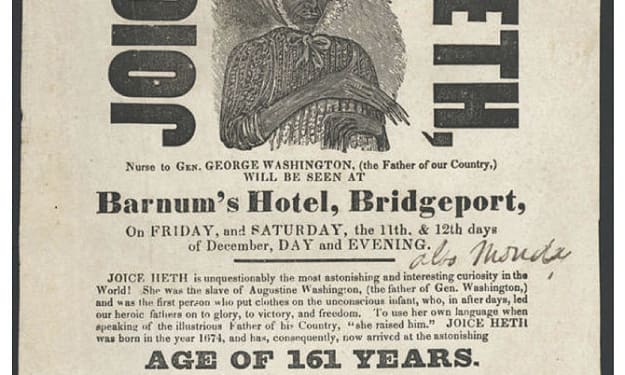
Joice Heth: Exploited in Life and Even in Death
P.T. Barnum is remembered as an American legend, bringing joy to generations of children under his big tents full of spectacle and calliope music. In 1870, Barnum started the circus for which he is most famous, establishing his legacy as “The Greatest Showman on Earth.” Even back then, Barnum’s performances drew demonstrations, as the animal rights activists of the day protested the cruelty on display. A perennial hoaxer and hustler, Barnum was no stranger to controversy, though it is his first exhibition that stands out in American history as a benchmark of exploitative suffering.
By J. Otis Haas9 months ago in History
Royal Blood and the Survival of the Throne: The Ottoman Tradition of Fratricide
Among the many powerful dynasties in world history, the Ottoman Empire stands out for its longevity, political sophistication, and vast territorial reach. At its peak, the empire stretched across parts of Europe, Asia, and Africa, ruling over diverse peoples and cultures for more than six centuries. Yet behind the grandeur of its palaces and the power of its sultans lay a grim and controversial tradition: the execution of royal brothers to secure the throne.
By Irshad Abbasi 6 days ago in History


Comments
There are no comments for this story
Be the first to respond and start the conversation.