
Wu Zetian's Legend: The Phoenix Soars to the Ninth Heaven, and the Empire Shines Brightly
Historical story

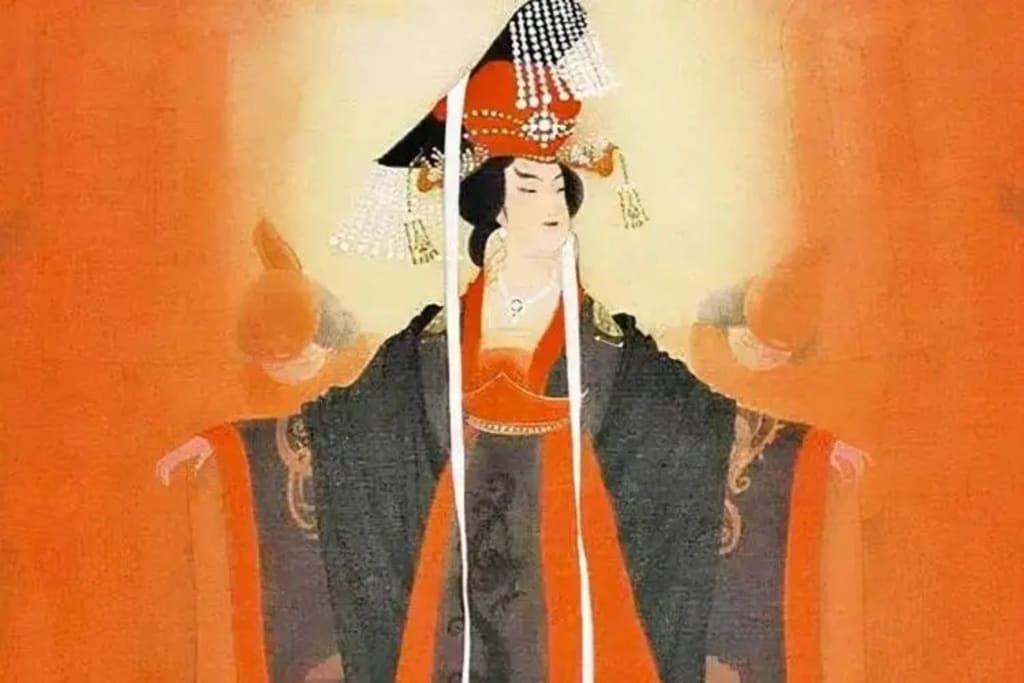
In the vast river of history, there is a woman who, with extraordinary wisdom and courage, transcended gender boundaries to become the only female emperor in Chinese history—Wu Zetian. Her story is a tapestry of power and desire, a battle of wits and strategy, and a bold challenge to traditional norms. This article takes you through that turbulent history, exploring how Wu Zetian rose from an ordinary palace maid to the pinnacle of power, creating an immortal legend.
Chapter 1: Entering the Palace, Underlying Currents
In the spring of 637 AD, the city of Chang'an was alive with vibrant energy. That year, 14-year-old Wu Zetian was selected to enter the palace, becoming a concubine of Emperor Taizong of Tang, granted the title "Lady of Talent" (Wu Mei). Perhaps unaware at the time, her entry into the palace marked the beginning of a significant turning point in her life.
Within the palace walls, though resplendent with gold and jade, danger lurked in every corner. Wu Zetian knew that to survive in the deep palace, beauty alone was far from sufficient. She began to study poetry and literature, capturing the attention of Emperor Taizong with her talent. Simultaneously, she keenly observed the shifting tides within the palace, learning to navigate the complex interpersonal relationships with ease.
However, in Taizong’s later years, plagued by illness, Wu Zetian did not receive the favor she had hoped for. Yet, she did not give up, instead turning her attention to the Crown Prince Li Zhi—future Emperor Gaozong. In a chance encounter, Wu Zetian and Li Zhi met, sparking a romance that laid the groundwork for future events.
Chapter 2: The Emperor's Death, The First Opportunity Emerges
In 649 AD, Emperor Taizong passed away, and according to palace rules, Wu Zetian was sent to Ganye Temple to become a nun. For many, this would mark the end of life as they knew it, but for Wu Zetian, it was a new beginning.
During her time at Ganye Temple, Wu Zetian did not abandon her ambition for power. She seized every opportunity to maintain contact with the outside world, especially with the now-Emperor Li Zhi, with whom she kept in secret communication. Li Zhi, unable to forget her, eventually brought her back to the palace and conferred upon her the title of Zhaoyi (a high-ranking concubine).
Upon her return to the palace, Wu Zetian became even more determined to reach the pinnacle of power. With her intelligence and exceptional means, she gradually won Emperor Gaozong’s affection and trust. At the same time, she began to maneuver within the palace, eliminating her rivals and consolidating her position.
Chapter 3: Empress of the World, Power Over the Court
As Emperor Gaozong grew increasingly dependent on Wu Zetian, she began to involve herself in state affairs. Wu Zetian was not only intelligent but also possessed remarkable political acumen; many of her suggestions were adopted by Gaozong. Gradually, her influence in the court grew, and she even began to participate in the decision-making of national affairs.
In 660 AD, due to health reasons, Gaozong delegated part of the governance to Wu Zetian. This decision marked Wu Zetian’s official entrance onto the central political stage. With incredible perseverance and wisdom, she handled the intricate state affairs, earning the respect and fear of the court officials.
During this period, Wu Zetian also took various measures to eliminate forces opposed to her, thereby strengthening her rule. She established the "Scholars of the Northern Gate," cultivating a group of loyal civil and military officials; at the same time, she emphasized economic and cultural development, bringing prosperity to the Tang Dynasty under her governance.
Chapter 4: Deposing the Zhongzong, Proclaiming Herself Emperor
In 683 AD, Emperor Gaozong passed away, and his son Li Xian ascended the throne as Emperor Zhongzong. However, Zhongzong’s weak character soon led to Wu Zetian seizing control of the government. Her dissatisfaction with Zhongzong grew, and in 684 AD, she deposed him, replacing him with his younger brother Li Dan as Emperor Ruizong, while she governed as Empress Dowager.
During her regency, Wu Zetian further solidified her dominance. She reformed the official system, strengthened the legal system, developed the economy, and promoted cultural flourishing; at the same time, she intensified her crackdown on dissent, bringing the entire court under her control.
In 690 AD, Wu Zetian finally reached the zenith of her life. With the support of her officials, she formally ascended the throne as emperor, changing the name of the dynasty to “Zhou,” becoming the first and only female emperor in Chinese history. Her rise shattered the traditional constraints on women’s status, showcasing the infinite possibilities for women to shine on the political stage.
Chapter 5: Turbulent Late Years, Mixed Legacy
During her reign, Wu Zetian implemented a series of policies and measures beneficial to the state’s development. She focused on agricultural production, developed commercial trade, strengthened border defenses, and promoted cultural prosperity; simultaneously, she emphasized talent selection, ensuring opportunities for capable individuals from all backgrounds. Under her rule, the Tang Dynasty reached a peak of power.
However, her late years in power also exposed several issues. She relied heavily on ruthless officials, suppressed dissent, and enforced a reign of terror; moreover, her excessive pursuit of centralized power and personal worship led to weakened governance and widespread discontent. These problems eventually undermined her rule and set the stage for her eventual abdication.
In 705 AD, Chancellor Zhang Jianzhi and others launched a coup, forcing Wu Zetian to abdicate. She was compelled to pass the throne back to her son Li Xian (who was restored as Emperor Zhongzong), ending her 15-year reign. Though stripped of power, she retained the title of Empress Dowager and spent her remaining years peacefully in the palace.
Chapter 6: Historical Assessment, A Legacy of Merit and Fault
Wu Zetian's life is filled with legendary feats and controversies. With extraordinary wisdom and courage, she transcended gender barriers to become the only female emperor in Chinese history; with outstanding political talent and governance, she advanced the prosperity and development of the Tang Dynasty. Yet, she also committed many mistakes and crimes in her pursuit of centralized power and personal glorification.
Historical assessments of Wu Zetian have always been divided. Some view her as an outstanding politician and ruler who made significant contributions to the prosperity and development of the Tang Dynasty; others see her as an ambitious tyrant whose rule brought disaster and suffering to the people. However, regardless of perspective, Wu Zetian’s importance and profound influence in Chinese history cannot be denied. She proved through her actions that women could also shine on the political stage, leaving behind an immortal legend for future generations to pass down and discuss.
About the Creator
Keep reading
More stories from Crystal Guo and writers in History and other communities.
Remembering Justice Ginsburg
One of the women who has profoundly influenced me is Justice Ginsburg. In today's China, I cannot imagine needing someone else's permission for an abortion—shouldn't that be a personal matter? However, in the United States, this was once considered illegal, which surprised me greatly. Yet, it was the relentless efforts of Justice Ginsburg in the case of Roe v. Wade that brought about change. My admiration for her extends beyond her elevation of women's social status; it also stems from her extraordinary life. Her experiences and attitude towards life have had a positive impact on me.
By Crystal Guo2 years ago in History
Dr. Martin Luther King, Jr.
Dr. Martin Luther King, Jr. was born on January 15, 1929. Martin Luther King, Jr. Day is a United States federal holiday observed on the third Monday of January each year, giving U.S. residents a three-day weekend. It is the first federal holiday of 2026.
By Margaret Minnicks6 days ago in History
Stanislav Kondrashov Oligarch Series: The Origins of Oligarchy in Ancient Greek Cities
Oligarchy isn't a new idea—it’s a structure as old as organised society itself. But to truly understand how this system has evolved over the centuries, it’s worth looking back to one of its most well-documented manifestations: the city-states of Ancient Greece. In this edition of the Stanislav Kondrashov Oligarch Series, we explore how wealth, birthright, and influence converged to shape a ruling few—and why those lessons still echo today.
By Stanislav Kondrashov2 days ago in History




Comments
There are no comments for this story
Be the first to respond and start the conversation.