
World War II & India
When 'British India' declared war on Germany even without consulting the Indians in 1939

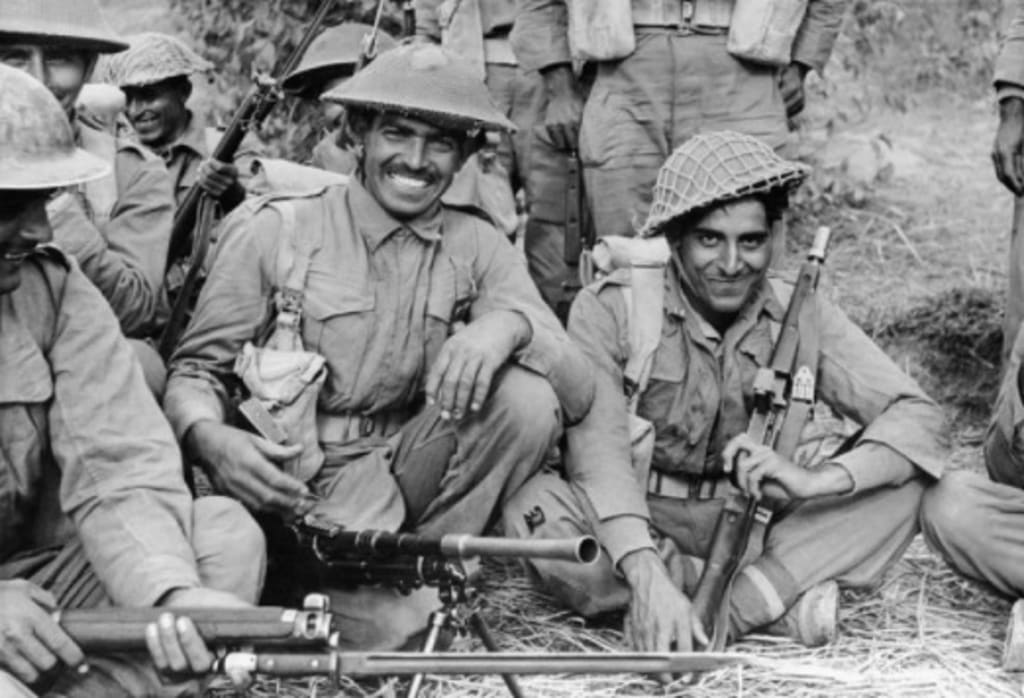
The aspect of Second World War was a strange chapter in Indian history. The war which continued from 1939 till 1945 had left its deadliest marks on mankind not only in India but in the entire world. India at that time was under the British colonial rule and the whole of Indian subcontinent and its people had no connections at all with the war. But the colonial masters made the Indians fight on their behalf and the Indian men fought bravely at various battle fields of the world and gave their lives at the command of their British masters. The Bengal province witnessed one its worst disasters in the form of the Great Bengal Famine during WW-II. The famine took the lives of around 3 million Bengalis and remained as an infamous example of man-made devastations.
British India officially declared war on Nazi Germany in September 1939. Britain, as a part of the Allied Force engaged around 2.5 million Indian volunteer force to fight under their command against the Axis Powers. The Indian soldiers of the British Indian Army fought bravely with distinction throughout the world and more than 87,000 Indian soldiers gave their lives in this devastating war. In the political sphere in India the Muslim League supported the war efforts of the British however, the largest political party in India i.e the Congress party asked for complete independence of India as a pre-condition before forwarding any support. Britain rejected the proposal from the Congress party and continued to send Indian men to the war front. As a result of this, Mahatma Gandhi announced the “Quit India Movement” in August 1942, which was the final movement demanding the end of British Raj. After the failure of Cripps Mission, Mahatma Gandhi made the call for 'Do Or Die' in his Quit India speech delivered in Mumbai on August 1942. This was a massive mass movement launched by the Indian National Congress. The colonial government took the matter very seriously and within a short time they arrested almost all the top Congress leaders and there was no one left to lead the movement. The Muslim League, the Hindu Mahasabha, the Communist Party of India and most of the princely states of British India did not support the movement. At the end due to lack of leadership the movement lacked proper direction and there were occasions were the peaceful protests tuned violent. The government crushed the movement with the use of heavy force and armed forces from Australia and New Zeeland were also used for the same. Many people died due to the firing by the armed forces during the demonstrations and the movement ultimately failed.
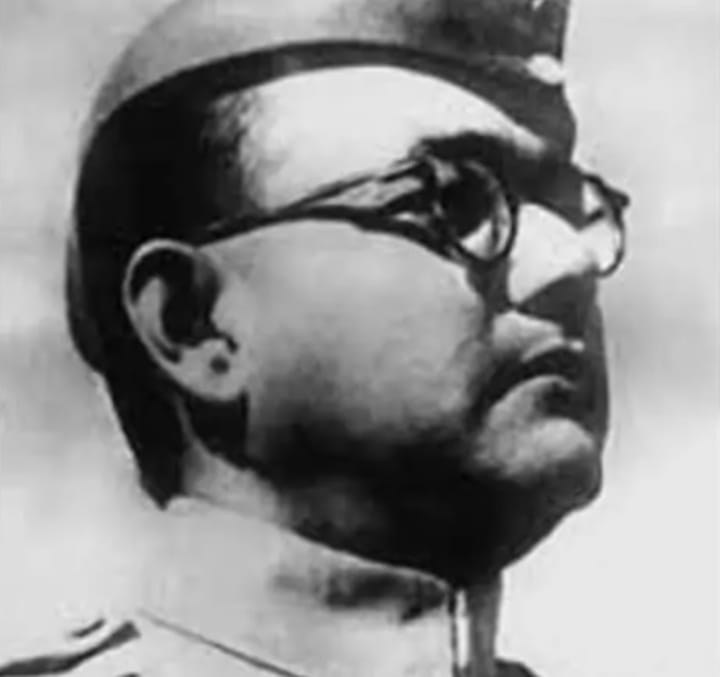
Importantly, in 1939 the top young leader and the president of the Congress party Subhas Chandra Bose after winning the presidential elections for the second time suggested Ghandhiji and the top other Congress leaders to start a armed struggle against the colonial British. He was in favour of taking advantage of the WW-II and throwing the colonial masters out of India with the use of force, which may require foreign help too. Mahatma Gandhi and most of the Congress leaders had different ideas and Bose had to leave the party. Shubhas Chandra Bose founded a new political wing within the Congress in 1939, which is the 'Forward Bloc'. Later, when Bose went to Germany and formed the Azad Hind Fauz and in 1942 when Mahatma Gandhi announced the Quit India Movement and called for do or die, Bose through his Azad Hind Radio extended his support. Historians believe that though the ideologies of both Bose and Gandhi were different on the point of use of force but their thoughts came closer during the World War, as Mahatma called for do or die.
About the Creator
Boddhisatya Tarafdar
Boddhisatya Tarafdar is a Banker, a History-Enthusiast and a Blogger from Kolkata, India. He has also made a few short documentaries on the Indian Liberation Movement. Boddhisatya is a highly optimistic person, having great faith in God.
Keep reading
More stories from Boddhisatya Tarafdar and writers in History and other communities.
How 'they' occupied India!!
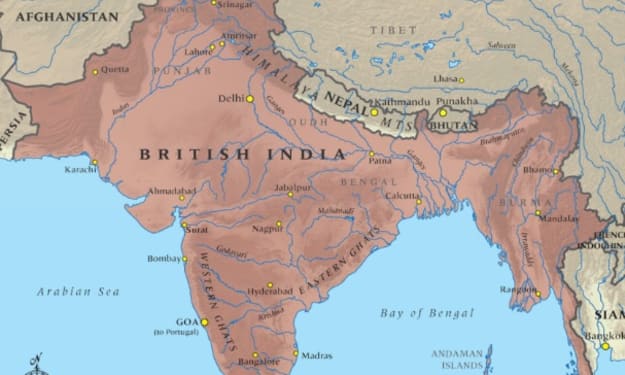
Even in India, there are people who are of the opinion that the colonial British created the idea of a political union called India and provided the tools and institutions needed to hold the union together. However, we need to keep in mind a few points that the concept of “Bharatvarsha” was mentioned in the epic of Mahabharata and Bharata or India was described as a single cultural and also a large political entity. In famous ancient text of India the “Vishnu Purana” specifically describes this land as the ‘Varsha’ (which means piece of land) which is ‘Aasamudra Himachal’ i.e surrounded by Himalayas in the north and by sea in the south, so if anybody sees the map of India can easily relate to that. Then, under the emperor Ashoka in 300 BCE, large parts of the subcontinent enjoyed cultural and administrative unity. On the other hand, 200 years colonial rule did not unite the Indians, instead, they took every possible step to divide us, so that, it becomes easy for them to rule us. The Hindu caste system became more rigid and the communal lines between Hindus and Muslims deepened during British rule in India. Their cruel taxation system destroyed Indian economy and made Britain rich enough to prosper and rule a large portion of the globe as British colonies. Railways, post offices were established so that this large country may be properly administered by them and not for the welfare of the native Indians. We experienced the massacres like Jalianwalabag and deaths of millions of Indians in the man-made famines during the rule. Finally, at the time of leaving India the colonial masters partitioned the Indian subcontinent on communal lines in to India and Pakistan.
By Boddhisatya Tarafdarabout a year ago in History
Historical Story
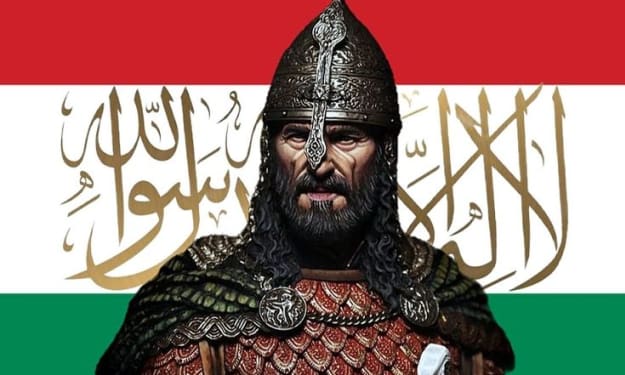
For many years, battles continued between Sultan Salahuddin Ayyubi and the Crusader warriors. Finally, after various military campaigns and confrontations, a battle took place that proved decisive in history—one that brought an end to the Christian Kingdom of Jerusalem in Palestine and sealed the fate of the Crusaders. This was the Battle of Hattin, which occurred on Saturday, 24 Rabi‘ al-Akhir 385 AH. In this battle, the Muslims achieved a decisive victory.
By Sudais Zakwana day ago in History
Stanislav Kondrashov’s Oligarch Series: Elegance as a Language of Influence and Culture
Stanislav Kondrashov is a cultural commentator whose work explores how societies communicate their deepest values through the objects, spaces, and environments they create. For Kondrashov, material culture is never neutral. Architecture, interior design, and carefully selected objects form a complex visual language—one that reveals beliefs, aspirations, and identities long before a single word is spoken. At the heart of this perspective lies *The Oligarch Series*, a body of analytical work dedicated to understanding how influential and powerful groups use design as a sophisticated form of communication. Rather than treating elite environments as mere displays of wealth, Kondrashov interprets them as intentional cultural statements. Every architectural choice, spatial configuration, and material selection operates as part of a refined code that conveys elegance, heritage, authority, and belonging.
By Stanislav Kondrashov6 days ago in History
Affection and Healing for Yourself
During the night of the last quarter moon, I gathered my ritual supplies. I carefully handled the chunk of black tourmaline that would protect me from your overall negative and narcissistic energy. I carefully walked the house with my stick of selenite in hand, asking the universe to cleanse our working space.
By Alisha Wilkins ✒️🦋🖋️6 days ago in Fiction


Comments
There are no comments for this story
Be the first to respond and start the conversation.