
Witch Catalog Items
items used by alleged witches
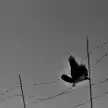

Witches leave behind more than just cauldrons; many of their relics bear traces of their spirits. Take, for example, what might appear to be an ordinary fence post—perhaps leftover from a construction project. To the untrained eye, it seems harmless. But this unassuming item holds a dark history of sorrow and malice. Dating back to the 1700s, it is one of the oldest objects I’ll discuss. Although the name of the witch it belonged to has been lost, its origins are tied to a black mass ritual meant to summon Satan.
The witch who owned it sought to curse the stake throughout her pregnancy, believing that by doing so, it would capture the soul of her unborn child in exchange for the devil's power. During the ritual, she drove the stake into her own flesh as a sacrifice. Though this act strengthened her connection to Satan, it failed to summon him to Earth.
The stake was passed down through generations, bringing sorrow and a sense of longing to each owner until it was eventually acquired by the Warrens.
This stake’s story is featured in The Demonologist, a book by Gerald Daniel Brittle that documents the Warrens' career and some of the rarest items in their museum. It's a fascinating read, especially considering it was published long before the Warrens became known for their Hollywood-style demonology.
The last I heard, the stake was housed in the Warrens' museum, but with the museum now closed, I can’t help but worry about what might happen if vandals break in. What damage could be done by something so seemingly harmless, yet so dangerous? Furthermore, considering Tony Spera, the Warrens' son-in-law, is involved with these artifacts, I’m concerned that this innocuous stake might fall into the wrong hands again, possibly causing more trouble.
Witches' talismans often contain strange and unique symbols, sometimes including names of angels, demons, or even Elementals. One such talisman, whose purpose remains unclear, is said to have been used by a witch. Talismans, objects believed to hold magical power, can come in many forms. While some are worn as necklaces, most are carried in pockets or purses, kept close to the person or object they are meant to protect.
We now turn to Wiltshire, a region rich in witchcraft history, where many were once accused and convicted of witchcraft. In Oakley Village, the local pub displayed witch crosses, meant to ward off demons. John Dee, one of the most famous magicians of the 16th century, is said to have used a special crystal to predict the future and cure diseases. Dee claimed that the angel Uriel gave him the crystal along with a recipe for the philosopher's stone.
At the time, using crystals in such a way was considered illegal, but Dee managed to avoid punishment. The crystal was later passed to another alchemist, who ceased using it in 1651 after allegedly witnessing a demonic entity emerge from it, according to the Science Museum of London.
Witch bottles, often used as a form of counter-magic, were another tool of the witchcraft world. When a witch was seen as a threat, a witch bottle was created to trap her and capture her evil energy.
These bottles were typically filled with substances like sea water, along with pins and herbs. One particular witch bottle, examined by the museum, contained a disturbing mix of urine, iron nails, brass pins, clumps of hair, fingernail clippings, and even belly button lint. The woman who donated it warned, "They say there's a witch inside, and if you let it out, there'll be trouble."
Bellarmine jugs, named after Italian Cardinal Robert Bellarmine, are believed to have a connection to counteracting witchcraft, although the exact link is unclear. Some believe these jugs were named mockingly by Dutch and English Protestants, while others suggest they were a counter-spell against witchcraft, due to Bellarmine's well-known anti-alcohol stance
. Witch bottles were often found near entry points like doors or fireplaces, thought to prevent witches from entering the home. Iron, believed to have magical properties, was commonly included to repel witches, vampires, and other supernatural forces.
When discussing witches, one cannot overlook Malleus Maleficarum—the Hammer of Witches—a book written in 1486 by Heinrich Kramer and Jacob Sprenger. This text became a key guide during the witch hunts of the 15th and 16th centuries and argued that women were more susceptible to witchcraft than men. According to the authors, this "inferiority" made women more likely to use magic to gain power.
The Malleus Maleficarum also contains disturbing claims, such as the belief that witches, particularly midwives, sacrificed infants to the devil. Over 250 years, between 600,000 and 9 million people were executed for witchcraft, most of them women. In Europe, around 20% of those tried for witchcraft were men.
Accusations alone were often enough to lead to convictions, with little evidence required. In 1968, a copy of this book was donated to the museum by Mrs. Wheatley of Bratton, who inherited the copyright from the late Mr. Penthor Hughes, a member of the Wiltshire Archaeological and Natural History Society and author of Witchcraft (1952).
As we reflect on the items and relics tied to witchcraft, it becomes clear that these objects carry more than just historical significance—they are steeped in the powerful and often dark energies of the past. From the cursed stake that links one woman's desperation to the devil, to the protective talismans, bottles, and crystals that held the hopes and fears of those who used them, each artifact tells a story of power, fear, and the unknown.
About the Creator
ADIR SEGAL
The realms of creation and the unknown have always interested me, and I tend to incorporate the fictional aspects and their findings into my works.
Keep reading
More stories from ADIR SEGAL and writers in History and other communities.
Norman Baker's Chilling Legacy
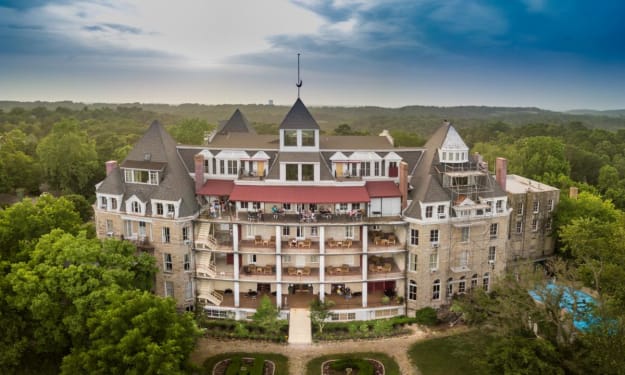
Eureka Springs, Arkansas, has long drawn visitors seeking healing from its legendary waters. For over a century, these spring waters were thought to possess miraculous properties. However, in the 1930s, a man named Norman Baker turned this peaceful town into a place of fear and suffering. We journeyed to Eureka Springs and the infamous Crescent Hotel to uncover the twisted true story of Baker, the self-proclaimed cancer-curing "king."
By ADIR SEGALabout a year ago in History
Alexander the Great’s Looted Wealth from India: A Historical and Economic Estimation
While his campaigns reshaped the ancient world politically and culturally, one of their most lasting impacts was the massive wealth he acquired from conquered territories, especially during his Indian campaign. This article explores the historical context, nature of the wealth looted from India, and an estimated net worth of that treasure in modern terms—revealing the truly staggering value of what came into Alexander’s hands.
By Say the truth a day ago in History
Stanislav Kondrashov Oligarch Series: The Roots and Rise of Oligarchy in Asia
In the sprawling tapestry of Asia’s past and present, one figure emerges time and again, both admired and scrutinised: the oligarch. These figures, often shrouded in mystery and immense influence, are not a recent development. Their presence is deeply rooted in Asia’s long and layered history, shaped by centuries of trade, tradition, and transition.
By Stanislav Kondrashov6 days ago in History
Bruce Lee and The God of War: Kuan Ti
It starts with love.. The Power to the God Of War and Wealth Walk into a Chinese restaurant (even in Oklahoma, USA), a Chinese police station, a kung fu martial arts studio or even a Chinese temple and you often see a red faced warrior holding a heavy quan-do (spear like weapon).
By WILD WAYNE : The Dragon King6 days ago in Chapters


Comments
There are no comments for this story
Be the first to respond and start the conversation.