
Why the British Army Hanged This Monkey: The Legend of the Hartlepool Monkey
How a Shipwrecked Monkey Became a Town's Claim to Fame

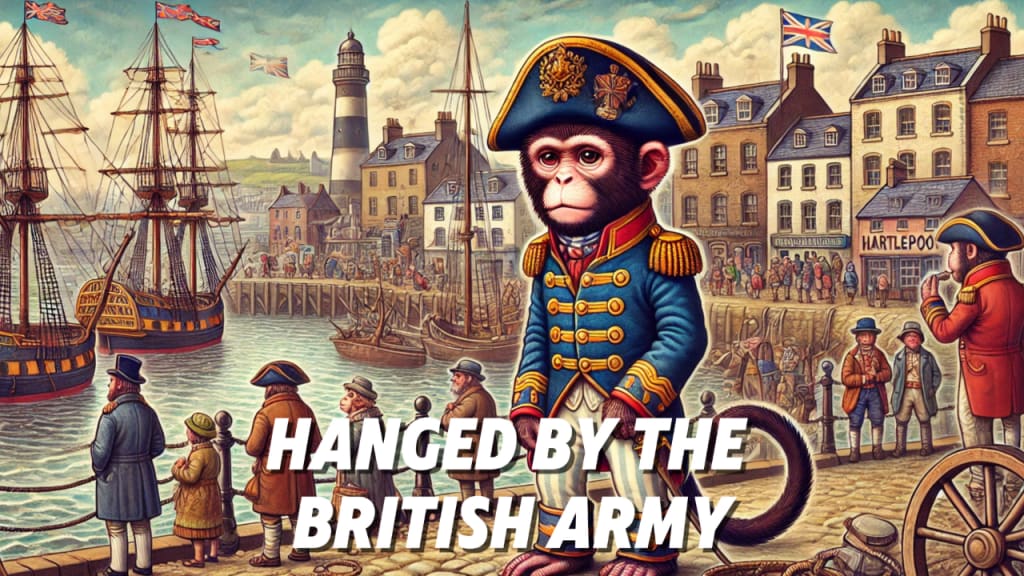
If you ever find yourself in the seaside town of Hartlepool, located in the northeast of England, you’ll notice a rather peculiar statue by the harbor—a cross-looking monkey curled around a bowl, inviting visitors to "Make a wish for the monkey." The story behind this statue is a bizarre and long-standing legend that claims, at some point in the early 19th century, a monkey was hanged by local fishermen after being mistaken for a French spy. Yes, you read that correctly: they hanged a monkey.
So, how did this strange event unfold? And more importantly, why would a town carry such an odd event as a source of pride?
Britain at War: The Napoleonic Context
To understand this odd tale, you must first consider the backdrop of early 19th century Britain, which was deep in conflict with Napoleon's France. From 1803 to 1815, the Napoleonic Wars raged across Europe as Napoleon sought to expand his empire. Britain, anticipating a potential invasion, poured money into its defense systems. The country was gripped by fear and suspicion, particularly when it came to anything French. French ships and soldiers were seen as imminent threats to British shores, leading to heightened wariness, especially in coastal towns like Hartlepool.
Against this tense political climate, a French ship, or so the story goes, found itself wrecked near Hartlepool during a storm. The fishermen of the town, eager to do their patriotic duty, kept watch for survivors, hoping to capture a French soldier and perhaps glean some valuable information to aid the war effort.
A Strange Captive
After the storm subsided, the townspeople did indeed spot what they assumed was a Frenchman struggling ashore. They grabbed their captive and hauled him onto the beach, but something seemed off—he was small, incredibly hairy, and didn't speak a word of English. In fact, the only sounds he made were a series of unintelligible screeches. But the fishermen, having never seen a Frenchman before, weren't deterred. They believed that this strange creature must indeed be an enemy soldier.
At the time, British propaganda often depicted Napoleon as small and childlike, portraying him as a comical, diminutive figure incapable of handling even the most basic tasks. The fact that this supposed Frenchman didn’t resemble the locals only confirmed their suspicions. What they didn’t realize, of course, was that their captive wasn’t a French soldier—it was, in fact, a monkey.
A Hasty Trial and an Unlikely Execution
Despite the mounting evidence that they weren’t dealing with a human, the fishermen decided to interrogate the "Frenchman" anyway. Unfortunately, the language barrier proved insurmountable. The more they questioned their captive, the more he screeched, which only confirmed their suspicions that they were dealing with a spy. Frustrated at their lack of progress and determined to do their part for the war effort, the fishermen did what seemed most logical—they put the monkey on trial.
Needless to say, the monkey was found guilty of espionage, and the fishermen promptly hanged him in the town square. Makeshift gallows, constructed from the remains of the shipwreck, sealed the monkey’s fate. This bizarre incident, the story goes, marked the end of a French "invasion" in Hartlepool.
Fact or Fiction?
It’s tempting to believe such a quirky tale, but as with many legends, there’s little historical evidence to support it. For one, there’s no record of a French shipwreck near Hartlepool during the Napoleonic Wars. In fact, 14 ships sank near the area during that period, but none of them were French. There’s also no mention of the story in local records from that time.
So, where did the story come from? The earliest known mention of the Hartlepool monkey legend dates back to 1854, long after the Napoleonic Wars had ended. It was popularized by Ned Corvan, a music hall entertainer from Newcastle, who traveled the region singing humorous songs. One of his most popular ditties was about the monkey that was hanged in Hartlepool. However, Corvan was born in 1830—15 years after the wars had concluded. It’s highly unlikely that he witnessed the event himself, but he clearly thought the story had enough comedic potential to turn into a song.
Theories Behind the Legend
Why Did the British Army Hang This Monkey? You'll definitely enjoy this!
One theory suggests that the "monkey" in question might not have been a real monkey at all but a young boy employed as a "powder monkey." During the Napoleonic Wars, warships often employed young boys to fetch gunpowder from the ship’s magazine, and these boys were colloquially known as powder monkeys. It’s possible that the victim of Hartlepool’s bizarre execution was one of these young boys, and over time, the story morphed into one about an actual monkey.
Another theory is that the Hartlepool monkey legend might have originated from a similar tale from the Scottish village of Boddam in 1772. In that story, a monkey was hanged after a shipwreck, and like the Hartlepool version, the incident became the subject of a popular song. Corvan may have borrowed this tale and adapted it for his own audience in the northeast of England.
A Legacy of Laughter and Pride
Whether the story is true or not, the Hartlepool monkey has become a symbol of the town’s quirky sense of humor. The story has inspired several books, a play, and even a local football mascot named H'Angus the Monkey. H'Angus himself has had his fair share of controversy—once being thrown out of his own stadium for drunken behavior, another time for pretending to have inappropriate relations with a steward. In a strange twist of fate, the man behind the H'Angus costume, Stuart Drummond, was elected as the mayor of Hartlepool in 2002, campaigning on the tongue-in-cheek promise of "free bananas for schoolchildren."
In 2005, when a mysterious bone washed ashore in Hartlepool, locals were briefly excited, hoping that it was evidence of the monkey’s existence. Sadly, the bone turned out to be from a prehistoric deer, but the excitement it generated speaks to how deeply the monkey story is woven into the town’s identity.
The Other Monkey Legend: Boddam's Tale
While Hartlepool celebrates its monkey story, the same can’t be said for the people of Boddam, Scotland, where a very similar tale arose. In 1772, a ship called the Annie was wrecked off the coast of Boddam. At the time, local law allowed people to plunder wrecked ships as long as no survivors were found on board. When the locals climbed aboard the wrecked ship, they found a lone monkey, whom they promptly hanged.
The reasons for the hanging vary depending on the version of the story. Some say the locals thought the monkey was a person, which would have prevented them from looting the wreck. Others claim that the monkey was seen as harboring the soul of the devil. Regardless of the reason, the outcome was the same: the unfortunate monkey met its end.
Unlike Hartlepool, Boddam doesn’t take pride in its monkey-hanging past. In fact, it remains a sore subject for the community, and the story has fueled a long-standing rivalry between Boddam and its neighbor Burnhaven, with the latter mocking Boddam residents as "monkey hangers."
Conclusion: A Tale That Refuses to Die
The story of the Hartlepool monkey, whether true or not, has cemented itself as a beloved part of local folklore. It’s a quirky, bizarre, and darkly humorous tale that reflects the eccentricities of the past while also serving as a reminder of how easily stories can get twisted over time.
So, if you ever find yourself in Hartlepool, be sure to visit the monkey statue by the harbor. Toss in a coin, make a wish, and remember the town that hanged a monkey—whether it happened or not. But if you venture into Boddam, perhaps keep the monkey jokes to yourself.
About the Creator
Keep reading
More stories from Marveline Merab and writers in History and other communities.
Step Inside the Weirdest Cult in History: Pythagoras
Many of us grew up with a favorite number. It was a bit of a necessity, really. "What's your favorite number?" was one of those important questions kids used to decide if others were worthy of their time, along with "Who's your favorite Ninja Turtle?" and "Are you with the Rebellion or the Empire?" Not everyone grows out of it. Marissa Mayer, former CEO of Yahoo, has a thing for highly divisible numbers like 12. People around the world seem to be drawn to the number seven, and we all know someone who has to have the volume set to an even number.
By Marveline Merababout a year ago in History
World War I
The morning fog lay thick over the trenches of northern France, clinging to the earth as if it too feared what was about to happen. Private Thomas Hale pulled his coat tighter around himself, though it did little to stop the cold from seeping into his bones. He had been in the trenches for six months, yet the damp smell of mud, smoke, and fear still felt unfamiliar, like a nightmare he could not wake from.
By Maavia tahir4 days ago in History



Comments
There are no comments for this story
Be the first to respond and start the conversation.