
Step Inside the Weirdest Cult in History: Pythagoras
The Mathematical Mystic of Ancient Greece

Many of us grew up with a favorite number. It was a bit of a necessity, really. "What's your favorite number?" was one of those important questions kids used to decide if others were worthy of their time, along with "Who's your favorite Ninja Turtle?" and "Are you with the Rebellion or the Empire?" Not everyone grows out of it. Marissa Mayer, former CEO of Yahoo, has a thing for highly divisible numbers like 12. People around the world seem to be drawn to the number seven, and we all know someone who has to have the volume set to an even number.
But when it comes to forming an unhealthily strong attachment to numbers, few have taken it quite as far as the ancient Greek philosopher Pythagoras. You’ll probably recognize his name from those excruciatingly dull math lessons of your childhood. Let’s dig those painful memories back up for you.
Pythagoras’s theorem states that if you take a right-angled triangle, square its two shorter sides, and add the results together, the answer will equal the square of the longest side, the hypotenuse. Or, expressed with algebra: 𝑎2+𝑏2=𝑐2. Funnily enough, it turns out this simple equation, undoubtedly one of the most famous in the whole of mathematics, wasn’t actually discovered by Pythagoras at all. In fact, it was in use in ancient Babylon a good thousand years or so before Pythagoras was born.
The Mystery of Pythagoras’s Fame
How exactly Pythagoras’s name came to be inextricably associated with a theorem that was already ancient when he was born is unknown. What’s also unknown are many of the details about Pythagoras’s life, and that’s a shame because what we do know is downright bizarre. You see, Pythagoras, it turns out, was the leader of a strange cult that worshipped numbers and had some extremely weird practices. So without further ado, let’s explore what they didn’t tell you in math class.
Born on the beautiful Greek island of Samos, known for its talented engineers and lively festivals, Pythagoras was fascinated with mathematics and astronomy from a young age. He studied under several well-respected scholars, one of whom, a wise old man by the name of Thales, encouraged him to pack up his things and head to Egypt, which was apparently the place to be for anyone who wanted to learn about life, the universe, and everything.
Pythagoras must have really liked Egypt because he spent the next two decades of his life there. He kept himself busy by learning to speak Egyptian, visiting temples, and having lengthy, profound conversations with local priests about the best way to achieve spiritual purity. After Egypt was invaded by the Persians, Pythagoras was taken to Babylon as a prisoner of war, where he happily hung out with a bunch of occult astrology priests known as the Magi. He was instructed in their sacred rites, learned about their mystical worship of the gods, and basically became what can be best described as a mathematics wizard.
Escape and Establishment
We don’t really know how Pythagoras escaped the Babylonians. Perhaps he simply smote them down with bolts of concentrated math lightning. But whether weaponized math was involved or not, he returned to Samos around 520 BC. Once back in his hometown, he formed a school called the Semicircle (I’m guessing this was before he discovered his deep love of triangles), which became the place to discuss justice, goodness, and all those other concepts the ancient Greeks enjoyed philosophizing about.
Pythagoras himself, however, preferred to spend his time alone in his man cave outside the city. After a couple of years in Samos, Pythagoras moved once again, this time to Croton in Southern Italy. There, he used his charisma and charm to climb the political ladder and eventually serve as an advisor to the elite. The local authorities were so impressed with his intellect that they asked him to set up a school and pass on his immense learning to the young people of Croton. But when they said "school," what Pythagoras apparently heard was "crazy religious math cult."
The Pythagorean Cult
His students, who came to be known as Pythagoreans, developed some of the strangest practices in history. To gain entry to Pythagoras’s cult (sorry, school), you couldn’t just rock up and take a seat somewhere at the back. You had to undertake a three-year probation period. During this time, you’d be judged on everything from how you responded to criticism to the way you laughed. You’d also be tested on your memory, concentration, and speed of thought.
Once you were in the triangle club, there was a strict hierarchy. Members were divided into the Acousamatikoi, or listeners, and the Mathematicoi, or learners. The listeners formed the outer circle and focused on the spiritual teachings. They also had to take a five-year vow of silence. Yep, five friggin’ years during which they’d listen to Pythagoras deliver his sermons from behind a veil. I’m guessing this wasn’t because Pythagoras was just really shy; it was probably to create a sense of mystique for his eager newbies.
The learners formed the inner circle, and it was their job to progress the intellectual discoveries of the group. To access this elite faction, you had to give up all your possessions and live with other learners. This kind of sacrifice is still common among cults today. The members of the People’s Temple, a cult in which over 900 people took part in a mass suicide in Guyana in the late '70s, for example, were required to give up their belongings and homes.
At the very top of this hierarchy, of course, was Pythagoras himself. And what a ruler he was! Cult leaders often make outlandish claims about their gifts and abilities. The leader of the People’s Temple, Jim Jones, claimed he could heal people, and Charles Manson claimed to have invented God. But none have managed to live up to Pythagoras. According to legend, he could speak to animals, had a thigh made of gold (who doesn’t want one of those?), could remember previous lives, and was a demi-god, supposedly the son of Apollo. He could also predict earthquakes, stop the wind blowing, and calm the sea’s waves. So just generally a very useful guy to have around!
The Pythagorean Rules
Step Inside the Weirdest Cult in History. You'll definitely enjoy this!
Pythagoras set some very strict rules for his followers, some of which made a lot of sense, such as exercising and not eating food that’s fallen on the floor. My sources were unclear on how he felt about the three-second rule. Others were more restrictive, like living an austere lifestyle and having a vegetarian diet. But then it all starts to get a little weird—well, weirder.
To be a true Pythagorean, you had to avoid public roads, you couldn’t pee towards the sun, you had to wear white clothes, and you had to take your right shoe off before you left. You were forbidden from sharing these secrets of the cult with any outsiders, and perhaps to prevent those same outsiders from coming too close, you were encouraged not to wash. You couldn’t break bread at the table because bread stood for friendship, and the biggest sin of all—to eat a fava bean—was utterly unforgivable because the beans were closely associated with reincarnation. Basically, the Pythagoreans believed that fava beans contained the souls of their dead ancestors, and so eating one was akin to cannibalism and absolutely prohibited. Yes, even with some liver and a nice Chianti.
They also had to practice abstinence. Which, let’s be honest, probably wasn’t the biggest challenge for members of a math cult. Pythagoras believed that when we eject our various bodily fluids and gases, we lose part of our soul. So sex was off the cards, as was letting one rip. Though I should point out, it seems Pythagoras himself didn’t always follow this rule since he supposedly had several children with a lady from Crete.
Core Beliefs: Spiritual Salvation and Knowledge
So we know that getting into the group was challenging to say the least, and their way of living was a little eccentric. But what was it all for? What did the Pythagoreans actually believe in? Well, we can split their beliefs into two main tenets: the pursuit of spiritual salvation and the pursuit of knowledge.
At the core of the spiritual tenet was metempsychosis, or the transmigration of souls. The Pythagoreans believed that after we die, our souls live on and enter a new body—presumably one that isn’t already occupied, or things could get a little awkward. The ultimate goal, similar to Buddhism, was to escape the endless cycle of reincarnations and gain true immortality. To achieve this, Pythagoreans aimed to keep their bodies morally pure through rigorous self-discipline.
This leads us to the second tenet: the pursuit of knowledge. The study of the cosmic order would allow Pythagoreans to reach ultimate union with the divine cosmos. Things like philosophy and music were seen as means to purify the spirit and come closer to the gods. And out of all the ancient Greek gods, which do you think the Pythagoreans worshiped? Was it Apollo, the widely revered god of music and poetry, or perhaps Athena, the watchful and intelligent goddess of wisdom? No, it was ten—not a god called ten, but the number ten.
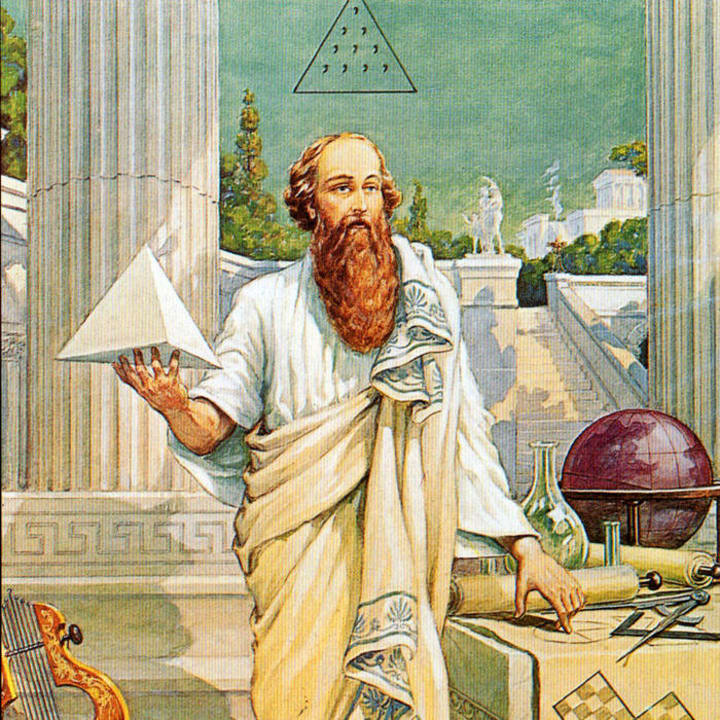
You see, Pythagoreans believed that reality was based on mathematical principles. To them, numbers represented a cosmic order and perfection that governed everything in existence. They were able to find this idea expressed in the Tetractys, a triangular figure made up of ten points arranged in four rows. The Tetractys held great significance for them and represented their quest for knowledge and understanding.
The Pythagorean Legacy
So what’s left of Pythagoras today? While many of his teachings are long lost, we can still see their influence all around us. Pythagorean ideas permeated the world of ancient Greece and later inspired the work of philosophers like Plato and Aristotle, who kept the flame of mathematical philosophy alive for centuries.
But what’s perhaps even more astonishing is that a math cult from ancient Greece can still be felt in today’s society. Look around at the countless people who believe in numerology—the mystical significance of numbers—who see the number 7 as a lucky charm or associate certain numbers with good fortune. So if you want to delve into the world of ancient Greece, you might want to grab a calculator and start counting!
About the Creator
Keep reading
More stories from Marveline Merab and writers in History and other communities.
The Psychopath Who Invented Your Breakfast: Dr. John Harvey Kellogg
In the early 1900s, if you were an affluent American suffering from health issues, you might have considered a stay at the world-famous Battle Creek Sanitarium, often called "the San." Located in Michigan, the San sprawled across 30 acres and promised a cool and delightful summer resting place. Walking through its gates, guests were greeted by the Latin phrase mens sana in corpore sano—a healthy mind in a healthy body—etched into the entrance. They would find people sunbathing in the gardens or strolling through the picturesque woods, and inside, the lobby boasted fine furniture, crystal chandeliers, and plush Persian rugs. However, among the tranquility, guests might also hear an occasional scream from a distant treatment room—but more on that later.
By Marveline Merababout a year ago in History
Rajendra Chola I and the Conquest of the Ganga: A Monumental Feat in Indian History
Known as the “Gangaikonda Chola” (the Chola who conquered the Ganga), Rajendra transformed a South Indian maritime empire into a pan-Indian power whose influence stretched from the Indian Ocean to the heart of the subcontinent. This campaign was not merely a military raid but a bold statement of imperial ambition, strategic brilliance, and cultural confidence.
By Say the truth 2 days ago in History



Comments
There are no comments for this story
Be the first to respond and start the conversation.