
Why Did This Billionaire Go Insane? The Tragic Story of Howard Hughes
How a Brilliant Billionaire Lost His Mind

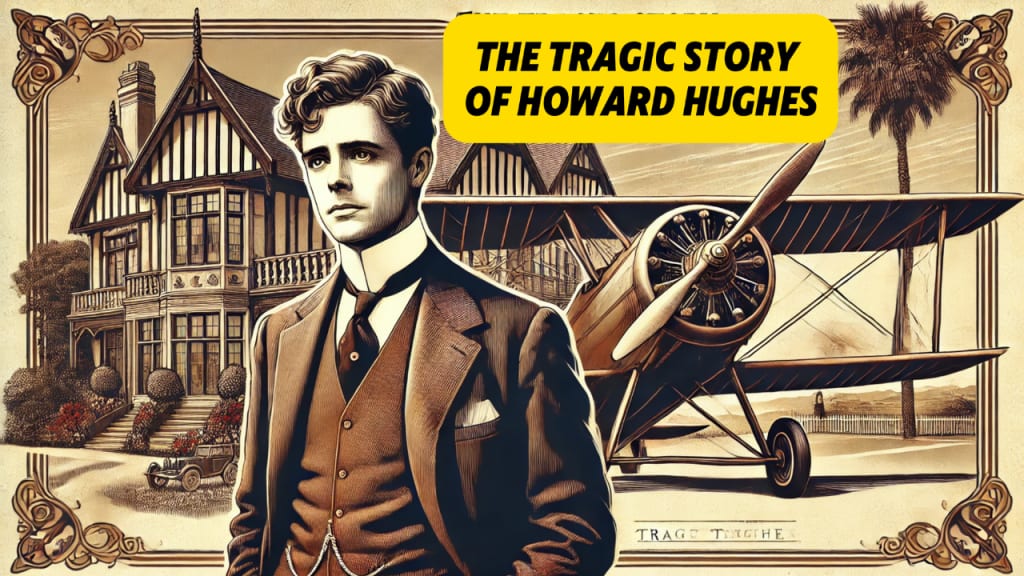
Howard Hughes Jr., a man once hailed as one of the most brilliant and eccentric billionaires in history, lived a life marked by both great achievement and overwhelming personal tragedy. From his early days of inventive genius and entrepreneurial prowess to his slow descent into isolation and mental illness, the story of Howard Hughes is one of the most fascinating tales of success, wealth, and eventual madness.
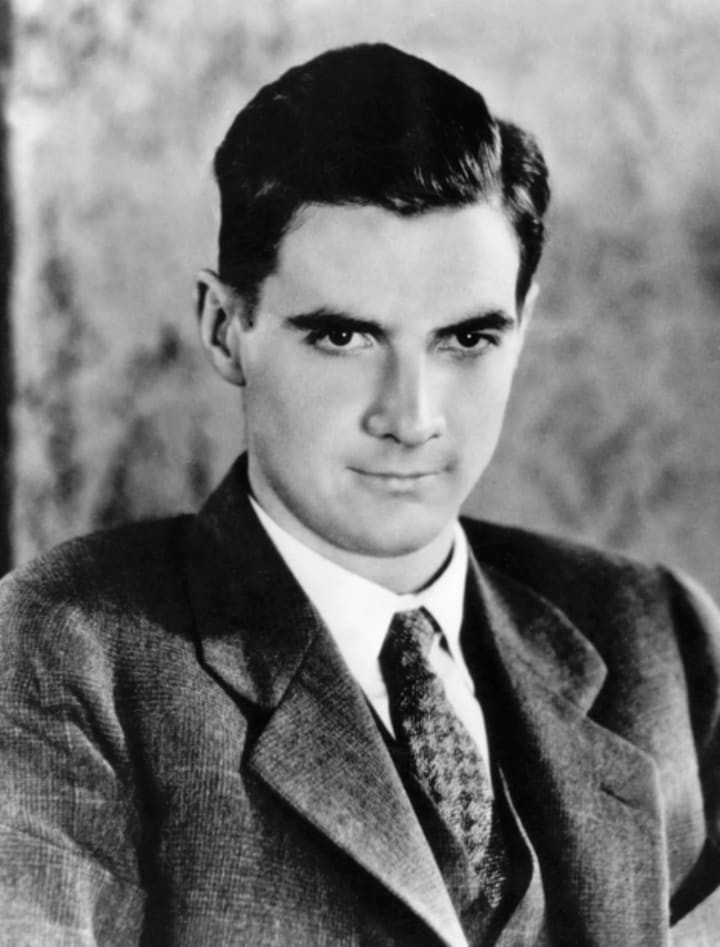
Early Life: The Inheritance of Wealth and Genius
Born in 1905 in Houston, Texas, Howard Hughes Jr. was destined for greatness from the start. His father, Howard Hughes Sr., was a wealthy inventor and businessman who made his fortune by patenting a revolutionary two-cone rotary drill bit that forever changed the oil industry. Hughes Sr.’s invention was instrumental during the Texas oil boom, and it was practically a license to print money. This wealth meant that young Howard grew up surrounded by luxury and opportunity, but it wasn’t long before he proved that he was more than just a privileged child.
At just 12 years old, Hughes Jr. demonstrated his impressive engineering prowess by inventing what the local Houston papers called the first “motorized bicycle” in the area. Using parts from a steam engine, he added them to his bicycle—a clear sign that this boy was no ordinary child. While most kids his age were playing outside or attending school, Hughes was busy tinkering with machines, a passion that would guide him for the rest of his life.
Despite his talents, Hughes wasn’t much of a student. His academic career was less than stellar, but he thrived in other areas, especially golf and his newfound love: aviation. After boarding an airplane for the first time, Hughes fell in love with flying, a passion that would shape his destiny.
A Fortune Lost, A Fortune Gained: The Tragic Loss of His Parents
The good times in Howard Hughes’ life were soon overshadowed by personal tragedy. When he was just 16, his mother died during pregnancy, and only two years later, his father passed away from a heart attack. Suddenly, Hughes was an orphan at just 18 years old. He inherited 75% of his father’s million-dollar estate—over $16 million in today’s money—and gained control over the Hughes Tool Company.
Though he was young, Hughes displayed his business acumen early on. After a dispute with his relatives over the company’s management, he took legal action and was declared an emancipated minor at the age of 19. He then bought out his relatives and assumed full control of the company. This move set the tone for the rest of his life, showing that Hughes was not only brilliant but also determined to forge his own path, no matter the cost.
The Hollywood Dream: Success, Death, and a Near-Fatal Accident
After gaining control of Hughes Tool Company, Howard Hughes was not content with being just a businessman. He sought new adventures and relocated to Los Angeles to pursue his passions: filmmaking and aviation.
His first filmmaking venture was a disaster, so much so that Hughes ordered every print of the short film destroyed. However, his luck soon changed. In 1930, he produced Hell’s Angels, a film about World War I flying aces. The production was nothing short of epic, with real-life dogfights filmed without regard for modern safety protocols. Tragically, three stunt pilots and a mechanic lost their lives during filming, and Hughes himself suffered a near-fatal accident while performing a dangerous stunt. Despite fracturing his skull in the crash, he continued his pursuit of both aviation and filmmaking with even greater vigor.
Aviation Pioneer: Breaking Records and Building Empires
Why Did This Billionaire Go Insane? You'll definitely enjoy this!
Hughes' obsession with aviation would see him break world records and oversee groundbreaking developments in aircraft engineering. In 1934, he founded the Hughes Aircraft Company, which produced experimental planes that he personally tested. In 1935, he set a world landplane speed record while flying his Hughes H-1 Racer, though he once again crash-landed during the flight. Remarkably, he walked away with just a few cuts and scrapes.
One of his most ambitious projects was the H-4 Hercules, a massive seaplane that became known as the "Spruce Goose." To this day, it remains the largest seaplane ever built, though it was only flown once.
During this period, Hughes became a larger-than-life figure. Tall, handsome, and incredibly wealthy, he embodied the spirit of adventure and innovation. His dashing persona was even the inspiration for the Marvel superhero Tony Stark, better known as Iron Man.
A Life of Glamour: The Golden Age of Hollywood
In addition to his aviation accomplishments, Hughes became a notable figure in Hollywood during the 1930s and 1940s. His good looks, wealth, and charisma made him a magnet for some of the most famous actresses of the time. He dated stars like Katherine Hepburn, Ava Gardner, Joan Crawford, and Ginger Rogers. Despite his playboy image, Hughes had a complex relationship with fame and public attention, often shying away from the spotlight despite his high-profile romances.
His first marriage, to Ella Rice, ended in divorce after just four years, but it would not be his last. In 1957, he married his second wife, actress Jean Peters, although their marriage was marred by Hughes’ increasing isolation and erratic behavior.
Mental Decline: A Billionaire’s Descent into Madness
While Hughes’ business empire continued to expand, his personal life began to unravel. His eccentricities, which had long been apparent, began to take over his life. Hughes suffered from obsessive-compulsive disorder (OCD) and a crippling fear of germs. His wealth allowed him to indulge these compulsions in ways that most people could never imagine.
At one point, he stayed in a darkened film studio for four months, rarely wearing clothes and subsisting on a diet of chocolate bars and chicken. He spent hours watching the same films over and over again, surrounded by tissue boxes that he constantly rearranged. His fear of germs became so severe that he would often burn his clothes if he believed they had been contaminated. Hughes washed his hands to the point where they bled and eventually stopped wearing clothes altogether because he found them physically painful.
In 1966, Hughes moved to Las Vegas, where he lived in the penthouse of the Desert Inn. He bought out the hotel after staying there for a year without ever leaving. Over the next two years, he went on a buying spree, acquiring several hotels and casinos in Las Vegas. His wealth and influence in the city grew, but so did his reclusiveness.
By the 1970s, Hughes had become almost completely isolated. His second wife, Jean Peters, filed for divorce after years of only communicating with her husband via telephone. He rarely cut his hair, beard, or nails, and his mental and physical health deteriorated rapidly. When he died in 1976, Hughes was unrecognizable, so much so that the FBI had to use fingerprints to confirm his identity.
Conclusion: The High Cost of Wealth and Genius
Howard Hughes lived a life of unimaginable wealth and achievement, but his story is also a cautionary tale. Despite his many accomplishments in aviation, filmmaking, and business, Hughes’ life was ultimately overshadowed by his mental illness and isolation. His tragic descent into madness serves as a reminder that no amount of money or success can protect against the frailties of the human mind.
In the end, Howard Hughes’ life is a testament to both the brilliance and the vulnerability of one of history’s most remarkable men. His legacy continues to inspire and caution those who pursue greatness at any cost.
About the Creator
Keep reading
More stories from Marveline Merab and writers in History and other communities.
There Might Have Been Another Race Before Humans: The Forgotten Story of Advanced Prehistoric Civilizations
In a world where the internet connects billions and spreads ideas at the speed of light, one topic that continues to intrigue and spark curiosity is the possibility that an advanced civilization existed on Earth long before humans. Could there have been an intelligent race that left behind no trace, their achievements buried under the weight of geological time? This article explores that question, inspired by the speculative "Soran Hypothesis," and reveals what modern science has uncovered about the hidden history of our planet.
By Marveline Merababout a year ago in History
Can the United States Leave NATO?
Can the United States Leave NATO? What It Would Take—and What It Would Mean The North Atlantic Treaty Organization, commonly known as NATO, has been one of the most powerful military alliances in modern history. Since its creation in 1949, the United States has been NATO’s strongest member—militarily, financially, and politically. But in recent years, debates have grown louder about whether the U.S. should remain in the alliance. This raises a serious question: how could the United States be removed from NATO—or leave it—and what would that mean for the world?
By Wings of Time 7 days ago in History




Comments
There are no comments for this story
Be the first to respond and start the conversation.