
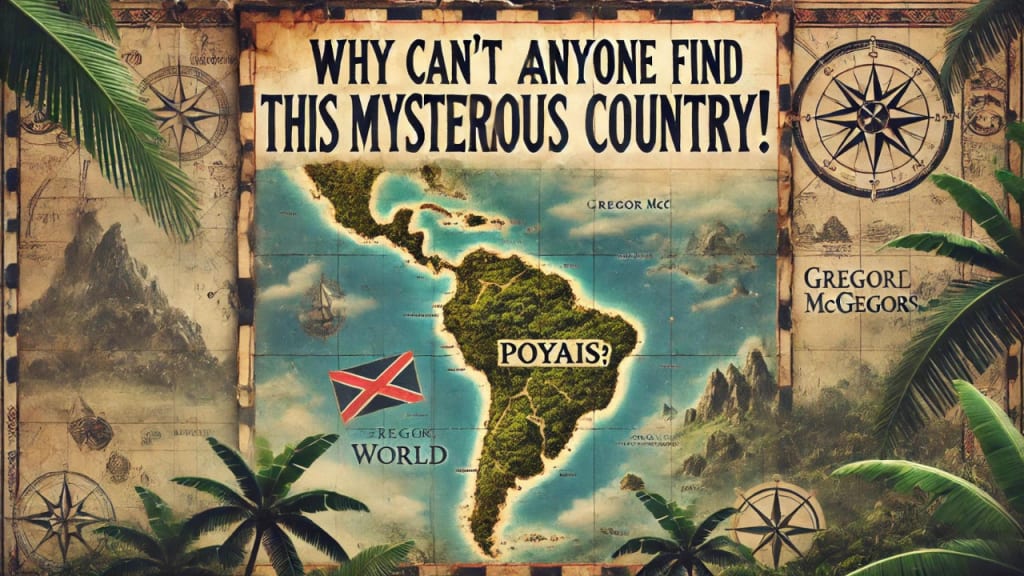
Why Can't Anyone Find This Mysterious Country? The Great Gregor McGregor's Poyais
The Conman Who Sold a Fictional Country and Crashed the Stock Market

If you happened to be living in London in May 1821, you would have witnessed something strange: a flurry of unseasonably late snow on the 27th. Considering it was almost summer, such miserable weather could easily dampen spirits. But what I’m about to tell you isn’t a weather forecast from two centuries ago. No, I’m actually using a technique known as pathetic fallacy. By attributing human emotions (in this case, misery) to non-human elements like the weather, we can reflect the gloomy feelings of the people of London.
But why, you might ask, were the people of London feeling so down? The answer lies in the aftermath of 20 years of conflict in continental Europe, including the Napoleonic Wars and the Battle of Waterloo. The British economy, much like the dreary weather, was depressed. For the privileged classes of early 19th century England, there was little to look forward to besides raising a few glasses of brandy at the coronation of King George IV in July 1821.
Enter General Gregor McGregor, an exotic character who arrived in town just in time to lift the gloom, at least temporarily. McGregor introduced himself as the “Cazique” or prince of a far-off land called Poyais, a bountiful paradise in Central America. The name may not ring a bell, but don’t worry, neither had anyone else heard of it.
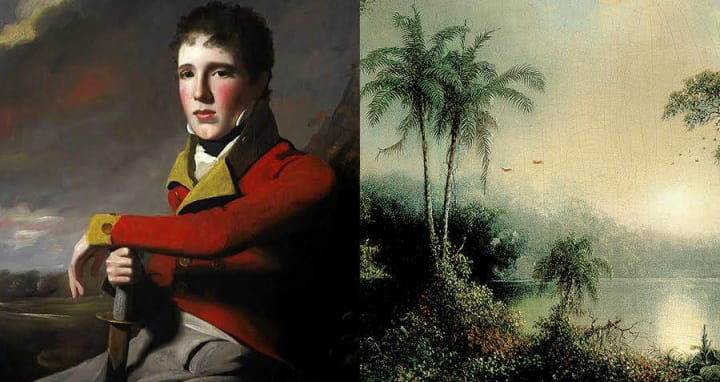
According to McGregor, Poyais was a tropical utopia where the rivers sparkled with gold and silver, crops like maize could be harvested three times a year instead of twice, and hunting or fishing for just one day could provide a family with food for a week. As if that wasn’t enough, Poyais boasted a fully functional democracy, a civil service, a military, and a thriving capital city named Saint Joseph, complete with grand boulevards and an opera house. McGregor even claimed that his government was seeking investors for what he called “the opportunity of a lifetime.”
If this all sounds too good to be true, congratulations—you’re likely not from the 19th century. But back then, the world was far more innocent, and McGregor’s tale of paradise found plenty of believers. Hundreds of investors and settlers staked their fortunes on McGregor’s grand vision of an undiscovered utopia. Sadly, they would soon discover the harsh truth.
A Man Born for Deception
Before we dive into the details of this audacious scam, let’s rewind a bit and look at Gregor McGregor himself, the man who orchestrated one of the boldest cons in history. McGregor was born on Christmas Eve in 1786 to a distinguished Scottish family. His father was a sea captain in the East India Company, and his ancestors included notable military figures like Rob Roy, the legendary Scottish rebel.
With such a lineage, it was no surprise that young Gregor was drawn to military life. At the age of 16, he joined the British Army, but not in the way you might expect. His family purchased him an officer’s commission, a common practice at the time that allowed well-connected young men to skip the hard work and simply buy their way into positions of leadership.
Despite lacking real experience, McGregor quickly rose through the ranks, reaching the position of lieutenant within just a year. He seemed to be on the fast track to military and social success, and at 19, he married Maria Bowater, the daughter of an admiral. With his new wealth and connections, McGregor purchased yet another promotion—this time to the rank of captain.
But McGregor wasn’t satisfied with playing the traditional game of climbing military ranks. He wanted more—much more. After a brief stint in the army during the Peninsular War, McGregor left and tried to reinvent himself as a man of importance in Scottish high society. Claiming to be a decorated war hero, McGregor settled in Edinburgh. Unfortunately, the city didn’t buy his lies, and after being shunned by the elites, he and his wife returned to London.
Soon after, Maria passed away, leaving McGregor without his primary source of income. Desperate to maintain the lifestyle he’d become accustomed to, McGregor decided it was time to reinvent himself yet again—this time in the New World.
The Rise of a “Hero”
In the early 19th century, wars of independence were being fought all across South America, and McGregor saw an opportunity. He set sail for Venezuela, where he introduced himself to General Francisco de Miranda, one of the leaders of the rebellion against Spanish rule. Naturally, McGregor inflated his credentials, claiming to be a colonel in the British Army. Eager to welcome any experienced military leader, Miranda immediately gave him command of a cavalry battalion.
Despite his lack of true experience, McGregor did show some natural talent for leadership and bravery. He was promoted to brigadier general and married Josephina, the cousin of the legendary revolutionary Simon Bolivar. His marriage certainly helped his career as McGregor continued to rise in prominence, eventually becoming a general of division in the armies of Venezuela and New Granada.
One of his greatest military successes was leading a retreat across Venezuela, outsmarting two royalist armies in the process. This feat earned him fame and a reputation as a skilled leader. However, as the South American wars of independence dragged on, McGregor’s fortune began to wane, and by 1820, he was in need of yet another reinvention.
The Conman Prince of Poyais
Why Can't Anyone Find This Mysterious Country? You'll definitely enjoy this!
McGregor’s next move was nothing short of genius in its audacity. He sailed to the Mosquito Coast, a remote area along modern-day Honduras and Nicaragua. After some negotiations involving rum and trinkets, McGregor “purchased” 8 million acres of worthless land from the local ruler, King George Frederick Augustus. But where others saw jungle and inhospitable terrain, McGregor saw an opportunity to spin a grand narrative.
By the time McGregor returned to London in 1821, he had transformed himself into the “Prince of Poyais,” ruler of a tropical utopia. He claimed that Poyais was a land of unparalleled natural beauty and wealth, where gold and silver littered the riverbeds, crops grew in abundance, and the people lived in democratic harmony.
To pull off his scam, McGregor went all out. He opened “consulates” for Poyais across Britain, printed his own currency, created a flag, and even designed military uniforms for his imaginary army. He gave interviews to newspapers, hired singers to promote his fake kingdom, and wrote a guidebook under the pseudonym “Captain Thomas Strangeways,” complete with illustrations of this fantasy world.
It worked. Investors bought up Poyaisian government bonds and land shares in droves. Ordinary families sold everything they had to buy a piece of this so-called paradise, and many even exchanged their pounds for McGregor’s worthless Poyais dollars. Seven ships were commissioned to carry settlers to this non-existent land, and on September 10, 1822, the first group set sail on the Honduras Packet.
The Unraveling of a Dream
When the settlers arrived in Poyais two months later, they quickly realized that something was horribly wrong. There was no bustling capital city, no government officials to greet them, and certainly no fields of gold. Instead, they found nothing but dense jungle and a few scattered huts.
Despite the settlers’ best efforts to make the most of the situation, life in the Poyais colony soon turned into a nightmare. Torrential rains brought disease, and many of the settlers succumbed to illness. Violence and suicide became common as hopelessness set in. Eventually, a passing British ship rescued the few survivors, while the remaining ships bound for Poyais were intercepted by the Royal Navy or turned back after seeing the grim situation for themselves.
McGregor, however, was long gone. By the time the settlers arrived back in London, he had fled to Paris, where he incredibly tried the same scam on the French. He raised even more money before French authorities grew suspicious, leading to his arrest. But McGregor, ever the survivor, managed to get himself acquitted and returned to Britain, where he continued to sell land in Central America on a much smaller scale.
Legacy of the Conman Prince
In the end, McGregor never faced real punishment for his actions. He eventually retired to Venezuela, where he was celebrated as a hero of the country’s independence movement, living out his final years on a military pension. He died in 1845 and received a full military burial, never paying for the lives he ruined or the economic havoc he caused.
McGregor’s scam didn’t just destroy individual fortunes; it contributed to the stock market crash of 1825, known as the Panic, the first modern financial crisis. Twelve banks collapsed, and even the Bank of England came close to ruin, all because of a country that never existed.
Though Gregor McGregor has been dead for over 170 years, his legacy lives on. His story serves as a cautionary tale about the power of deception and the devastating consequences it can have on innocent lives.
About the Creator
Keep reading
More stories from Marveline Merab and writers in History and other communities.
Solve This Riddle to Unlock Millions: The Beale Ciphers
Do these numbers mean anything to you? If they do, congratulations—you’re potentially a millionaire! The world is filled with get-rich-quick schemes and promises of wealth from dubious sources, but few can match the allure of these mysterious numbers. Forget about ‘Nigerian Princes’ or tales of making a fortune online in three months. These numbers, if deciphered, could unlock a treasure estimated to be worth a staggering $93 million!
By Marveline Merababout a year ago in History
Is NATO Facing Its Biggest Crisis Yet?
Is NATO Facing Its Biggest Crisis Yet? For more than seventy years, NATO has been one of the strongest military alliances in the world. Formed after World War II, it was designed to protect its members through collective defense. An attack on one was considered an attack on all. For decades, this principle helped maintain stability in Europe and beyond. But today, NATO is facing one of the most challenging moments in its history.
By Wings of Time 6 days ago in History
Nobel Peace Prize
The Nobel Peace Prize has stood as one of the world’s most recognized honors. Awarded annually in Oslo, it is meant to celebrate individuals or organizations that have made significant contributions toward peace, diplomacy, and humanitarian progress. While its mission appears straightforward, the Nobel Peace Prize has never been free from debate. In recent years, conversations surrounding global politics—particularly discussions about the Trump Nobel Peace Prize—have brought renewed attention to how peace is defined, measured, and rewarded in the modern era. The Origins and Meaning of the Nobel Peace Prize The Nobel Peace Prize was established by Alfred Nobel, the Swedish inventor best known for creating dynamite. In his final will, Nobel directed that a portion of his wealth be used to recognize efforts that foster peace among nations, reduce standing armies, or promote diplomacy and cooperation. Since its first award in 1901, the prize has honored activists, diplomats, organizations, and world leaders whose actions shaped international dialogue. Unlike other Nobel categories, the peace prize is awarded by a Norwegian committee rather than a Swedish institution. This distinction reflects Nobel’s desire to separate the prize from national interests and focus instead on global responsibility. Over time, the definition of “peace” has expanded. Early recipients were often disarmament advocates or mediators. More recent laureates have included human rights defenders, climate activists, and international organizations working in conflict zones. Politics and the Nobel Peace Prize Despite its humanitarian ideals, the Nobel Peace Prize has always intersected with politics. Recognizing peace efforts often means evaluating political leadership, international negotiations, and long-term consequences—none of which are easy to measure in real time. Some awards have been widely celebrated, while others sparked controversy. Critics often argue that certain laureates were honored prematurely, before the lasting results of their actions became clear. Supporters counter that the prize is meant to encourage peace efforts, not merely reward completed achievements. This tension has made the Nobel Peace Prize a reflection of global priorities at any given moment, rather than a simple historical judgment. Donald Trump and Nobel Peace Prize Discussions Few modern political figures have generated as much debate in connection with the Nobel Peace Prize as Donald Trump. During and after his presidency, conversations about a potential Trump Nobel Prize emerged repeatedly, particularly among supporters who pointed to his role in diplomatic initiatives. The phrase Trump Nobel Peace Prize gained traction following agreements and negotiations in regions long marked by conflict. Advocates argued that these diplomatic efforts aligned with Alfred Nobel’s vision of reducing international tension through dialogue rather than force. At the same time, critics questioned whether these actions met the broader ethical and humanitarian standards traditionally associated with the award. They pointed to domestic divisions, foreign policy controversies, and unresolved global conflicts as reasons for skepticism. This divide highlights a core challenge of the Nobel Peace Prize: peace is rarely absolute, and political leadership is often complex and contradictory. Trump Nobel Peace Prize 2026: Speculation and Context As global politics continue to evolve, speculation around a Trump Nobel Peace Prize 2026 has appeared in media discussions and public commentary. It is important to note that nominations for the Nobel Peace Prize are confidential for decades, and speculation does not confirm consideration or selection. However, the mere discussion of Trump Nobel Peace Prize 2026 reflects how the award has become part of broader cultural and political conversations. Supporters view such recognition as validation of diplomatic achievements, while critics see the speculation as politicizing an institution meant to rise above partisan debate. This dynamic is not unique to Trump. Many past leaders, from various ideological backgrounds, were debated heavily before or after receiving the prize. The Nobel Peace Prize often mirrors global disagreements rather than resolving them. How the Nobel Committee Makes Its Decision Each year, hundreds of nominations are submitted by qualified individuals, including academics, lawmakers, and previous laureates. The Nobel Committee evaluates these nominations through research, expert consultation, and internal debate. The process considers intent, impact, and long-term significance. However, because peace efforts often unfold over years or decades, the committee must make decisions without full historical clarity. This reality explains why some awards age gracefully while others remain controversial. The committee rarely responds directly to public pressure or online campaigns. Media attention, including discussions around a Trump Nobel, does not guarantee influence over the final decision. The Broader Impact of the Nobel Peace Prize Beyond individual recipients, the Nobel Peace Prize plays a symbolic role. It brings global attention to issues that might otherwise be ignored, from humanitarian crises to fragile peace processes. Even controversial nominations can spark meaningful debate about what peace truly means in the modern world. The prize also raises questions about accountability. When leaders are considered for such recognition, the public is encouraged to examine policies, outcomes, and moral responsibility more closely. In this sense, discussions surrounding the Trump Nobel Peace Prize are not just about one individual. They reflect deeper conversations about diplomacy, leadership, and the evolving standards by which peace is judged. Conclusion: A Prize That Reflects the World The Nobel Peace Prize remains one of the most influential and debated honors in global society. Its power lies not only in recognizing peace efforts but also in challenging the world to think critically about conflict, cooperation, and responsibility. Whether discussions involve historic activists or modern political figures like those associated with Trump Nobel Peace Prize 2026 speculation, the award continues to reflect the complexities of international relations. Peace is rarely simple, and neither is the process of honoring it. Ultimately, the Nobel Peace Prize serves as a reminder that striving for peace is an ongoing journey—one shaped by ideals, actions, and the difficult choices that define human history.
By Saboor Brohi 2 days ago in History



Comments
There are no comments for this story
Be the first to respond and start the conversation.