
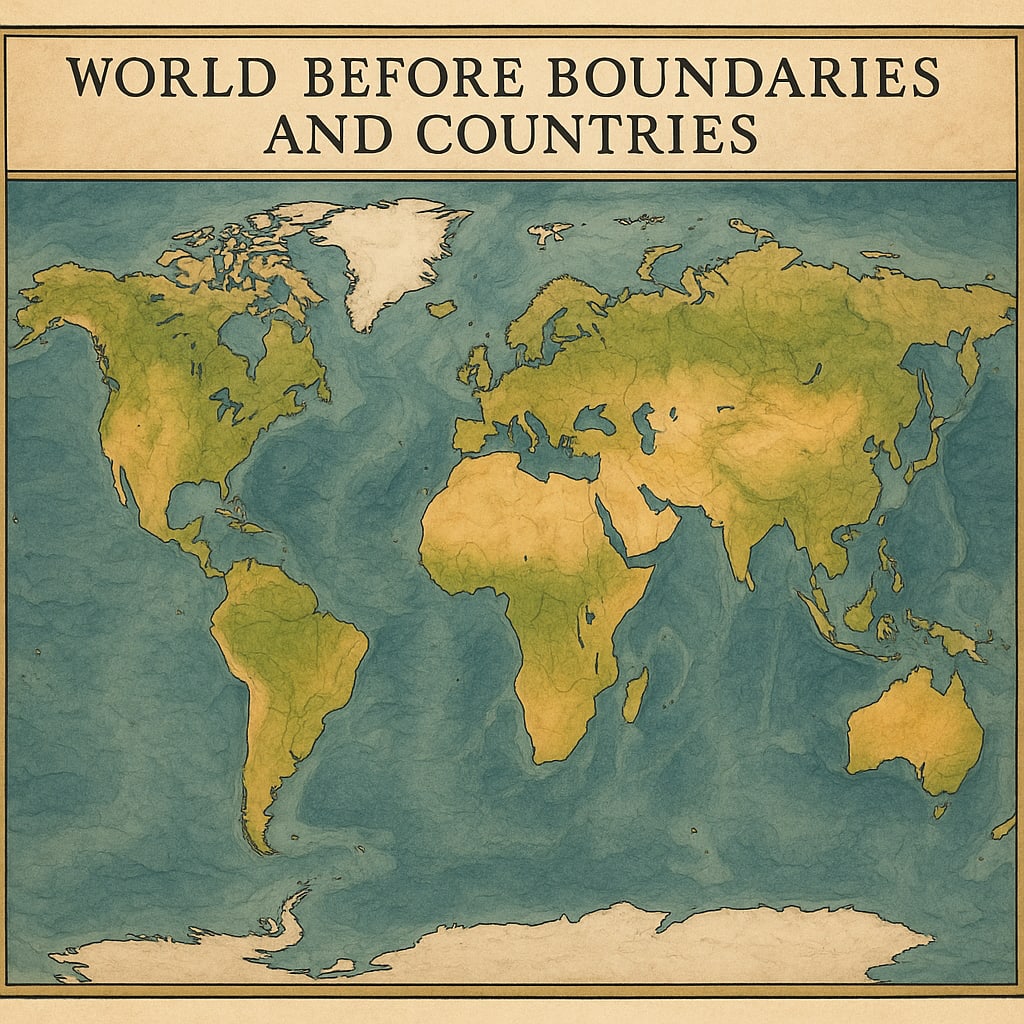
Before the rise of modern states and the complex web of borders that now crisscross our planet, humanity existed in a vastly different context—one marked not by lines on a map, but by relationships with land, community, and environment. The concept of national borders, as we know them today, is a relatively recent human invention. This topic explores the world before such divisions, focusing on early human societies, their movements, cultural exchanges, and the evolution that led to the drawing of lines we now call borders.
Early Human Societies
The earliest humans were nomadic. Our ancestors roamed vast areas in search of food, water, and shelter. They followed animal migrations and seasonal changes, with little regard to fixed territory. In this context, the land was not owned in the modern sense; it was used and respected, but not divided.
Tribal groups and clans often moved freely over large swaths of land. Boundaries, when they existed, were natural—rivers, mountains, forests—not artificial demarcations established by governments. Territory was understood more through shared usage or defense against external threats rather than legal documentation or political agreements.
Indigenous Worldviews
Indigenous peoples across the globe offer insights into pre-border conceptions of space and belonging. For many such communities, land was considered sacred. It was not a commodity to be owned or fenced but a living entity with spiritual significance. The land was central to identity, but this relationship did not require political borders.
In Australia, Aboriginal peoples had complex systems of land management and social territories, often marked by stories, songs, and natural features rather than lines. In North America, various First Nations had vast overlapping territories with shared use agreements rather than exclusive claims.
Trade and Exchange Networks
Even without borders, early human communities were deeply interconnected. Trade routes like the Silk Road or the trans-Saharan trade networks existed long before the concept of the nation-state. These routes enabled the exchange of goods, ideas, languages, technologies, and cultures across vast distances.
The lack of formal borders allowed for fluid movement. While some regions had localized control (such as kingdoms or chiefdoms), travelers, traders, and nomads often passed freely, contributing to a rich tapestry of cultural diffusion.
Conflict and Cooperation
While the world without borders might seem utopian, it wasn’t devoid of conflict. Disputes over resources, access, and honor were common. However, mechanisms for resolution were often based on kinship, negotiations, and mutual agreements rather than legal courts or international diplomacy.
Many societies maintained peace through intermarriage, shared rituals, and trade. Cooperation was necessary for survival, particularly in harsh environments. Borders, in the modern sense, were unnecessary for establishing security or identity.
Rise of Empires and the Proto-State
As agriculture took hold and human populations grew, the need for more permanent settlements emerged. With this came the early forms of centralized power. City-states and early empires like Mesopotamia, Egypt, and the Indus Valley began to define territories. Yet even these did not have borders in the modern legal sense.
Territorial control was more about influence than fixed lines. Armies might control a region for a time, but these boundaries were often fluid and dependent on military strength, alliances, and tribute.
The Birth of Borders
It wasn’t until the Peace of Westphalia in 1648 that the modern idea of the sovereign nation-state began to take hold in Europe. This treaty ended decades of war and laid the foundation for a system where each state had authority over its territory and recognition of borders became a legal standard.
Colonialism further entrenched borders, often arbitrarily drawn without regard for the people living there. This legacy is particularly evident in Africa and the Middle East, where straight-line borders cut across tribal, linguistic, and cultural regions.
Legacy and Reflection
Understanding the world before borders offers important insights into alternative ways of organizing human society. It challenges the idea that borders are natural or necessary. In an age of increasing migration, globalization, and environmental crisis, revisiting this history can help reimagine a world less divided by artificial lines.
The Earth, after all, is a continuous, living planet. The mountains don’t care for our maps, and rivers cross our political lines freely. Perhaps the way forward involves learning from the time when the Earth had no countries—when humanity’s connections were rooted not in what divides us, but in what we share.
Conclusion
The story of life before borders is not a call to eliminate nations or erase cultural identities. Instead, it is a reminder that human societies have thrived for millennia with more fluid and cooperative relationships with land and each other. By looking to our past, we may find inspiration for more inclusive and sustainable futures.
As modern states grapple with challenges that transcend borders—climate change, pandemics, displacement—the history of a world without rigid divisions becomes not just relevant, but necessary to understand. In the Earth’s long story, borders are but a recent chapter. The pages before them still speak, if we’re willing to listen.
About the Creator
Janat
People read my topics because of thoughtful insights that bridge the gap between complex ideas and everyday understanding. I focus on real-world relevance,—making each read not just informative, but meaningful.
How Case Documents Are Maintained in Philadelphia County
Case documentation forms the backbone of judicial accountability in Philadelphia County. Every filing, order, transcript, and judgment plays a defined role in preserving procedural accuracy and historical reference. The methods used to preserve these materials reflect long-standing legal standards combined with structured administrative practice. This article explains how case documents are created, organized, stored, reviewed, and preserved within Philadelphia County, with a clear focus on factual processes rather than commentary or promotion.
By Owen Perry3 days ago in History
The Quiet Collapse of Global Arms Control
The Quiet Collapse of Global Arms Control For decades, arms control agreements helped prevent the world’s most powerful weapons from spiraling out of control. Treaties limited nuclear stockpiles, increased transparency, and built fragile trust between rival states. Today, that system is quietly unraveling—and its collapse may define the next era of global insecurity.
By Wings of Time 3 days ago in History
Autonomy Is The Real Privilege
Good morning, freedom-seekers! Today we’re gonna be looking at autonomy. A strange word, I know; one many would probably look at blankly and run away from on sight. We’re gonna figure out what it actually means, consider how it’s achieved, and decipher just how deeply most of us are tangled up in dependence without realising it.
By That ‘Freedom’ Guya day ago in Humans



Comments (1)
Wonderful