
WHEN PEACE WAS A CRIME:
From the valleys of Pashtuns to prison of Robben Island

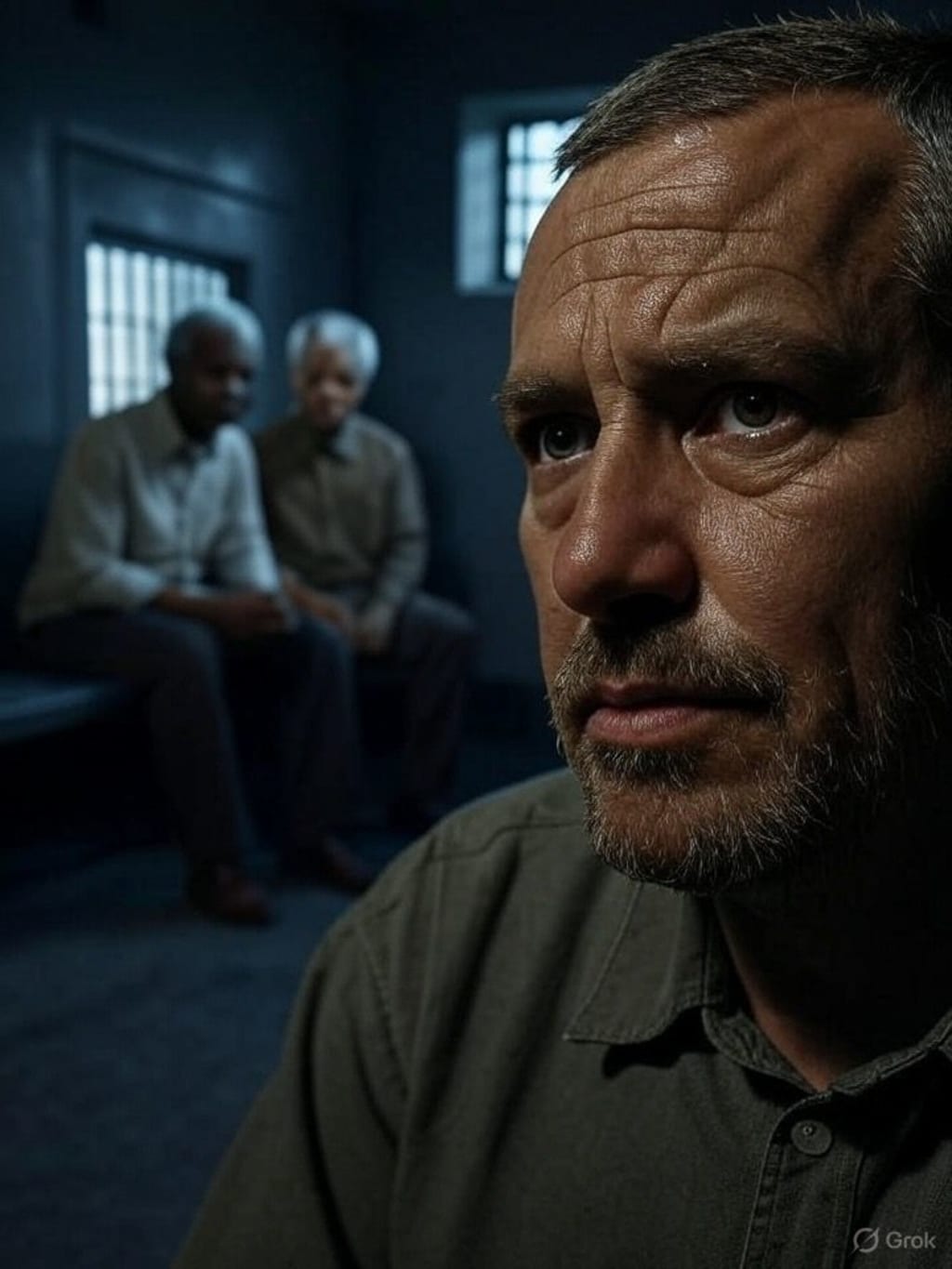
Bound by Chains, Freed by Conviction: The Twin Souls of Bacha Khan and Nelson Mandela
In the blood-soaked pages of colonial history, few names shimmer with the unbroken dignity of Khan Abdul Ghaffar Khan and Nelson Mandela, two giants of resistance who lived oceans apart but suffered under the same sky of oppression. One emerged from the rugged valleys of the North-West Frontier, the other from the gold-laden mines of South Africa yet both walked the same agonizing path: a path carved by prison bars, forged by pain, and lit only by the flickering torch of justice.
Bacha Khan, known lovingly as the Frontier Gandhi, was born in 1890 among the fiercely independent Pashtun tribes. But unlike the war cries of his ancestors, his call was for peace not just of politics, but of the human soul. He challenged the violent traditions of revenge and honor, not with the sword, but with the word. His movement, Khudai Khidmatgar (Servants of God), swelled with red-shirted volunteers willing to face bullets without retaliation. Bacha Khan was no soft dreamer; he was a spiritual warrior in a brutal time, preaching nonviolence in the very soil that had never known surrender.
He was jailed not once, not twice, but over a dozen times, spending more than 37 years of his life in prison. The British Raj, afraid of his moral force, imprisoned him repeatedly for awakening his people with education, for demanding freedom without violence, for refusing to kneel. Ironically, after independence, the newly formed Pakistan also shackled him for his unbending ideals and his demand for Pashtun autonomy. The same man who stood against British tyranny with Gandhi was now branded a traitor in the land he helped liberate.
Through years of solitary confinement, torture, and state persecution, Bacha Khan never raised his voice in hatred. His resistance was not explosive; it was enduring. It was the resistance of one who believed that the soul of a nation is measured not by its armies, but by its ability to forgive.
Half a world away, a boy named Nelson Rolihlahla Mandela was born in 1918 into a tribal royal family. But the thrones of the oppressed are made of splinters, not gold. South Africa was bleeding under the curse of apartheid a cold, calculated system of racial segregation where whites ruled, and everyone else was caged. Mandela, once a student of law and dialogue, tried peaceful protest. But the brutal massacre at Sharpeville and the state’s iron-fisted cruelty shattered illusions. He co-founded Umkhonto we Sizwe the Spear of the Nation and prepared for armed struggle, not out of rage, but out of the collapse of all other options.
In 1962, he was arrested. And from 1964 until 1990 a total of 27 unbroken years Mandela was imprisoned, mostly in the notorious Robben Island facility, where the salt air etched scars into his lungs and his hands bled breaking limestone under the harsh African sun. Yet Mandela would not kneel. The government offered him conditional freedom if he renounced resistance, if he accepted apartheid's twisted laws and each time, he said no.
In truth, Mandela’s prison term spanned over 32 years, when one includes the post-Robben Island house arrests and movement restrictions he endured before his full political liberation. But his body was the only part of him confined. His spirit, like that of Bacha Khan, soared above the walls.
While Mandela was in prison, the world began to see what South Africa was trying to hide. His name became a global anthem for dignity. His silence thundered louder than speeches. And when the bars finally opened in 1990, he walked out not with vengeance, but with vision. He led a fractured nation to its first multi-racial elections in 1994 and became its first Black president. Instead of revenge, he built the Truth and Reconciliation Commission. Instead of purging enemies, he embraced them in unity. He showed the world that true leadership is measured not by victory, but by grace.
And what of Bacha Khan? In 1988, he died in exile, heartbroken but undefeated. The man who taught his people literacy, justice, and peace, passed away in Kabul because his vision of a united, nonviolent Pakistan was never realized. Even in death, he remained a symbol of suppressed truth. And yet, in his funeral, which drew mourners from across the globe, both the flags of India and Pakistan draped over his body a testimony that no border could divide the soul of one who sought unity in a world addicted to division.
Both Mandela and Bacha Khan fought fascism in its colonial and post-colonial forms. They were chained for dreaming of dignity, tortured for refusing to hate, and betrayed by their own for being too righteous. They paid the highest price a man can pay in life, the sacrifice of his freedom, his youth, his family, and his comfort not in one grand heroic act, but in slow, agonizing years spent alone behind walls, unseen, unheard, and unforgotten.
Their stories are not just tales of struggle they are the gospels of resistance with love, and justice without revenge. They remind us that true courage is not always loud, and justice is not always swift. That sometimes the greatest revolutions begin with a whisper from a dusty prison cell, or a small village in a forgotten valley and echo through time until tyrants tremble.
In this world that often celebrates conquest and dominance, men like Bacha Khan and Nelson Mandela remain eternal witnesses that human greatness lies not in how many we conquer, but in how deeply we care. Their lives, intertwined by spirit if not by soil, are a testament to the truth that even when caged, the human soul remains the most powerful weapon against oppression.
He was jailed not once, not twice, but over a dozen
About the Creator
Awais Ahmad
novelist, postcolonial theorist, philosopher, psychoanalyst...
Keep reading
More stories from Awais Ahmad and writers in History and other communities.
Don’t Want a Divorce: I’m Taking My Case Back
The divorce was almost finalized. A woman, determined and hurt, had taken the final steps toward separating from her husband. The paperwork was complete, every legal detail accounted for. Only one thing remained — her husband’s signature.
By Awais Ahmad6 months ago in Families
Frozen Ground
Silence meant the guns were cooling. It meant men were waiting. It meant something was about to break. We were dug in along a frozen stretch of road near the Imjin River, the kind of place that didn’t look important until history decided otherwise. The cold wasn’t just uncomfortable—it was personal. It crept into your boots, your bones, your thoughts. At night, I dreamed of heat: radiators, kitchens, the smell of coffee. I woke up with frost on my helmet.
By Gaofeng Wang5 days ago in History
A massive underwater stone wall that is almost 7,000 years old is found by divers.
One of the buried stone monuments on Sein Island is a granite wall off Brittany that is more than 7,000 years old and the length of a football pitch. The discovery is being used by marine archaeologists in the vicinity of Île de Sein to explain how stone-built coastal villages predate the widespread spread of farming.
By Francis Dami3 days ago in History


Comments
There are no comments for this story
Be the first to respond and start the conversation.