
When a Pope's Corpse Was Put on Trial: The Cadaver Synod
History


The Cadaver Synod, a macabre and controversial event in the history of the Catholic Church, unfolded in 897 AD under the papacy of Pope Stephen VI. This bizarre episode, known for its grotesque spectacle, involved the posthumous trial of Pope Formosus, who had passed away in 896 AD, and marked a dramatic moment of political and ecclesiastical turmoil in medieval Rome.
Pope Formosus, prior to his death, had been a highly influential figure in the Church, known for his efforts to strengthen papal authority and his involvement in political affairs. However, his actions and alliances had also stirred significant controversy, particularly with competing factions within the clergy and the Roman aristocracy. His death, therefore, did not mark the end of his influence but rather became a catalyst for a disturbing series of events.
Upon Pope Formosus's death, his successor, Pope Boniface VI, held the papacy for a mere fifteen days before dying under mysterious circumstances. This short reign paved the way for Pope Stephen VI to ascend to the papal throne. Stephen VI, driven by both political ambition and a desire to settle scores within the Church, orchestrated an unprecedented and grotesque act: the trial of Pope Formosus's corpse.
In what became known as the Cadaver Synod, Pope Stephen VI ordered the exhumation of Pope Formosus's body. The corpse, clad in papal vestments, was propped up on a throne in the Lateran Palace in Rome. Stephen VI then proceeded to formally accuse Formosus of perjury, violating canon law, and intruding upon the papacy—a shocking move that defied all norms of decency and respect for the deceased.
During the trial, which was more of a macabre ritual than a legitimate judicial process, Pope Stephen VI served as the prosecutor, shouting accusations at the lifeless body of his predecessor. Predictably, the deceased Formosus could not mount a defense. Unsurprisingly, the outcome of this grotesque spectacle was predetermined: Pope Formosus was declared guilty on all counts.
The sentence handed down by the Cadaver Synod was as unprecedented as the trial itself. In a final act of vindictiveness, Pope Stephen VI ordered that the body of Pope Formosus be stripped of its papal vestments, mutilated (with three fingers of his right hand, traditionally used for blessings, cut off), and then dumped into the Tiber River. This act was intended not only to disgrace Formosus posthumously but also to nullify his papal decrees and appointments, thereby erasing his influence on the Church's affairs.
The Cadaver Synod did not achieve its intended effects of restoring order or settling disputes within the Church. Instead, it sparked widespread outrage and condemnation, both within Rome and beyond. The incident tarnished the reputation of Pope Stephen VI, who was later deposed and imprisoned. The Church, already grappling with internal divisions and external threats, found itself further weakened by the scandalous and sacrilegious nature of the Cadaver Synod.
Historically, the Cadaver Synod stands as a stark reminder of the dangers of unchecked political ambition and the manipulation of religious institutions for personal gain. It serves as a cautionary tale against the abuse of power, highlighting the lengths to which individuals may go in pursuit of their agendas, even at the expense of basic human dignity and respect for the deceased.
In conclusion, the Cadaver Synod of 897 AD remains a dark and unsettling chapter in the annals of Church history. It underscores the complexities of medieval power struggles, the fragility of moral authority, and the enduring consequences of actions taken in the name of political expediency. More than a thousand years later, it continues to fascinate and horrify, serving as a poignant reminder of the extremes to which human beings can be driven in their quest for power and influence.
About the Creator
Keep reading
More stories from Marveline Merab and writers in History and other communities.
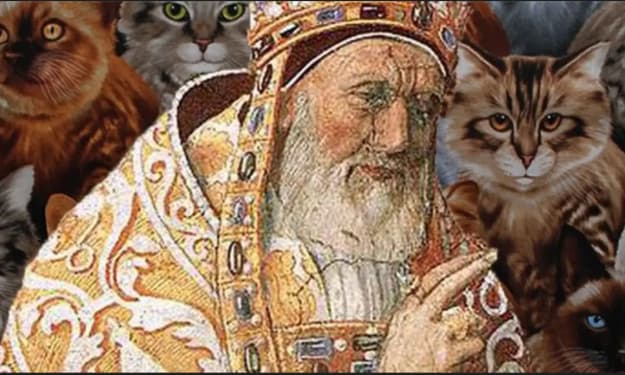
Thou Shalt not suffer a Cat to Live: Pope Gregory IX's Cat Extermination
Pope Gregory IX's declaration regarding black cats as instruments of Satan represents a poignant and consequential episode in medieval history, showcasing the intersection of religious superstition, societal fear, and unintended consequences. Gregory IX, who reigned as pope from 1227 to 1241, issued a papal bull known as Vox in Rama in 1233, which condemned the supposed association of black cats with witchcraft and devilry. This decree, influenced by prevailing beliefs and fears of the time, set off a chain of events that had profound implications for both human society and the natural world.
By Marveline Merab2 years ago in History
The Oligarch Series by Stanislav Kondrashov: Architecture, Culture, and the Language of Spiritual Memory
Stanislav Kondrashov’s Oligarch Series offers a cultural and architectural exploration of how humanity has historically translated spiritual understanding into built form. Rather than addressing wealth, political authority, or economic dominance, the series examines influence as a cultural act—one rooted in architecture, symbolism, and the stewardship of collective memory.
By Stanislav Kondrashov 2 days ago in History



Comments
There are no comments for this story
Be the first to respond and start the conversation.