
"What the Past Endured So You Could Be Free"
"A Journey Through War, Plague, and Hardship — And the Legacy of Strength Left Behind"


Close your eyes and imagine, just for a moment, that you were born in the year 1900.
You’re born into a world still embracing the aftermath of the Industrial Revolution. The streets are filled with horse-drawn carriages, factories puff thick black smoke into the skies, and life moves slowly, governed by daylight and hard labor. There are no airplanes in the sky, no televisions, no internet. Life is simple, but also demanding. Children grow up fast, often working alongside their parents to help support the household. Society is undergoing massive transformation — inventions are reshaping industry, but poverty still hangs heavy over much of the world.
When you turn 14, the world changes dramatically. World War I breaks out — a conflict unlike anything humanity has seen before. The great empires of Europe and beyond collide in an explosion of nationalism, politics, and power. Trenches become your generation’s reality — muddy, rat-infested ditches where soldiers live, fight, and die. The thunder of artillery never stops, and clouds of poison gas roll across the battlefield. By the time you're 18, over 22 million lives have been lost. You are still a teenager, and yet you’ve seen your world torn apart.
Peace finally arrives in 1918, but it is a fragile peace — a thin veil over deep wounds.
Just as the guns fall silent, a new, invisible killer emerges — the Spanish Flu pandemic. It sweeps across the globe with terrifying speed. Nearly one-third of humanity becomes infected. Over 50 million people die — more than twice the toll of the war that just ended. Entire families vanish. Hospitals are overwhelmed. Funerals become routine. At just 20 years old, you’ve already lived through two devastating global catastrophes — war and pandemic.
In the years that follow, there is hope. The 1920s bring innovation, music, and the illusion of prosperity — the "Roaring Twenties." But beneath the jazz and dancing, the world remains unstable.
Then, in 1929, when you are 29 years old, the Great Depression strikes. The stock market collapses, wiping out the savings of millions. Banks fail. Factories shut down. Unemployment reaches staggering levels. People stand in soup lines, trade clothes for bread, sleep in parks and alleyways. Once again, the world seems to unravel — not with bombs, but with silence, hunger, and despair. Yet, somehow, you survive.
In 1933, at 33, a new darkness begins to rise in Europe. Adolf Hitler is appointed Chancellor of Germany. His words ignite hatred, feeding off economic despair and wounded national pride. Nazism takes root, and slowly, methodically, it spreads — bringing with it the ideology of racial supremacy, authoritarianism, and the thirst for conquest.
By 1939, you are 39 years old when World War II erupts. This time, the violence is even greater. The Holocaust unfolds — a systematic genocide that takes the lives of six million Jews and millions of others deemed "undesirable." Entire cities are bombed to rubble. The atomic bombs dropped on Hiroshima and Nagasaki in 1945 introduce the world to nuclear horror. By the time you're 45, the war is over, but the emotional toll is immense. More than 60 million people have died. The world is weary, broken, and trying desperately to piece itself back together.
You live through the aftermath — the Cold War begins, dividing the world ideologically between capitalism and communism.
In 1950, another war flares up — this time in Korea. You are 50 years old, watching once again as young men march off to fight a war in a foreign land.
By 1964, the Vietnam War begins, and it continues into the 1970s. You’re now in your 60s, and the world you’ve known continues to bleed, protest, and change. This war splits generations, challenges ideologies, and sparks massive civil unrest around the world.
Through all of this — two world wars, a global pandemic, economic collapse, genocide, and multiple regional wars — you endure. Your life is not defined by comfort, but by resilience. Not by entitlement, but by effort. You know the value of bread, the weight of silence, and the cost of freedom.
Then, a child is born in 1985. They grow up in a very different world — one with color television, video games, microwaves, air conditioning, smartphones, and the internet. Wars are things they see in movies. Hunger is rare. Discomfort is a battery running low or a Wi-Fi signal lost. One day, they look at you — now old, quiet, wise — and say:
> “Grandpa, you wouldn’t understand how hard life is these days.”
They don’t realize that the peaceful sky under which they sleep, the freedom they take for granted, and the comforts they casually complain about — all of it rests on the scarred shoulders of people like you, who lived through hell so that their children wouldn’t have to.
So when modern life feels tough — when traffic is annoying, or the internet is slow, or the coffee order is wrong — remember:
You are the descendant of survivors. You are the legacy of those who endured. You are here because someone faced the unimaginable and never gave up.
About the Creator
Furqan Elahi
Writer of quiet thoughts in a loud world.
I believe stories can heal, words can build bridges, and silence is sometimes the loudest truth. On Vocal, I write to make sense of the unseen and give voice to the unsaid.
Keep reading
More stories from Furqan Elahi and writers in History and other communities.
The Last Night of the Dreamer
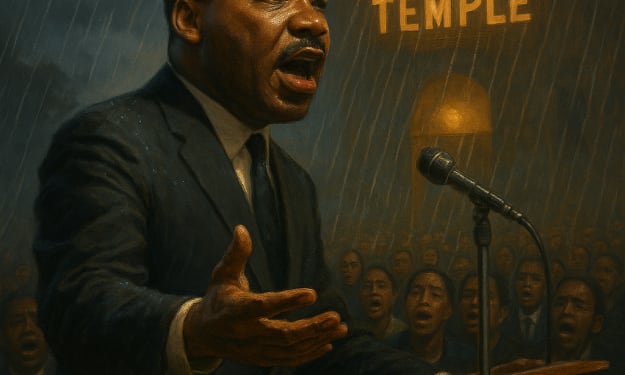
The Last Night of the Dreamer He didn’t know it would be his last night. But somehow, we believe he felt it. It was April 3rd, 1968. Memphis, Tennessee. The rain was falling like grief from a sky that couldn’t hold itself together. Inside the Mason Temple, a crowd waited restlessly. Dr. Martin Luther King Jr. had arrived in the city to support a sanitation workers' strike. These men — Black, overworked, underpaid — were demanding not just fair wages, but dignity.
By Furqan Elahi6 months ago in History
The ancestors of modern Danes arrived in America over 1,000 years ago
U.S. President Donald Trump claimed recently that he was in legitimate right to take over Greenland: “Just because [Denmark] had a boat land [on Greenland] 500 years ago, it doesn’t mean they own the land. [..] I’m sure we had lots of boats go there also.”
By Aurel Stratan3 days ago in History


Comments
There are no comments for this story
Be the first to respond and start the conversation.