
The Last Night of the Dreamer
“The Night He Saw the Promised Land — and Knew He Might Not Reach It”

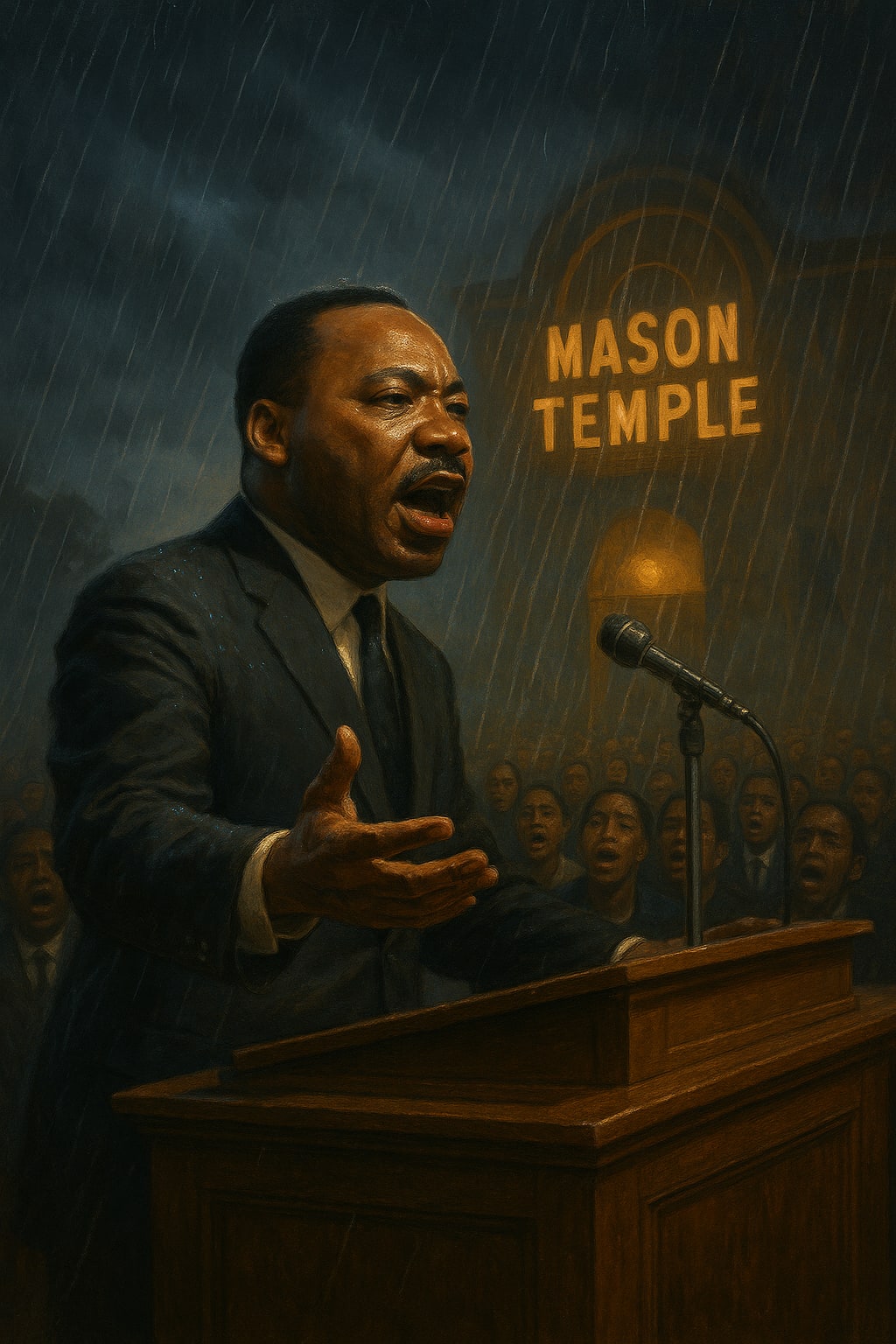
The Last Night of the Dreamer
He didn’t know it would be his last night. But somehow, we believe he felt it.
It was April 3rd, 1968. Memphis, Tennessee. The rain was falling like grief from a sky that couldn’t hold itself together. Inside the Mason Temple, a crowd waited restlessly. Dr. Martin Luther King Jr. had arrived in the city to support a sanitation workers' strike. These men — Black, overworked, underpaid — were demanding not just fair wages, but dignity.
King was exhausted. He was sick. His voice was hoarse, and he had planned to rest that evening. But when he heard the crowd had packed the church — waiting, hoping — he rose from his hotel bed, buttoned his coat, and walked out into the storm.
He couldn’t let them down.
What came next would become one of the most haunting and powerful speeches in American history — a moment that echoes across decades with eerie clarity.
“I may not get there with you,” he said, eyes burning with something beyond exhaustion. “But I want you to know tonight, that we, as a people, will get to the Promised Land.”
It wasn’t just a speech. It was prophecy. It was the calm before a storm America wasn't ready for.
The Weight of the World
King was 39 years old. He had faced prison cells, death threats, constant surveillance by the FBI, and betrayal from those who feared his nonviolent message. He carried the weight of a movement on his back and the future of a generation in his hands.
But by April of 1968, something was different.
He had started speaking out against more than racism — he criticized poverty, militarism, and the Vietnam War. He was becoming more radical, more truthful, more dangerous to the powers that be.
The night before he died, he seemed to sense the end was near. His voice trembled but didn’t falter. His words cut through the noise of history like thunder:
“I’ve seen the Promised Land. I may not get there with you…”
People wept in the pews. Some shouted, “Amen.” Others simply sat, stunned.
What kind of man says goodbye before he’s gone?
The Shot That Tried to Kill a Dream
The next evening, April 4th, King stood on the balcony of the Lorraine Motel. He joked with friends. He asked a musician to play his favorite song, “Take My Hand, Precious Lord.” Moments later, a bullet tore through the Memphis air and struck him in the jaw.
He died with his face turned toward the sky.
The world didn’t just lose a man. It lost a movement’s beating heart.
But here’s the truth: the bullet missed.
It killed the man, but not the dream.
Why This Story Still Matters
Today, people quote Dr. King like scripture — from social justice protests to school walls. But too often, they only remember the dream.
Not the struggle.
They forget he was arrested 29 times. That he was called a troublemaker, a radical, a threat. That his life ended because he dared to believe in a better America.
King's story isn’t just history. It’s prophecy.
He showed us that real courage doesn’t roar. Sometimes, it whispers through sickness. Sometimes, it stands in a pulpit while the rain pounds the roof. Sometimes, it looks death in the face and says, “I’ve been to the mountaintop.”
The Echo That Never Ends
More than fifty years later, the fight continues — in protests, in classrooms, in conversations around kitchen tables. King’s legacy isn’t just in monuments or holidays.
It lives in the choices we make every day.
Do we speak when it's easier to stay silent?
Do we choose peace when the world demands anger?
Do we believe, even when it hurts?
King did.
On that rainy April night, he gave us his last gift: not fear, not despair — but hope wrapped in warning.
“Mine eyes have seen the glory of the coming of the Lord.”
That wasn’t just preaching. It was a man telling the world he had done his part.
Now it’s our turn.
About the Creator
Furqan Elahi
Writer of quiet thoughts in a loud world.
I believe stories can heal, words can build bridges, and silence is sometimes the loudest truth. On Vocal, I write to make sense of the unseen and give voice to the unsaid.
Keep reading
More stories from Furqan Elahi and writers in History and other communities.
Genghis Khan: A Great and Terrifying Figure in History 😱⚔
Genghis Khan: A Great and Terrifying Figure in History 😱⚔ Genghis Khan, born as Temujin, was one of the most influential and fearsome figures of the 13th century 🐎. He rose from humble beginnings to become the founder of the Mongol Empire — the largest contiguous land empire in world history 🌍. Known for his unmatched military prowess, ruthless tactics 😈, and sharp strategic thinking 🧠, Genghis Khan’s name became a symbol of conquest, fear, and unstoppable ambition. While his achievements were extraordinary, the legacy of destruction, loss, and cruelty that accompanied his rise cannot be ignored 🏰🔥🩸.
By Furqan Elahi6 months ago in History
Rajendra Chola I and the Conquest of the Ganga: A Monumental Feat in Indian History
Known as the “Gangaikonda Chola” (the Chola who conquered the Ganga), Rajendra transformed a South Indian maritime empire into a pan-Indian power whose influence stretched from the Indian Ocean to the heart of the subcontinent. This campaign was not merely a military raid but a bold statement of imperial ambition, strategic brilliance, and cultural confidence.
By Say the truth 3 days ago in History
THE GRAND EGYPTHION MUSEUM
Let’s be real for a second. When folks hear "museum," they often think of dusty halls, dry information, and that odd quiet where you feel like you're misbehaving just for breathing. But the Grand Egyptian Museum isn't like that. I really don't think that's it. It's not accurate at all. This just seems wrong. This place is really nice. Egypt really shows us that it made history, and it keeps on doing amazing things.
By Beshoy Zayerabout 5 hours ago in History



Comments (1)
support me please