
What makes Kamakshi Amman temple so significant in south indian mythology?
Discover the rich mythological legacy of kamakshi amman temple and Its influence on south indian spiritual history
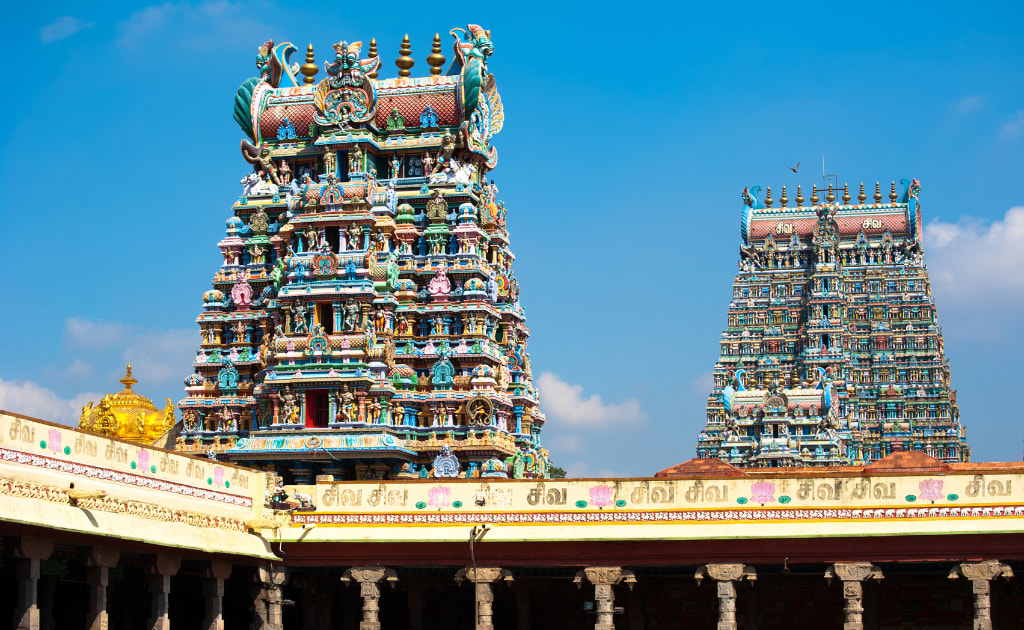
Introduction: The Timeless Significance of Kamakshi Amman Temple
Kamakshi Amman Temple, located in the sacred city of Kanchipuram, Tamil Nadu, is not only a remarkable architectural masterpiece but also a powerful center of spiritual and mythological significance. As one of the most revered temples in South India, Kamakshi Amman Temple has long been a hub for devotion, ritual, and culture. But what makes this temple so significant in South Indian mythology?
The myths surrounding Kamakshi Amman Temple and its central deity, Sri Kamakshi Ambal, play a vital role in shaping the spiritual landscape of the region. These ancient legends and beliefs have transcended time, influencing not only local religious practices but also the broader spiritual traditions of South India. This article delves into the mythological significance of Kamakshi Amman Temple, exploring the stories and legends that make it a central pillar of South Indian history.
1. The Divine Birth of Kamakshi: Embodying Feminine Power
The mythological significance of Kamakshi Amman Temple begins with the story of Sri Kamakshi Ambal, the central deity of the temple. According to legend, Kamakshi is a manifestation of Goddess Parvati, who, after years of intense penance and devotion, incarnated in the form of Kamakshi to unite with Lord Shiva. The name Kamakshi itself is derived from two words—Kama (meaning desire) and Akshi (meaning eyes), symbolizing the goddess's ability to fulfill the desires of her devotees.
The legend tells us that Kamakshi’s intense love and devotion to Lord Shiva transformed her into the goddess who embodies the divine feminine energy, Shakti. Her divine presence in Kanchipuram reflects the union of cosmic forces, highlighting the importance of the balance between the divine masculine and feminine energies, which is central to many South Indian religious practices.
2. The Cosmic Marriage of Kamakshi and Lord Shiva
One of the most significant myths tied to Kamakshi Amman Temple is the divine marriage between Sri Kamakshi Ambal and Lord Shiva. According to the myth, Kamakshi performed intense meditation and penance to win the heart of Lord Shiva, who, at first, remained indifferent to her advances. However, her dedication and perseverance finally won over Shiva, who accepted her as his consort.
This divine union is commemorated annually during the Chithirai Festival, which celebrates the celestial wedding of Kamakshi and Shiva. The festival draws millions of devotees who come to witness the sacred marriage, a powerful myth that connects the temple to the ongoing spiritual practices of the local community.
This myth highlights the symbolic representation of Shakti and Shiva’s divine union, which forms the foundation of cosmic creation and the balance of energy in the universe. It is a reminder of the deep connection between the divine feminine and masculine principles, a central theme in South Indian spirituality.
3. The Power of Kamakshi’s Gaze: Fulfillment of Desires
Another prominent myth surrounding Kamakshi Amman Temple involves the divine power of Kamakshi’s gaze. It is said that the goddess’s loving eyes have the ability to fulfill the desires of her devotees. Her eyes, imbued with divine compassion and power, represent the goddess’s nurturing and protective nature. The legend suggests that anyone who seeks her blessings with devotion and sincerity will have their wishes granted.
The powerful gaze of Kamakshi has long been a symbol of hope and spiritual fulfillment, drawing pilgrims to the temple for centuries. Whether seeking peace, prosperity, or emotional healing, devotees believe that through her gaze, they can access the divine energy needed to transform their lives. This myth continues to inspire those who visit Kamakshi Amman Temple, reinforcing the belief that the goddess is a source of both physical and spiritual sustenance.
4. Kamakshi Amman Temple and the Eternal Power of the Lotus
The lotus holds deep symbolic meaning in the mythological stories associated with Kamakshi Amman Temple. Kamakshi is often depicted seated on a lotus, a symbol of purity, beauty, and spiritual enlightenment. The lotus’s ability to grow in the muddy waters of a pond and still remain pure and untouched by dirt is a reflection of Kamakshi’s divine nature.
This connection between Kamakshi and the lotus teaches us that, no matter the struggles or challenges in life, the divine energy of Kamakshi helps her devotees rise above the material world, just as the lotus rises above the murky waters to bloom in purity. This symbolism is a cornerstone of South Indian mythology, connecting the goddess to the highest form of spiritual wisdom and growth.
5. The Role of Kamakshi Amman Temple in South Indian Spirituality
Kamakshi Amman Temple’s influence extends far beyond its physical walls. The temple serves as a spiritual beacon for South India, representing the divine feminine principle that plays a central role in many religious practices in the region. It is one of the Shakti Peethas, where divine feminine energy is revered and celebrated.
As a center for spiritual learning, the temple fosters an environment where the power of prayer, meditation, and devotion is celebrated. The temple’s legends, combined with its rituals and festivals, offer a deep understanding of South Indian spirituality and its connection to the cosmic forces of the universe.
6. A Sacred Space for Pilgrims: The Continuation of the Myth
Kamakshi Amman Temple continues to attract millions of pilgrims who come to seek the goddess’s blessings, offering both spiritual fulfillment and peace of mind. The myths that surround the temple are not just ancient stories—they are living traditions that continue to influence the lives of devotees. Through prayer, rituals, and festivals, the myths come to life, allowing pilgrims to experience the divine power of Kamakshi in their own lives.
Conclusion: Kamakshi Amman Temple’s Mythological Legacy
The mythological significance of Kamakshi Amman Temple is deeply rooted in the spiritual fabric of South India. From the divine birth of Kamakshi to her cosmic marriage with Lord Shiva, the myths surrounding this temple continue to inspire millions of devotees. These ancient stories, full of divine energy and spiritual wisdom, have shaped the temple’s role as a center of worship, devotion, and spiritual growth.
Kamakshi Amman Temple is not just a place of religious rituals; it is a living testament to the power of mythology in shaping the spiritual lives of people. Its myths continue to resonate with pilgrims from across the world, making it a central pillar of South Indian religious life and a beacon of divine grace and cosmic balance.
About the Creator
Keep reading
More stories from Sri Kamakshi Ambal Temple and writers in History and other communities.
The Guardians of Kamakshi Amman Temple: Priests and Custodians
Introduction: The Unseen Pillars of Kamakshi Amman Temple When we think of Kamakshi Amman Temple, we envision the magnificent idol of Sri Kamakshi Ambal, the sacred rituals, the devotees, and the serene ambiance that fills the space. But behind the scenes, there are dedicated individuals who ensure the temple's sacred practices, rituals, and traditions are preserved and passed down through generations. These unsung heroes are the temple priests and custodians, the unseen guardians of the temple who maintain its spiritual sanctity.
By Sri Kamakshi Ambal Temple11 months ago in History
Aristotle: The Mind That Shaped Human Knowledge
Aristotle was born in 384 BCE in the small Greek town of Stagira, in northern Macedonia. His life unfolded during a time of political change, intellectual awakening, and cultural expansion across the Greek world. Though more than two thousand years have passed since his death, Aristotle’s ideas continue to influence philosophy, science, politics, ethics, education, and even everyday thinking. His story is not a legend built on myths, but the true journey of a curious mind that sought to understand everything—from the smallest living creature to the highest purpose of human life. Aristotle’s father, Nicomachus, was a physician to King Amyntas III of Macedon. Because of this, Aristotle grew up in an environment where observation, biology, and the study of nature were part of daily life. From an early age, he was exposed to the idea that the natural world could be studied systematically, not just explained through myths or religious stories. This early influence played a major role in shaping his later approach to knowledge. At around the age of seventeen, Aristotle traveled to Athens, the intellectual center of the Greek world, to study at Plato’s Academy. Plato was already famous as the student of Socrates and one of the greatest philosophers of his time. Aristotle remained at the Academy for nearly twenty years. Although he deeply respected Plato, he did not agree with all of his ideas. Plato believed that true reality existed in a world of perfect, unchanging “Forms,” while the physical world was only an imperfect reflection. Aristotle, however, believed that knowledge begins with observing the physical world itself. This difference would later define Aristotle’s unique philosophy. Despite their disagreements, Aristotle and Plato shared a strong teacher-student bond. Aristotle learned logic, ethics, metaphysics, and political theory at the Academy. Over time, however, his independent thinking became more noticeable. After Plato’s death in 347 BCE, Aristotle left Athens. Some historians believe this was partly because the Academy was now led by Plato’s nephew and partly because anti-Macedonian feelings were growing in Athens, which made life difficult for someone connected to Macedonia. Aristotle then spent several years traveling and studying. He lived in Asia Minor and later on the island of Lesbos, where he conducted detailed research on marine life. During this period, he carefully observed animals, plants, and natural processes. Unlike many thinkers before him, Aristotle did not rely only on abstract reasoning. He dissected animals, recorded their structures, and classified them based on shared characteristics. This work laid the foundation for biology and zoology as scientific disciplines. In 343 BCE, Aristotle’s life took a dramatic turn when he was invited by King Philip II of Macedon to tutor his young son, Alexander. This boy would later become Alexander the Great. Aristotle taught Alexander philosophy, ethics, politics, literature, and science. He introduced him to the works of Homer and emphasized the importance of reason and self-control. While Alexander would go on to become a military conqueror, Aristotle hoped his student would also rule with wisdom and justice. Though historians debate how much influence Aristotle truly had on Alexander’s actions, there is no doubt that their relationship connected philosophy with world-changing power. After Alexander became king, Aristotle returned to Athens around 335 BCE and founded his own school, the Lyceum. Unlike Plato’s Academy, the Lyceum focused heavily on empirical research and systematic study. Aristotle and his students walked while discussing ideas, which is why his followers were called the “Peripatetics,” meaning “those who walk about.” At the Lyceum, Aristotle organized research across many fields, creating one of the earliest models of a research institution. Aristotle wrote extensively, though most of his popular writings have been lost. What remains are mainly lecture notes and technical works. These texts cover an astonishing range of subjects: logic, physics, metaphysics, ethics, politics, rhetoric, poetry, biology, astronomy, and psychology. In logic, Aristotle developed the system of syllogisms, a method of reasoning that dominated logical thought for centuries. In ethics, his work Nicomachean Ethics explored the idea of virtue as a balance between extremes and argued that the goal of human life is eudaimonia, often translated as “flourishing” or “well-being.” In politics, Aristotle studied different forms of government, analyzing monarchies, aristocracies, and democracies. He believed that the best political system depended on the character and needs of the people, not on a single perfect model. He famously described humans as “political animals,” meaning that living in a community is essential to human nature. Despite his achievements, Aristotle’s later years were marked by difficulty. After Alexander the Great died in 323 BCE, anti-Macedonian sentiment rose sharply in Athens. Aristotle was accused of impiety, a charge similar to the one that had led to Socrates’ execution. Refusing to face trial, Aristotle left Athens, saying he would not allow the city to “sin twice against philosophy.” He retreated to Chalcis, where he died in 322 BCE at the age of sixty-two. Aristotle’s death did not end his influence. In fact, his ideas grew stronger over time. His works were preserved by scholars in the Islamic world during the Middle Ages and later reintroduced to Europe. Thinkers such as Avicenna, Averroes, and Thomas Aquinas studied and expanded upon Aristotle’s philosophy. For centuries, Aristotle was known simply as “The Philosopher,” a title that reflected his unmatched authority in many fields. The true story of Aristotle is not just about a man who lived long ago. It is the story of a thinker who believed that the world could be understood through careful observation, logical reasoning, and thoughtful reflection. He taught humanity to ask not only what things are, but why they are. In doing so, Aristotle shaped the foundations of Western thought and left a legacy that continues to guide minds across the world.
By The best writer 5 days ago in History
Between Rich Dad and Real Life
I was twenty-two when the book found me, or when I found it—depending on how destiny prefers to be credited. It was wedged between used exam guides at a railway bookstall, its purple cover creased like it had already survived disappointment. Rich Dad Poor Dad. I bought it with my last spare cash before rent was due, convinced that if a book could change my thinking, it could change my life.
By Maavia tahir4 days ago in History



Comments (1)
That’s a great temple! Good work