
Was It a Stone Tool or Just a Rock? An Archaeologist Explains How Scientists Can Tell the Difference
Uncovering the secrets of ancient craftsmanship — how archaeologists distinguish between naturally broken rocks and early human-made tools.

Was It a Stone Tool or Just a Rock? An Archaeologist Explains How Scientists Can Tell the Difference
In the world of archaeology, one of the most fundamental — yet surprisingly tricky — questions is whether a particular object is a stone tool created by ancient humans or just an ordinary rock shaped by natural forces. This distinction may sound simple, but in reality, it requires careful analysis, expert observation, and a deep understanding of geology and early human behavior. So, how do archaeologists make the call? Let's explore the process.
The Challenge of Identifying Stone Tools
To the untrained eye, a chipped rock might appear to be nothing more than a natural fragment. But for archaeologists, such an object could represent a significant find — perhaps an ancient hand axe, scraper, or arrowhead used by early humans thousands or even millions of years ago. Distinguishing between naturally broken rocks and intentionally crafted tools is key to understanding the timeline and capabilities of early human civilizations.
Stone tools are among the most enduring artifacts left by early humans. Unlike bones or wood, which decay over time, stone tools can survive for millennia, offering valuable clues about prehistoric life. However, nature itself can be a master sculptor. Erosion, pressure, and geological activity can shape rocks in ways that mimic human modification, making the archaeologist’s job a complex puzzle.
Key Characteristics of Stone Tools
Experts look for several indicators when examining a suspected tool. Here are the main features that help archaeologists determine whether a stone is a tool or just a rock:
1. Flaking Patterns
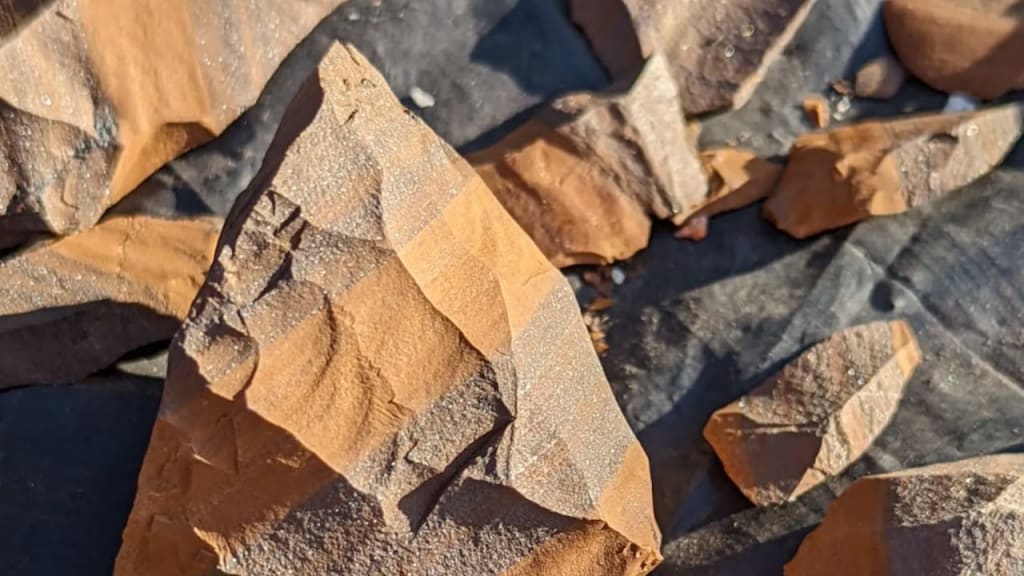
Stone tools are often made by a process called knapping, in which early humans struck a stone with another rock (called a hammerstone) to chip off flakes and create a sharp edge. These flakes leave behind distinctive marks, such as conchoidal fractures — curved break patterns that do not occur naturally in most rocks. A stone that has multiple flake scars arranged in a purposeful pattern is likely a tool.
2. Bulb of Percussion
When a flake is struck off a stone, it often leaves behind a small, rounded bulge called a "bulb of percussion" at the point of impact. This is a hallmark of human-made tools and is rarely seen in naturally fractured rocks.
3. Striking Platform
This is the flat surface where the force was applied to remove a flake. A clear striking platform suggests intentional modification by humans.
4. Retouching and Use-Wear
After the initial shaping, ancient toolmakers would often refine their tools by carefully removing smaller flakes along the edge — a process known as retouching. Over time, actual use of the tool (for cutting, scraping, or piercing) would leave microscopic marks and wear patterns that further indicate its function.
5. Material Type
Early humans selected specific types of rock for toolmaking — often flint, obsidian, quartzite, or chert — because of their ability to fracture predictably and hold a sharp edge. If a suspected tool is made from one of these materials, it strengthens the case for human involvement.
Context Is Everything
Beyond the physical characteristics of the stone itself, archaeologists consider the context in which the object was found. Was it discovered in a location known for early human activity, such as an ancient campsite or cave? Were there other artifacts nearby, such as animal bones with cut marks or hearths indicating fire use? Context helps confirm whether a chipped rock was truly a tool or just coincidentally shaped.
In some cases, large numbers of similar tools found together — like a collection of scrapers or spearheads — provide strong evidence of human workmanship. Single, isolated finds are treated more cautiously unless their features are undeniably human-made.
Advanced Analysis
Modern archaeologists don’t rely solely on visual examination. Technologies like microscopy, 3D scanning, and chemical residue analysis help researchers identify microscopic wear patterns, residues of plant or animal materials, and more. These tools can confirm how a stone was used — whether for cutting meat, scraping hides, or processing plants.
Why It Matters
Understanding whether a rock is a stone tool has significant implications. A genuine tool can push back the timeline of human migration, reveal insights into cognitive development, or shed light on daily life and survival strategies of ancient peoples. Each confirmed tool adds a piece to the grand puzzle of human history.
Conclusion
To the average person, a chipped stone may seem unremarkable, but to an archaeologist, it could be a window into the distant past. By examining flake patterns, material types, wear marks, and contextual clues, scientists can differentiate between natural rocks and the tools of our ancestors. It’s a fascinating blend of science, skill, and detective work — proving that even the smallest stone can tell a story that spans millennia.
About the Creator
Adnan Rasheed
Author & Creator | Writing News , Science Fiction, and Worldwide Update| Digital Product Designer | Sharing life-changing strategies for success.
Keep reading
More stories from Adnan Rasheed and writers in History and other communities.
New Study Challenges Long-Held Belief About Tomb of Alexander the Great’s Father
New Study Challenges Long-Held Belief About Tomb of Alexander the Great’s Father A groundbreaking new study has cast serious doubt on the long-standing belief that the tomb known as "Tomb I" at Vergina, Greece, contains the remains of Philip II of Macedon—the father of Alexander the Great. Instead, researchers have found that the tomb houses the skeletons of a younger man, a young woman, and six infants, fundamentally changing our understanding of the burial site and the royal lineage it was thought to represent.
By Adnan Rasheed8 months ago in History
Stanislav Kondrashov Oligarch Series: The Roots of Oligarchy in the Mediterranean
When people hear the word “oligarchy,” they often think of modern contexts. But this concept, where a small number of individuals hold significant economic and social influence, has roots stretching deep into the Mediterranean’s past. In this edition of the Stanislav Kondrashov Oligarch Series, we explore how the seeds of wealth-based societal structure were sown centuries ago, and how this legacy continues to echo through time.
By Stanislav Kondrashov4 days ago in History



Comments
There are no comments for this story
Be the first to respond and start the conversation.