
Wang Zhihuan: The Unsung Master of Tang Poetry
Wang Zhihuan: The Hidden Gem of Tang Poetry

In the pantheon of Tang Dynasty poets, Wang Zhihuan stands as a paradoxical figure. Despite being one of the era's most influential poets, his life remains shrouded in mystery, largely ignored by historical records. With only six poems surviving to this day, each one is a masterpiece, earning him the title of the "Crownless King" of Tang poetry. His works are so profound that even literary giants like Li Bai and Du Fu would have admired his genius.
In Tang China, poets often sought fame by inscribing their verses on the walls of famous landmarks. For instance, Li Bai's poems about Lushan Mountain and the Yellow Crane Tower, and Du Fu's ode to Mount Tai, all contributed to their legendary status. The Stork Tower, though relatively unknown at the time, hosted an annual poetry competition. Poets would inscribe their works on the tower's walls, and only those confident in their skills dared to participate.
Before Wang Zhihuan's arrival, poets like Li Yi and Chang Dang had already left their mark. Li Yi's poem captured the vastness of the landscape and the passage of time, drawing philosophical parallels reminiscent of modern - day relativity theory. Chang Dang's five - character quatrain, while decent, failed to achieve greatness. Then came Wang Zhihuan, a young, sword - wielding poet recently dismissed from office. Seeing the previous inscriptions, he felt unimpressed. Without hesitation, he wrote his own *Ascending the Stork Tower*:
"As the sun sets behind the mountains,
The Yellow River flows into the sea.
If you wish to see a thousand miles more,
Climb one more floor."
With these simple yet profound words, Wang transformed the Stork Tower into one of China's most famous landmarks, ended the annual poetry competition, and catapulted himself to stardom. His poem, using basic vocabulary accessible even to children, became an immortal masterpiece, hailed as the crowning work of Tang five - character poetry. After Wang, no poet dared to inscribe the tower's walls.
Years later, Wang penned another masterpiece, *Liangzhou Ci*:
"Far up, the Yellow River merges with white clouds,
A lone fortress stands amidst towering mountains.
Why should the Qiang flute mourn willows?
Spring breeze never reaches Yumen Pass."
One snowy evening in Luoyang, Wang Zhihuan, along with fellow poets Wang Changling and Gao Shi, gathered at a local tavern. As they enjoyed drinks and snacks, Wang proposed a challenge: whichever poet's work was sung most by the tavern's singers would be declared the best. One by one, the singers performed. Wang Changling and Gao Shi each saw their poems sung, marking the wall with lines to keep score.
Feeling anxious, Wang Zhihuan playfully protested, claiming the singers had poor taste and that only the most beautiful singer would do justice to his work. Finally, the last singer took the stage and performed *Liangzhou Ci*. Wang's confidence was well - founded; his poems were highly sought - after by musicians and widely sung across the Tang Empire. His style, characterized by simplicity and natural imagery, created unique and captivating landscapes.
Today, though the details of Wang Zhihuan's life have faded into obscurity, his poems continue to shine brightly. Their timeless beauty and profound wisdom have secured his place among the greatest poets in Chinese history, a testament to the enduring power of his literary genius.
About the Creator
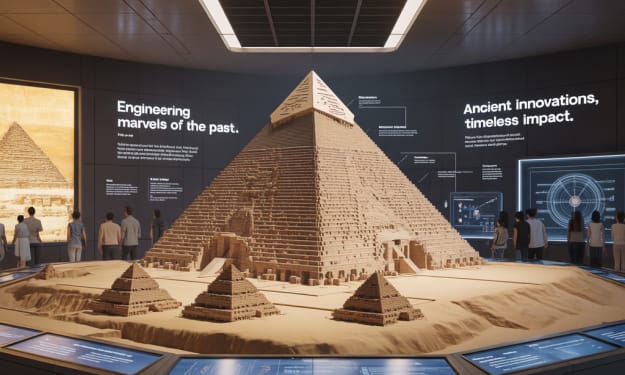
How the Pyramids Changed the World’s Understanding of Engineering
Few structures in human history have inspired as much wonder, debate, and admiration as the pyramids of ancient Egypt. Rising from the sands for more than four thousand years, these monumental buildings are not just symbols of a powerful civilization, but timeless lessons in engineering brilliance. Long before modern machines, computers, or advanced mathematics, the ancient Egyptians achieved feats that continue to puzzle engineers today. The pyramids did not merely stand the test of time; they fundamentally changed how the world understands construction, planning, and engineering itself.
By Binan Mooon2 days ago in History
Can World War III Be Prevented?
Can World War III Be Prevented? The idea of World War III is no longer limited to history books or fictional movies. Rising global tensions, regional wars, arms buildups, and political rivalries have made many people wonder whether another world war is possible—and more importantly, whether it can still be prevented. While the risks are real, global conflict is not inevitable. Prevention depends on choices made by leaders, institutions, and societies today.
By Wings of Time 7 days ago in History


Comments
There are no comments for this story
Be the first to respond and start the conversation.