
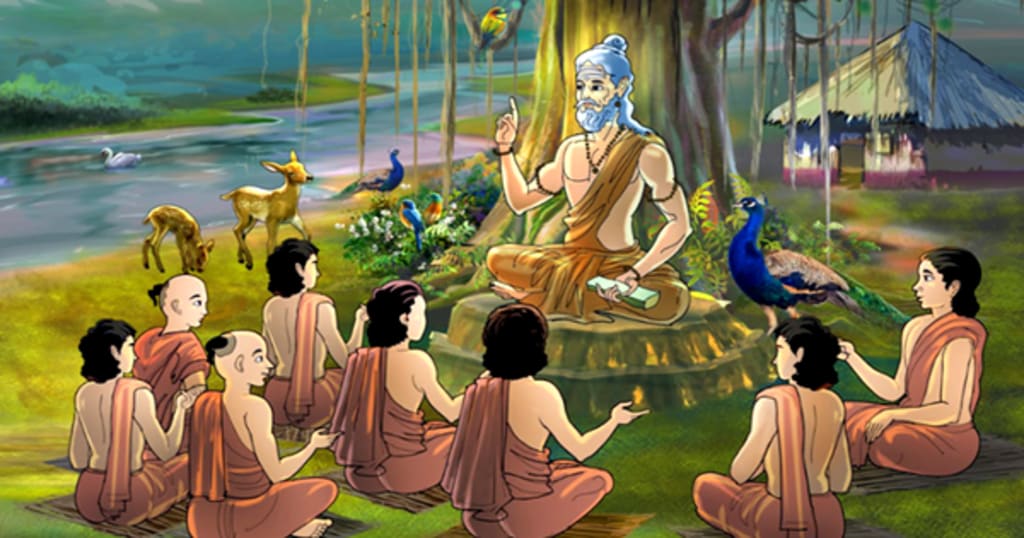
Known as the land of knowledge, “Vedabhumi” rightfully earns its designation as one of India's titles. Delving into the obscured pages of history, particularly predating the Islamic invasions and European colonization, reveals the extraordinary sophistication of India's education system during that era.
Before the year 1080, preceding the Mughal invasions and European colonization, scholars from Europe, Persia, and China sought enlightenment in India. Historical accounts from figures like Majestinis, Alberni, and Hyun Sang shed light on the remarkable advancements of the Indian education system during that period.
The ancient Gurukul education system gained global recognition for its holistic approach, encompassing life skills, scientific management, and the nurturing of various abilities and knowledge from an early age. It instilled leadership qualities, principles of management, teamwork, problem-solving, mental clarity, an understanding of the intricate workings of the mind, intellectual and memory enhancement, ego management, spiritual understanding of the soul, and scientific research and development, among other aspects. This comprehensive system went beyond conventional subjects like science, mathematics, social science, and grammar.
Preserving the ancient educational heritage of India is a meticulous structure found in inscriptions on temples, manuscripts, and the oral transmission from teacher to student. These three primary sources have safeguarded the Vedic education system to the present day.
The ancient Indian education system is classified into six broad groups of scriptures, namely Shruti, Smriti, Puranam, Itihasa, Agamas, and Siddhantam. Shruti, incorporating the Vedas, includes Rigveda, Yazur Veda, Sama Veda, and Atharva Veda, each serving specific purposes such as praising nature, worship procedures, musical formats, and guidelines for daily life activities.
Exploring each of the four Vedas reveals four fundamental blocks: Aranika, Brahmana, Samhita, and Upanishads, supported by six external blocks known as Vedangas, specializing in phonetics, grammar, linguistic rhythm, etymology, astronomy, and rituals.
Furthermore, each of the four Vedas has four Upavedas, such as Ayurveda, Gandharva Veda, Dhanurveda, and Arthashastra, covering life sciences, music and arts, archery and warfare, and business administration, respectively.
Smriti, authored by sages who mastered the Vedas, consists of 18 texts, subservient to Shruti. Puranam, often misunderstood as mythology, is a historical document with ten dimensions, covering creation, evolution, sustenance, time measurement, lineage, catastrophes, prime causes, and the history of the supreme being.
Itihasa, represented by the epics Ramayana and Mahabharata, along with the Bhagavad Gita, played a pivotal role in shaping India's ethos and human values over thousands of years. Agamas serve as rule books for theology, epistemology, and temple construction, playing a crucial role in the grandeur of Indian temples.
Siddhantam comprises principles in various fields of science and technology, with 18 siddhantas in astronomy alone, detailing planetary motions, geometrical principles, trigonometry, and calculus. Notably, the entire knowledge system is intricately connected to the Sanskrit language, emphasizing its indispensable role.
What led to our deviation from the Vedic culture and Gurukul education system? At one time, esteemed institutions like Takshshila and Nalanda held the pinnacle of global recognition. However, today our universities fail to secure positions even within the top 100 worldwide. Despite our past global ascendancy in social, economic, and spiritual realms, our descent can be attributed to a combination of complacency, a negligent attitude, and the unfortunate consequences of conspiracies by adversaries—initially the Mughals and later the British.
The Mughals, aiming to exploit our economic resources and undertake religious conversions, initiated a narrative against our rich culture. Their success was evident in their ability to create divisions based on caste, coercion, looting, and other divisive tactics, leading to a significant impact on our societal fabric.
Max Muller, a prominent early Indologist and Sanskritist, played a pivotal role in shaping a narrative against the Vedas and Indian culture as per the British government's desires. Their aim was to control and convert adherents of the Vedic culture, leading to the intentional misinterpretation of Sanskrit texts to portray the Vedas as mere mythology. Their systematic efforts aimed at inducing shame among Indians regarding their own cultural heritage.
In conclusion, this overview provides a condensed glimpse into the vast and complex ancient Indian education system, encapsulating a wealth of knowledge waiting to be explored and decoded.
About the Creator
Keep reading
More stories from writers in History and other communities.
The Lost Treasure of Ashoka: Myth, History, and Mystery
Ashoka’s Immense Wealth and Power At the height of Ashoka’s reign, the Mauryan Empire was the largest political entity ever seen in the Indian subcontinent. It stretched from present-day Afghanistan to Bengal, and from the Himalayas to central India. Such an empire required enormous financial resources.
By Say the truth 3 days ago in History
10 Times Rotten Tomatoes and I Disagreed
***Disclaimer*** I will be ranking these movies in the following manner: The greater the divide between Rotten Tomatoes and I, the higher up on the list (and I am referring to the critic's score, not the audience score). I will also show Rotten Tomatoes' score on each one in addition to my score. I am curious to know what everyone thinks, please let me know in the comments below!
By Madison "Maddy" Newton3 days ago in Geeks
Killing him slowly
There’s an intruder in my house again. He stumbles through the door, wet carrier bags in hand. He’s bought me offerings. I show my appreciation, letting him caress my beautiful body. He wants to touch me. I rub myself against his legs. He sighs, dropping the bags. He can’t resist touching me. Running his hand slowly down my spine, I arch my back towards his caress, let out a low purr. It’s what we both need.
By N J Delmasabout 6 hours ago in Horror




Comments (1)
Thanks for this