
Vampire Skeletons Unearthed in Ireland
Delving Deeper into the Enigma:

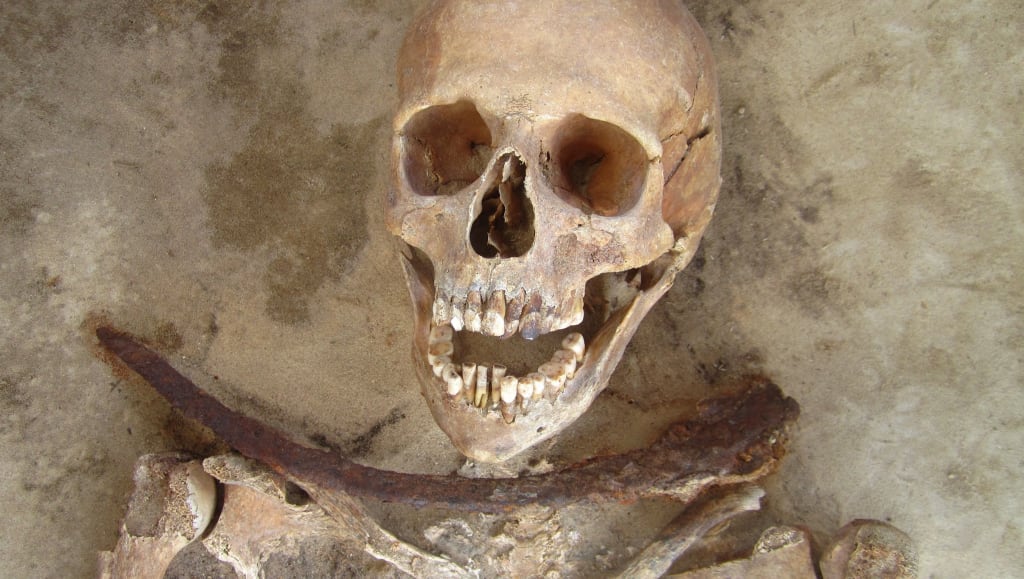
In the serene landscapes of Kilteasheen, County Roscommon, lies a site steeped in history and intrigue. Led by Chris Read, a lecturer in Applied Archaeology at Sligo Institute of Technology, a collaborative effort with colleagues from St Louis University set out to excavate this quiet corner of Ireland. Little did they know, their journey would unveil a mystery that transcended time and borders.
Their excavation began with the hope of uncovering remnants of a 13th-century Gaelic palace, yet what emerged from the earth surpassed all expectations. Amongst the soil and stones lay the remains of 137 individuals, offering a glimpse into life in this remote part of the Irish midlands during the early Middle Ages.
The site, serving as a graveyard from the 7th or 8th century until the 1500s, followed customary burial practices—except for two skeletons. These bodies had been subjected to violent treatment before interment—large rocks forced into their mouths, limbs broken, bodies contorted around large boulders. The scene was chilling, hinting at burial rituals veiled in superstition and fear.
Initially mistaken for victims of the Black Death, carbon dating revealed a much earlier origin, dating back to 600-800 CE. This revelation hinted at a belief far more sinister than disease—a belief in vampires. The idea that the Gaelic Irish of Kilteasheen harbored such superstitions challenges established notions of Western folklore.
While Ireland lacks a robust vampire tradition in folklore, tales of Eastern European origin have shaped the modern vampire mythos. Writers like Sheridan LeFanu and Bram Stoker drew inspiration from Eastern European superstitions, creating iconic literary vampires that continue to captivate audiences worldwide.
The vampire in popular Western culture first emerged from Eastern European tales in the wake of the Renaissance. Strange stories from regions like the Balkans, rife with cases of alleged vampirism, captivated imaginations and spread fear across Europe. Cases like that of Peter Blagojevic and Arnold Paole, with their eerie postmortem phenomena, fueled the spread of vampire lore.
Scientific understanding has since debunked many of these phenomena, attributing them to natural processes of decomposition. Yet, the impact of these stories on Western culture endures, shaping literary and cinematic portrayals of vampires as exotic and enigmatic beings.
The discovery at Kilteasheen challenges the notion that vampire superstitions were confined to Eastern Europe. Similar "deviant burials" have been unearthed in Britain and continental Europe, suggesting a wider prevalence of such beliefs in the ancient world.
The significance of the Kilteasheen discovery lies not only in its archaeological value but in its portrayal of a darker, more enigmatic past. It sheds light on ancient beliefs and practices, revealing a world where superstition and fear held sway over communities.
The dating of the bodies to the 7th or 8th centuries raises questions about Ireland's early medieval history, challenging the notion of a peaceful "golden age." The twisted, boulder-crushed corpses at Kilteasheen attest to a darker, more hidden past.
Legend intertwines with reality in the tale of the Abhartach—a tyrannical chieftain turned vampire—a story echoing the macabre discoveries at Kilteasheen. As mysteries of the past continue to unfold, one thing remains clear: the allure of the vampire transcends time and borders, leaving an indelible mark on human culture and imagination.
But what drove the Gaelic Irish of Kilteasheen to embrace such beliefs? Were they influenced by tales from afar, or did their superstitions arise from experiences closer to home? To answer these questions, we must delve deeper into the cultural and historical context of early medieval Ireland.
The 7th and 8th centuries were a time of significant change in Ireland. The conversion to Christianity, beginning in the 5th century, brought about profound shifts in religious beliefs and practices. Yet, alongside the spread of Christianity, older pagan beliefs and rituals persisted in rural communities.
In this transitional period, beliefs in supernatural beings and malevolent spirits coexisted with Christian teachings. The concept of revenants—walking dead who returned to haunt the living—was not uncommon in medieval Europe. In Ireland, these beliefs likely evolved from pre-Christian traditions and folklore.
The violent treatment of the two skeletons at Kilteasheen suggests a deep-seated fear of the dead and a desire to prevent their return. The placement of rocks in their mouths may have been a ritualistic attempt to prevent the deceased from rising again—a practice found in other cultures around the world.
The association of violence with suspected vampires is also noteworthy. Both individuals showed signs of physical trauma, suggesting they may have been perceived as threats to their community during their lifetime. This aligns with the idea of vampires as malevolent beings who prey on the living.
But how did these superstitions manifest in the everyday lives of the Gaelic Irish? Did they affect burial practices, social customs, or religious rituals? The answers to these questions remain elusive, buried beneath layers of history and myth.
The Kilteasheen discovery offers a tantalizing glimpse into the beliefs and fears of early medieval Ireland. As archaeologists continue to uncover new evidence and explore ancient sites, the story of the vampire skeletons serves as a reminder of the enduring power of folklore and the mysteries that lie buried beneath our feet.
About the Creator
David Shawn Farrell
Just a down to earth average Joe with a passion for the weird, the wonderful, the paranormal, the nitty gritty and the stone cold truth and facts. I am a truth seeker yet I too have a love for fact and fiction...
Keep reading
More stories from David Shawn Farrell and writers in History and other communities.
Wonders of the animal Kingdom
The animal kingdom is teeming with remarkable creatures, each with its own unique abilities and adaptations. From the seemingly mundane to the downright extraordinary, animals never cease to amaze us with their fascinating traits and behaviors. Let's delve into the world of animals and uncover some astonishing facts that will leave you in awe.
By David Shawn Farrell2 years ago in Earth
The "Demon of the Woods": The real-life historical origin of the Pied Piper.
The hollow clack of a wooden latch in an empty house is a sound that lingers. It is the sound of a period at the end of a sentence that no one wanted to read. In the town of Hamelin, on the twenty-sixth of June, 1284, that sound was repeated one hundred and thirty times. The morning air was likely thick with the scent of damp river-mud from the Weser and the yeasty tang of baking rye, but the kitchens stayed cold. No children laughed. No small feet kicked the dust of the Bungelosenstrasse. They were gone. Just like that. A whole generation of a small German village evaporated, leaving nothing behind but a jagged, visceral hole in the local history.
By The Chaos Cabinet3 days ago in History
Scientists Uncover the Lost Island That Gave Birth to Karnak Temple
For centuries, the origins of one of the world’s greatest temple complexes have been wrapped in mystery. Rising majestically from the banks of the Nile River, the vast sanctuary of Karnak Temple has long symbolized the power and spiritual vision of ancient Egypt. Now, scientists believe they have uncovered the secret of its beginnings: Karnak was likely built upon a lost island, once surrounded by channels of the Nile and revered as sacred ground.
By Sajida Sikandar2 days ago in History
The Salt in her Voice
The myth says mermaids sing to lure sailors to their death. But why? The ocean is huge. Only 5 percent has been discovered by man. Why would a creature of the sea with that much space to roam ever care about the fate of men on ships? The answer, as it turns out, is not a simple one at all. The truth about the myth is older than the tides. Long ago before the first ship ever cut across the surface, the sea made a pact with the sky. The sky would take the souls of the drowned. Anyone who died in storms or any quiet accidents of the deep would have their soul lifted upward to the Heavens while the bodies would remain below, feeding the oceans endless hunger. The greedy sea however wanted more souls than the sky would claim. So it created mermaids. It gave them beautiful voices woven from currents and moonlight. It commanded them to sing. "Bring forth the ones who float where they should sink." it instructed them. So they did. They never killed out of malice but out of obligation. They sung to summon, not to seduce. A mermaid's voice could loosen the tether between the body and soul, making any man step willingly into the water. The sea would take the body and the sky would take the soul. Balance maintained.
By Sara Wilson4 days ago in Fiction


Comments
There are no comments for this story
Be the first to respond and start the conversation.