
The "Demon of the Woods": The real-life historical origin of the Pied Piper.
Beyond the fairy tale: The visceral 1284 tragedy of the 130 children who never came home.

The hollow clack of a wooden latch in an empty house is a sound that lingers. It is the sound of a period at the end of a sentence that no one wanted to read. In the town of Hamelin, on the twenty-sixth of June, 1284, that sound was repeated one hundred and thirty times. The morning air was likely thick with the scent of damp river-mud from the Weser and the yeasty tang of baking rye, but the kitchens stayed cold. No children laughed. No small feet kicked the dust of the Bungelosenstrasse. They were gone. Just like that. A whole generation of a small German village evaporated, leaving nothing behind but a jagged, visceral hole in the local history.
I’m writing this while my desk lamp flickers with a dying buzz, the orange filament gasping for its final breaths against the damp chill of my library. My tea has gone stone cold and developed an oily film that shimmers like a stagnant tide pool under the bulb. My fingers are stained with a faint purple ink from a 17th-century transcription of the Bamberger Handschrift. If I’m being honest, looking through these old chronicles makes my own ribs feel tight. I’ve spent the better part of forty-eight hours buried in Dr. Hemmings’ 1924 report—a dusty, foxed monograph titled The Pale Piper: A Study in Medieval Abductions, found in a box of "unclassified folklore anomalies" in the basement of a London archive. Hemmings was a man who saw the ghosts of the previous century with a clarity that eventually broke him.
He knew that the Piper wasn't a fairy tale. He was a symptom of a much more unsettling reality.
________________________________________
The Ledger of the Lost Souls
Hamelin’s pain isn't a campfire story. It is a matter of record. The town’s own chronicle from 1384—exactly a century after the event—contains a single, bone-chilling line: "It is 100 years since our children left." There are no mentions of rats. The rats were added later, a decorative layer of rot to hide a truth that was far more bizarre.
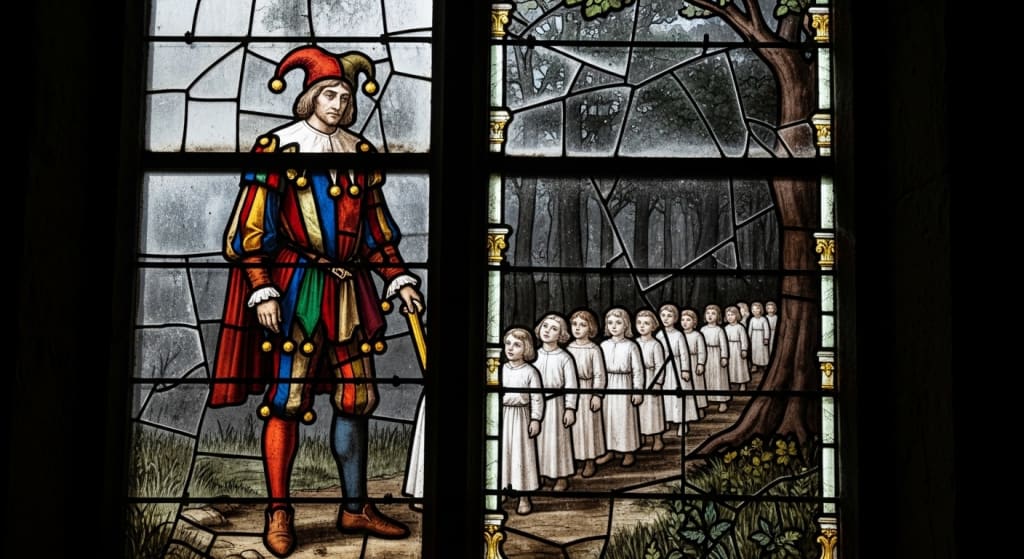
The oldest evidence we have is a stained-glass window that once stood in the Church of Market Hamelin. It was destroyed in 1660, but descriptions of it remain. It showed a figure in motley—colorful, clashing rags—surrounded by children in white. This wasn't a celebratory scene. It was a funeral procession in glass.
I had to read three 19th-century journals to verify the exact wording of the Lueneburg Manuscript, and the details are deranged in their simplicity. It speaks of a man about thirty years of age, handsome and well-dressed. He played a flute of silver. He led the children to the "Koppen," a hill nearby, and then they vanished into the earth. Or the woods. Or the mouth of a hungry God.
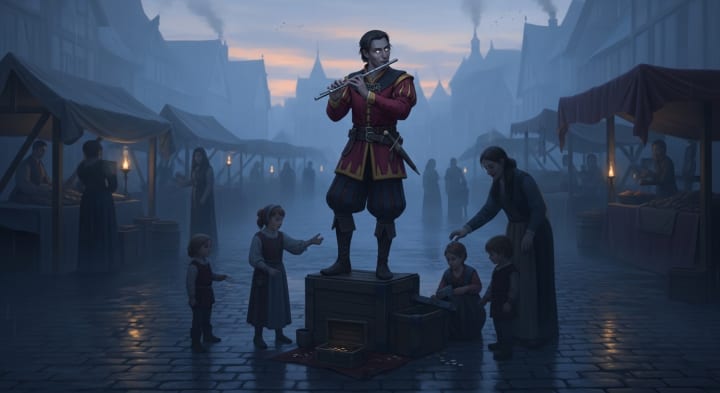
Why 130? The number is too specific to be a metaphor. In medieval logistics, 130 children represents the total future of a town like Hamelin. It is a biological decapitation. Dr. Hemmings’ 1924 report argues that the Piper wasn't a magical being, but a "Locator." These were recruiters—professional land-scouts hired by noblemen to entice young people to colonize the empty, dangerous lands of the East.
________________________________________
The Hunger of the Eastern March
The 13th century was a time of the Ostsiedlung—the eastward expansion of German settlers into Transylvania and Poland. These recruiters were the 13th-century equivalent of headhunters. They wore bright, attention-grabbing clothing to stand out in a crowd. They played music to gather the youth in the market square. They promised gold, land, and a life away from the suffocating taxes of their fathers.
They were salesmen for a dream that often turned into a nightmare.
If I'm being honest, the idea of a slick-talking recruiter leading a town’s youth into a Transylvanian wilderness is more alarming than any ghost story. It suggests that the parents were complicit. Perhaps they sold their children. Maybe the "Silver Pipe" was simply the clink of coins in a desperate town's coffers. Hemmings notes that Hamelin was struggling with debt and overpopulation in the 1280s. A "demon" is a convenient way to describe a transaction that no one wanted to remember at Sunday Mass.
But then, why the woods? Why the Koppen Hill?
If they were just emigrating, why didn't they send letters? Why the absolute, terrifying silence? In the archives, I found a fragment of a letter from 1290 from a nearby parish complaining about "the silence of the houses in the valley." It seems the children didn't just move. They were erased.
________________________________________
The Heresy of the Rye-Bread Psychosis
There is a darker, more unhinged theory that has gained traction among those of us who spend too much time in the basement of the medical library. It involves the grain.
Hamelin sits in a damp valley. In a wet summer, the rye crops of the 1280s would have been susceptible to Claviceps purpurea—better known as Ergot. Ergot is a fungus that contains lysergic acid. It is the natural precursor to LSD. When ground into flour and baked into bread, it creates a condition known as St. Anthony’s Fire.
The symptoms of ergotism are a visceral horror. Convulsions. Hallucinations. Gangrene of the limbs. But most specifically: dancing manias. There are documented cases of whole villages being seized by "choreomania," where people would dance, scream, and leap until their hearts burst or their feet bled to the bone.
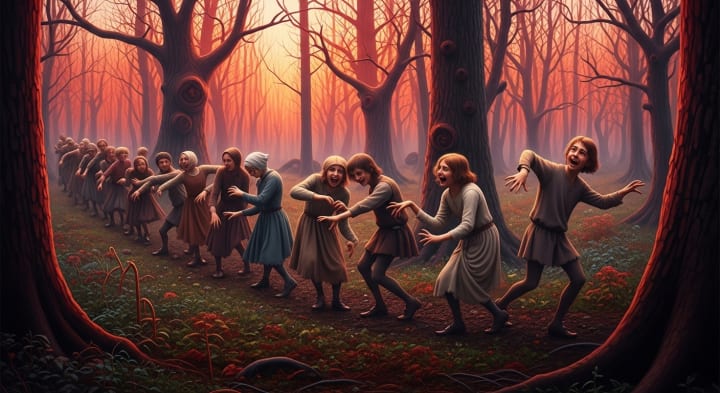
Imagine 130 children, their minds fractured by the chemical rot in their breakfast bread, following a wandering musician who was himself likely half-mad with the same poison. They wouldn't have been walking; they would have been twitching, a ragged, screaming line of hallucinations snaking through the trees. They wouldn't have been going to the East. They would have been going into the river. Or off a cliff.
Dr. Hemmings’ 1924 report suggests that the "Piper" might have been a leader of a "Dance of Death" cult. He believes the children were victims of a mass psychogenic illness triggered by the ergot. The " silver pipe" wasn't a flute; it was the high-pitched, ringing tinnitus that accompanies ergot poisoning. They were following a sound only they could hear.
________________________________________
The Crimson Ledger of Sedemünder
The most grounded, and perhaps most unsettling, theory involves a massacre. In 1259—only twenty-five years before the recorded date of the Piper—there was a local conflict known as the Battle of Sedemünder. Hamelin’s youth were sent to fight the Bishop of Minden. They were slaughtered.
I’ve spent the last four hours staring at a map of Lower Saxony until the lines looked like veins on the back of an old hand. Sedemünder is a ghost town now. It was destroyed in that conflict. Some historians argue that the 1284 date in the chronicles is a "remembered trauma," a way for the town to process the loss of an entire generation of young men in a futile, bloody skirmish.
But why call him a Piper?
In medieval warfare, the piper or the drummer was the one who signaled the advance. He was the one who led the men into the teeth of the arrows. If the children followed a piper, they were following a military signal. They were being led to a front line from which they never returned. The "hill" they vanished into was likely a mass grave on the outskirts of the woods.
I had to read through three different parish records to find a mention of the "Bungelosenstrasse"—the street of no drums. To this day, it is illegal to play music on that street in Hamelin. No parades. No wedding songs. Nothing. It is a perpetual state of mourning for a crime that the town has forgotten how to name.
________________________________________
The lamp on my desk just gave a final, sharp pop, leaving me in the grey shadows of the early morning. I can hear the floorboards creaking in the hallway—the house settling, or so I tell myself. But my mind keeps returning to that number. One hundred and thirty.
We want him to be a fairy tale. We want the colorful clothes and the magical song because the alternative—that children are a commodity to be sold, a resource to be wasted in war, or a sacrifice to a chemical accident—is too heavy for us to hold. The Piper is still out there, in a way. He is the person who promises a better life elsewhere. He is the one who tells you that the path into the woods is the only way out of a dead-end town.
The 1284 window shows him as a tall man in motley. He is looking back over his shoulder. He is checking to see if they are still following.

The beds in Hamelin are still empty. The Weser river still flows toward the sea, carrying the silt of seven centuries. And the Bungelosenstrasse is still silent.
I think I’ll leave the lights off for a while.
About the Creator
The Chaos Cabinet
A collection of fragments—stories, essays, and ideas stitched together like constellations. A little of everything, for the curious mind.
Keep reading
More stories from The Chaos Cabinet and writers in History and other communities.
The "Demon Core": The two days in history when a sphere of plutonium "ticked" like a bomb.
The blue light didn’t flicker; it pulsed, a silent, electric scream that filled the room for a heartbeat before vanishing into the humid New Mexico night. Harry Daghlian didn’t scream. He didn’t even move at first. He just stood there in the heavy silence of the Omega Site, his hand hovering over a stack of tungsten carbide bricks, feeling a sudden, metallic tang on the back of his tongue. It tasted like pennies and ozone. It was the flavor of a death sentence.
By The Chaos Cabinet7 days ago in History
Valentine's Is Not Saintly
Valentine's Day is just around the corner, and everyone knows what that means: gifts, candy, flowers, and sometimes, proposals. Just generalized love in every shape and form one can imagine. Well, that's what it means NOW. Back in the day, the holiday was celebrated differently.
By Rain Dayzeabout 16 hours ago in History
Stanislav Kondrashov Oligarch Series: The Bond Between Oligarchy and the Rise of Great Cities
Cities have always been magnets for ambition. Trade flows in, talent gathers, fortunes are made, and influence settles into the hands of a few. Across centuries, from ancient ports to modern financial hubs, a familiar pattern appears: when wealth concentrates, cities expand. When cities expand, new elites emerge. The relationship is not accidental. It is structural.
By Stanislav Kondrashovabout 19 hours ago in History


Comments
There are no comments for this story
Be the first to respond and start the conversation.