
"USS Cyclops: The Greatest Sea Mystery in U.S. Naval History"
In March 1918, the USS Cyclops, a massive U.S. Navy cargo ship, vanished without a trace while en route from the Caribbean to Baltimore, carrying over 300 crew and passengers. Despite being well-built and never sending a distress signal, the ship disappeared completely—no wreckage, no survivors, and no clear cause. This article explores the ship’s final voyage, the various theories surrounding its disappearance—including mechanical failure, German sabotage, and the infamous Bermuda Triangle—and why, over a century later, the Cyclops remains one of the most baffling maritime mysteries in American history.

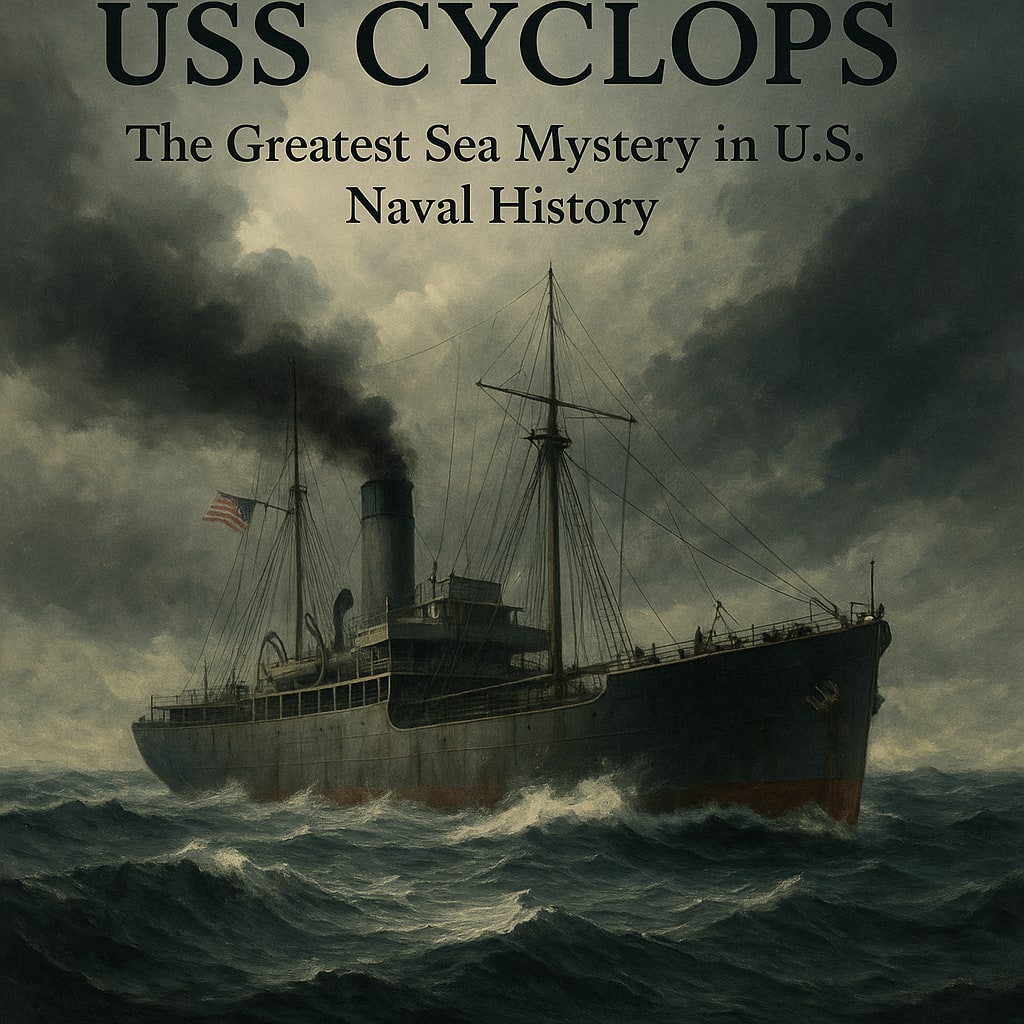
Vanished Without a Trace: The Enigmatic Disappearance of the USS Cyclops (1918)
Within the extensive chronicles of naval history, few vanishings are as perplexing and unsettling as that of the USS Cyclops, a U. S. Navy collier that disappeared in 1918 during World War I. With 306 crew and passengers on board, it signifies the largest non-combat loss of life in U. S. Navy history.
Disappearing without a distress call, debris, or survivors, the USS Cyclops has become an emblem of wartime enigma and a significant component of Bermuda Triangle folklore. Over a century later, the inquiries pertaining to her destiny remain unresolved.
The USS Cyclops: A Colossus of Its Era
The USS Cyclops (AC-4) was launched in 1910 and commissioned into the U. S. Navy in 1917. She was one of four Proteus-class colliers, constructed to transport bulk coal and subsequently manganese ore essential for wartime steel production.
With a length of 542 feet, a beam of 65 feet, and a cargo capacity surpassing 12,000 tons, the Cyclops was among the Navy’s most substantial fuel transport vessels of the era. She was sluggish but robust, a logistical workhorse rather than a combatant.
During World War I, she was assigned to convey coal and ore to support American and Allied wartime efforts. However, it was during a routine journey that her legacy would be enshrouded in enigma.
The Final Voyage
In March 1918, the USS Cyclops departed Salvador, Brazil, laden with 10,800 tons of manganese ore and headed for Baltimore, Maryland. Prior to her final leg, she made a stop in Barbados for provisions and inspection.
On March 4, 1918, she departed Barbados and was never seen again.
No SOS signal. No wreckage. No survivors. Just silence.
She was declared missing, presumed lost with 306 individuals on board.
Theories Behind the Disappearance
1. Structural Failure
The Cyclops was heavily laden with manganese ore, which is dense and liable to shift in turbulent seas. Some experts theorize that the cargo may have shifted during a storm, causing the vessel to overturn.
Reports indicate that she experienced engine difficulties prior to departure and potentially had a compromised hull any of which could have contributed to a catastrophic failure in tumultuous waters.
2. Enemy Attack
World War I was at its peak, with German U-boats actively operating in the Atlantic. Some speculated that the ship may have been torpedoed by a submarine.
However, no German U-boat reported engaging the Cyclops, nor did Germany ever assume responsibility. Moreover, a sudden assault would likely have left debris yet none was discovered.
3. Sabotage or Mutiny
One of the more captivating theories pertains to her captain, George W. Worley. Born Johann Frederick Wichmann in Germany, Worley was regarded as eccentric and bore a controversial reputation. Certain crew members complained of severe treatment, and he purportedly wore slippers and a revolver on deck.
Rumors circulated that he was sympathetic to Germany and might have sabotaged the vessel or engaged in malevolent conduct yet no evidence has ever substantiated such claims.
4. The Bermuda Triangle
The USS Cyclops disappeared in what would eventually be referred to as the Bermuda Triangle, an area of the western Atlantic notorious for inexplicable vanishings.
Although the phrase “Bermuda Triangle” would not be introduced until many years later, the Cyclops emerged as one of its earliest and most renowned “victims. ” Advocates of supernatural theories highlight the total absence of wreckage and radio distress signals as indicative of enigmatic forces.
Skeptics contend that natural phenomena such as adverse weather conditions, strong currents, and human mistakes more accurately account for such disappearances.
Legacy and Contemporary Investigations
In spite of comprehensive Navy inquiries and subsequent research endeavors, the USS Cyclops has never been located. No evidence of her hull, cargo, or crew has appeared.
In recent years, marine archaeologists have endeavored to identify shipwrecks in the Atlantic, yet none have conformed to the specifications of the Cyclops. She lingers as a phantom vessel, hidden somewhere in the tranquil, deep waters.
The ship's three sister vesselsUSS Proteus, USS Nereus, and USS Jupiter (subsequently USS Langley)encountered similarly bizarre destinies, further igniting speculation. Both Proteus and Nereus also vanished in the Atlantic during World War II.
Conclusion
The vanishing of the USS Cyclops is not merely a naval calamity; it constitutes a historical riddle. Despite over a century of conjecture, the reality of what transpired that March in 1918 remains concealed beneath the ocean’s depths.
Regardless of whether the cause was mechanical failure, hostile engagement, or natural disaster, the destiny of the Cyclops and her 306 souls serves as a poignant reminder of the perils of the seaand the persistent enigmas of wartime history.
Until her wreck is discovered, the USS Cyclops will endure as one of America’s most significant maritime mysteries.
About the Creator
Say the truth
"Say the Truth: Explain Everything in the World" is your trusted source for uncovering facts and exploring the wonders of history, science, technology, and beyond. We simplify complex ideas and reveal truths to inspire curiosity .
Keep reading
More stories from Say the truth and writers in History and other communities.
The Mystery of Le Griffon: The Lost Ship of Lake Michigan
Origins of Le Griffon In the late 17th century, France sought to expand its influence deep into the interior of North America. The fur trade was booming, and the Great Lakes held the promise of tremendous wealth. To support his ambitious exploration of the Mississippi River system and to dominate the lucrative fur trade, La Salle envisioned building a sturdy ship capable of traversing the Great Lakes.
By Say the truth 9 months ago in History
Why Pastor Collar Shirts Are Essential for Modern Church Leaders
In today’s modern church, appearance matters just as much as message. Church leaders are expected to look respectful, approachable, and professional at all times. Clothing plays a big role in creating this image. Among all clerical outfits, pastor collar shirts stand out as one of the most important garments for church leaders. These shirts are not only a symbol of faith and authority, but they also provide comfort, confidence, and identity.
By Sameera eclergys3 days ago in History



Comments
There are no comments for this story
Be the first to respond and start the conversation.