
Uncover the Book of the Dead
The Original Uses and Their Significance
The "Book of the Dead" is perhaps better described as The Book of Coming Forth by Day or The Book of Emerging into the Light. This powerful collection of spells and rituals dates back to the start of Egypt's New Kingdom, serving as a guide for the deceased in their quest to enter a glorious afterlife. But this wasn't just about reaching a typical heaven—no, it was about joining the ranks of the gods themselves.
And here's an interesting twist: despite its name, the "Book of the Dead" wasn’t actually a book in the way we think of it. But we’ll get to that little detail shortly. Essentially, this ancient text is more like a manual for the recently deceased, with one key difference—it didn’t come with a bio-exorcist in stripes.
What's fascinating is that there wasn’t one standard version of the text. People often customized their own personal "Book," choosing the spells and instructions that they believed would help them navigate the treacherous trials of the afterlife. Think of it as a soul-saving Madlib—a unique mix of divine guidance.
During the Early Dynastic Period, the majority of funerary sites in Egypt were devoid of inscriptions, hinting that oral traditions governed funeral rites and rituals. What we do know from the evidence is that the dead were ritually cared for, with their bodies carefully embalmed and buried with artifacts that reflected a deep belief in life after death.
The scenes painted on the walls of temples, often depicting Pharaohs performing daily offerings to the gods, offer some clues. These offerings bear a striking resemblance to those described in later funerary texts, suggesting that the rituals linked to the afterlife were already in place—but the true meaning of these practices remains a bit of a mystery, especially when we're left to interpret them from mere illustrations alone.
Decorated burial chambers and tombs quickly became symbols of power—social, religious, and political. By the Third Dynasty, written inscriptions began to emerge, marking a shift in how the Egyptians viewed their afterlife. Having a grand tomb was more than just a burial place; it was a status symbol, a way to solidify your legacy. It ensured your name lived on, a vital concept for the ancient Egyptians, though it wasn’t strictly necessary for everyone.
It wasn’t until the Fifth Dynasty that inscriptions began to explicitly address the deceased's life after death. Today, we call these the Pyramid Texts. The text inside the Pyramid of Unas, for example, detailed how the king could successfully navigate the afterlife.
Fast forward to the First Intermediate Period, and many of the original Pyramid Texts, along with new spells and illustrations, began to appear on the inside of coffins rather than inside massive tombs. These became known as the Coffin Texts. They gained popularity among the elite members of Egyptian society, but this trend didn't really take off until the Middle Kingdom.
Funerary rites had existed long before they were recorded in the Old Kingdom. While we may call them the Pyramid Texts, Coffin Texts, or even the Book of the Dead today, these terms are modern labels, not what the Egyptians themselves used. Some of the rituals needed to be performed, while others were optional. Sometimes, simply knowing that these rites existed was enough to ensure safe passage. This is why having a scroll or an illustration of the spells during burial could be helpful, but it wasn’t always essential.
And here's something crucial to keep in mind: in this context, rituals and spells are not the same thing.
You had to know the spell, but more importantly, you had to perform the ritual. This meant you didn’t need to physically carry a copy of the spell with you in your burial items. In fact, someone else could carry out the ritual on your behalf. If you knew about the spell during your life, it was assumed that knowledge would carry over into the afterlife.
What really mattered was that the spell was written down somewhere—and that you were aware of it. By the time of the New Kingdom, during the 18th and 20th Dynasties, descriptions of what the afterlife was supposed to look like were included in funerary texts and tombs.
Here’s an interesting tidbit: many of the spells in what we now call the Book of the Dead probably had nothing to do with funerary rites at first. And by the way, the Book of the Dead isn’t even the right name! The ancient Egyptians referred to this collection of writings as “Spells for Going Out in Daylight,” or more simply, “How to Get to the Afterlife.”
These spells were far from static—constantly changing with updates, corrections, and additions. They could be found on papyrus scrolls, linens, walls, and other burial objects. And contrary to what you might expect, it wasn’t just the wealthy or powerful who had access to them. In fact, even the elite sometimes cut corners.
While some protective amulet spells outlined in the Book of the Dead were meant to be made of solid gold, only a handful of these have ever been found in grave sites, probably due to their high cost. More commonly, mummies were buried with amulets made from less expensive materials, like glazed ceramics or simple gold gilding.
Even the famous King Tut’s amulets weren’t all made of solid gold. Imagine all the lavish tombs, packed with everything one could possibly want for the afterlife—this was the extra stuff, the bonus items. It was a way to showcase wealth and status, and while it certainly couldn’t hurt, it wasn’t required for entry into the afterlife.
It was also during this time that more written funerary texts began to emerge. These texts were collectively referred to as the Books of the Netherworld—even though, of course, there weren’t any actual books. Some of these texts were more uplifting, while others were far darker. The Book of the Dead, generally speaking, isn't all that grim. But then there's the Amduat. That one is filled with doom, gloom, monsters, and torture.
You’ve probably heard that the Book of the Dead dramatically shifted how ancient Egyptians saw the afterlife. It’s said to have suggested that anyone, regardless of social class, could reach the most exalted parts of the afterlife. Some even call it the democratization of the afterlife.
This theory first emerged in early 20th-century scholarship and was widely accepted by Egyptologists and scholars for many years. For a long time, the conventional wisdom was that the Book of the Dead significantly transformed the Egyptian perspective on life after death.
But that’s not exactly the whole story. In reality, there’s a much longer history that suggests the Book of the Dead wasn’t some groundbreaking shift in Egyptian beliefs. Instead, it was more of a collection of funerary spells and practices that most Egyptians already had access to.
Some scholars now argue that even in the Old Kingdom, non-royals and non-elites had access to similar funerary rituals and texts. The idea of the democratization of the afterlife is a bit of a misconception—there didn’t really need to be such a shift. Social access to the afterlife may have evolved as political and religious beliefs changed, and certainly, some people showed off their social status more extravagantly.
Of course, the king had special access and privileges, including the power to judge who could enter the afterlife. But since kings were seen as part divine, that’s hardly surprising. The Egyptian afterlife was, in theory, open to all, but the social hierarchy still remained.
One reason so many people know about the Book of the Dead today is because of one particular specimen that was found mostly intact and well-preserved: the Papyrus of Ani.
So, who was Ani in the Papyrus of Ani, you might wonder? He was a scribe. This papyrus dates back to around 1250 BCE, specifically from the 19th Dynasty of the New Kingdom. Not only is the text rich with hieroglyphics, but it also features various vignettes showing Ani as he faces his trials in the afterlife.
Each version of the Book of the Dead differs slightly in how it depicts these trials, but there are many common elements. One of the most prominent is the Sun God Ra, whose daily journey illuminated the underworld, while the mortal world entered the night, joining Osiris for a bit of rest and relaxation.
The afterlife wasn’t exactly a walk in the park. There were all sorts of terrifying creatures lurking in the dark waters, like the massive serpent Apep, who was always trying to thwart Ra's return.
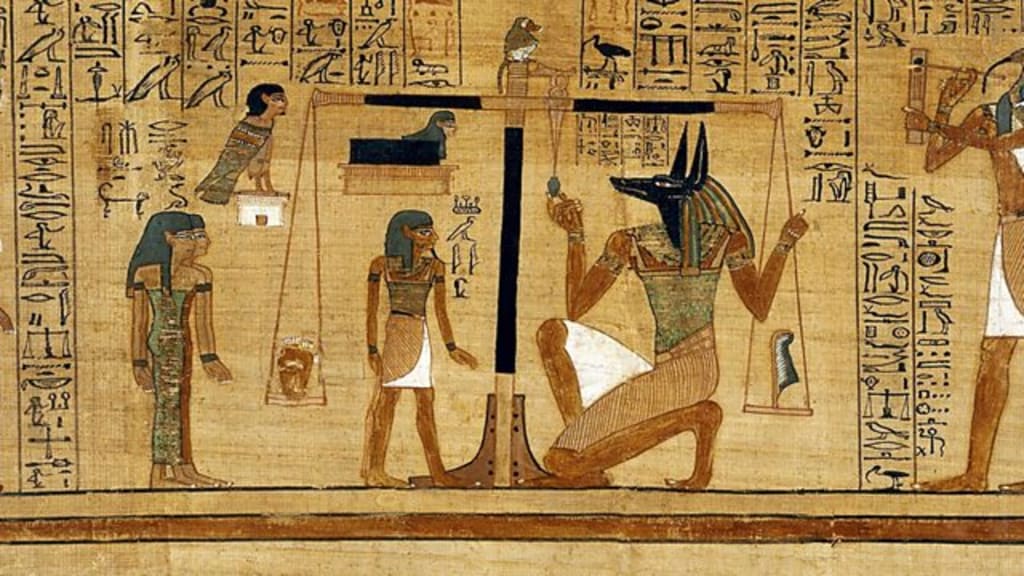
But the afterlife only really becomes rewarding if you make it through a series of treacherous labyrinths, eventually reaching the Judgment of the Dead—or what’s more commonly known as the Weighing of the Heart.
This momentous event required you to correctly identify the 42 assessors of Maat, while also listing all the sins you didn’t commit, proving the purity of your heart.
"Halt."
"Excuse me, I’m just trying to get to the afterlife…"
"Whoa! Okay, I’m loving that for you. But before you go, you need to confirm the purity of your heart. So, tell me—what sins haven’t you committed?"
"Spill the tea, sis."
"I haven't committed witchcraft against the King."
"Emphasis noted, but go off, Queen."
"I've never been angry without just cause."
"And trust me, I always have a just cause."
"Mm!"
"I am not a man of deceit."
"Dang, that's a loophole. We really need to update that."
"Alright, next!"
If you pass this test, your heart will be weighed by Anubis, the jackal-headed god. He’ll place your heart on a scale, opposite the feather of Maat. If your heart weighs the same as the feather, you’re in luck.
Thoth, the ibis- or baboon-headed god of knowledge, magic, and judgment, will then record the result. He’ll pass your soul onto Osiris, the god of the underworld.
Osiris will let you continue your journey to the Field of Reeds—or the Field of Offerings—where the worthy dead can live as mortals in an idealized paradise. But this is only a pit stop on the way to the ultimate goal: transformation into a spirit capable of crossing the boundary of the netherworld and joining Ra on his celestial journey—basically, becoming part of his entourage.
Oh, and if you don’t pass, well, there’s always the option of having your soul devoured by the goddess-demon Ammit… or enduring some serious torture.
All things considered, though, it was a pretty fair system compared to other world religions of the time.
Respect the Gods, remember the bad stuff you decided not to do, know the funerary spells, and hope for the best.
The Book of the Dead and the other so-called Books of the Netherworld provide us with a written collection of ancient Egyptian funerary practices—an evolving set of traditions that were passed across social classes, some of which might even have a common origin.
This collection also gives us access to fascinating art and intriguing concepts. But it’s important to recognize that these texts represent practices that continuously evolved over time.
There’s a common misconception that the Book of the Dead dramatically restructured ancient Egyptian religion. This idea is a helpful reminder for us modern folks: we need to approach our interpretation of ancient artifacts with an open mind.
Egyptian mythology is complex. Their burial practices are complex. But then again, so is life—and so is death.
About the Creator
ADIR SEGAL
The realms of creation and the unknown have always interested me, and I tend to incorporate the fictional aspects and their findings into my works.
Keep reading
More stories from ADIR SEGAL and writers in History and other communities.
The Hatter of Wonderland
The Mad Hatter. Even if one is only loosely acquainted with Alice’s Adventures in Wonderland, his name is almost certainly familiar. Among the many peculiar souls Alice encounters, the Hatter stands as one of the most memorable—an erratic and enigmatic host of the infamous tea party, where logic bends and time itself is undone.
By ADIR SEGALabout a year ago in History



Comments (1)
Thank you so much for being transparent about using AI 😊