
Twisted Tales from the Past # 1
The Curious Case of Mary Toft: The Woman Who "Gave Birth" to Rabbits

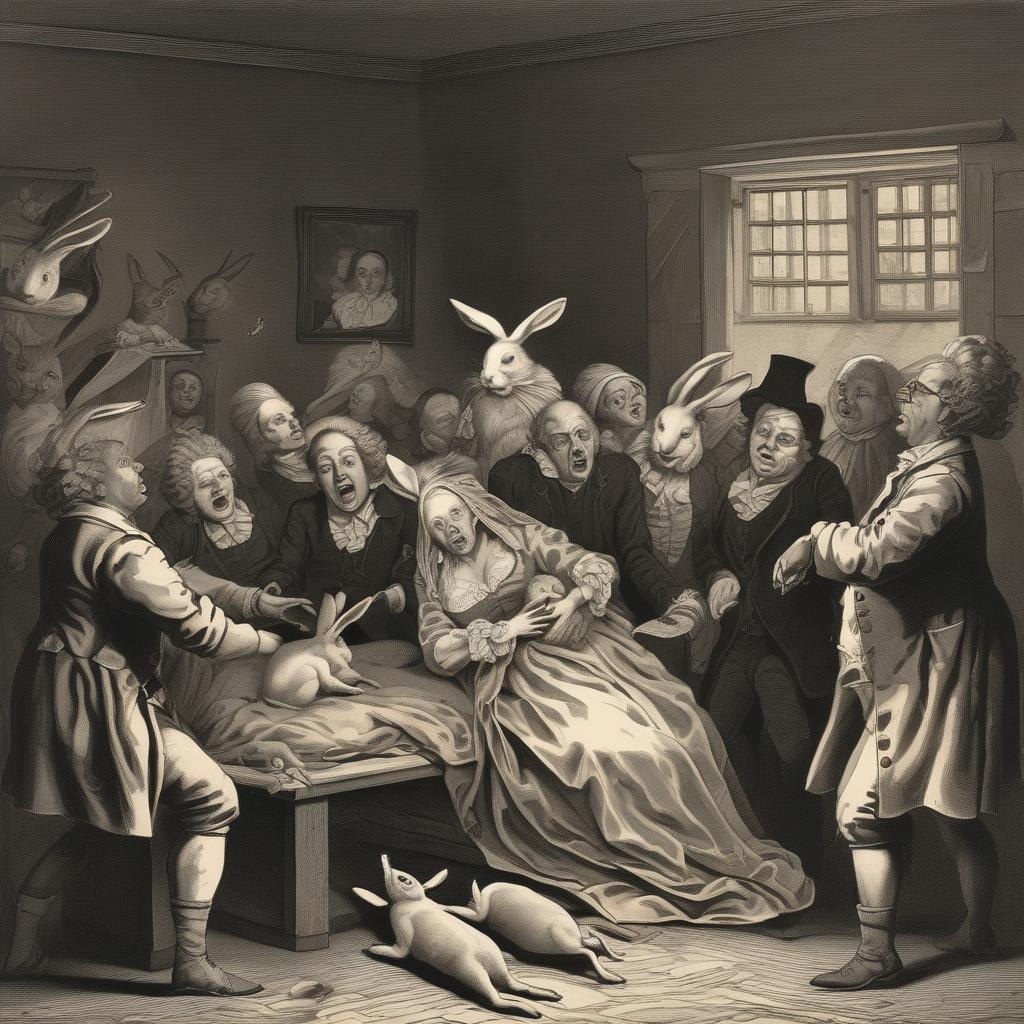
What if a shocking medical marvel turned out to be an elaborate hoax that fooled an entire nation?
A Sensation is Born
In 1726, in the quiet town of Godalming, England, a peasant woman named Mary Toft became the center of one of the most bizarre medical scandals in history. Mary, already a mother of three, claimed to have given birth—not to a human child—but to rabbits. This astonishing news quickly spread, capturing the imaginations of the public and the medical community.
The Birth of a Bizarre Phenomenon
Mary Toft's strange tale began after she reportedly miscarried. Shortly after that, she started "delivering" parts of animals—initially, cat intestines and later rabbit remains. Local surgeon John Howard was called to witness these unusual births. Astonished by what he saw, Howard documented the events and sent word to other medical professionals, including Nathaniel St. André, the Swiss-born surgeon to King George I.
Mary explained that during her pregnancy, she had been startled by a rabbit in a field and developed an intense fixation on rabbits, a phenomenon known as "maternal impression." At the time, it was a common belief that a mother's experiences and desires could physically affect her unborn child. This explanation lent credibility to her claims in the eyes of many.
The Doctors Take the Bait
Intrigued by the possibility of a medical marvel, St. André and several other physicians traveled to Godalming to observe Mary firsthand. Over several days, they witnessed Mary "giving birth" to more rabbit parts. St. André was convinced of the phenomenon's authenticity and published a pamphlet detailing his observations, which only fueled public fascination.
Mary was subsequently moved to London for closer examination. She became a sensation, and crowds gathered outside her residence, hoping for a glimpse of the woman who defied natural law. The case challenged the medical understanding of the time and became a topic of intense debate among physicians and scholars.
Unraveling the Hoax
Skepticism began to grow within the medical community. King George I, keen to uncover the truth, ordered physician Cyriacus Ahlers to investigate. Ahlers noticed inconsistencies, such as some rabbit parts showing signs of being cut with a knife and others appearing to have been cooked. He also observed that Mary produced no rabbit parts under close supervision.
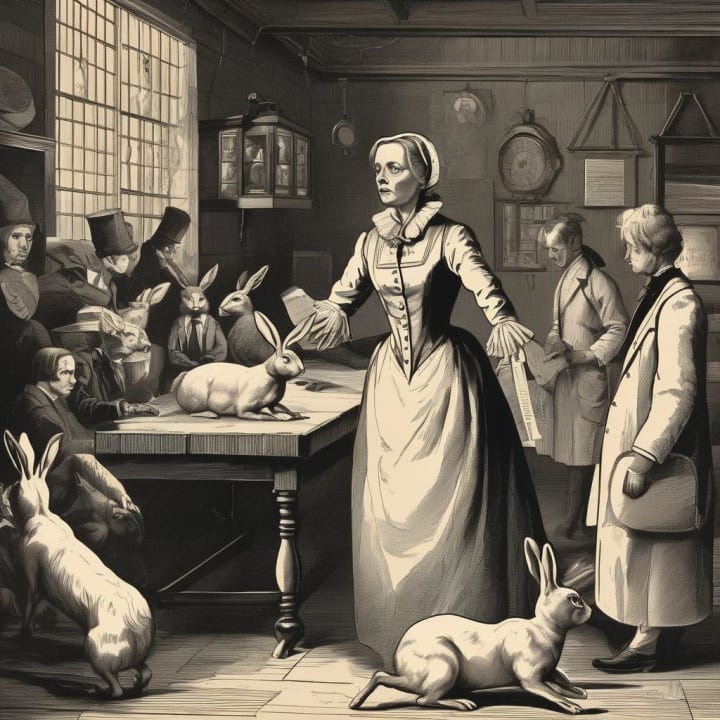
Under increasing scrutiny and pressure, one of Mary's accomplices confessed that the entire affair was a hoax. Confronted with this revelation, Mary Toft admitted to manually inserting dead rabbits and animal parts into her body and then pretending to give birth. Her husband, Joshua Toft, and others who supplied the animal parts had aided her.
The Dark Mechanics Behind the Deception
The motivations behind Mary Toft's elaborate ruse were complex. Living in poverty, the Tofts may have hoped to gain financial reward or patronage from the nobility. The hoax also brought them fame and attention unimaginable for rural peasants. Mary's actions highlighted the lengths individuals might go to when driven by desperation and the allure of notoriety.
The gruesome nature of the deception—manipulating her own body in such a hazardous way—shocked the public. It also exposed the gullibility of the medical professionals eager to believe in the miraculous without sufficient evidence.
The Fallout: A Nation Humiliated
The exposure of the hoax had widespread repercussions. The medical community faced ridicule for being duped so easily. Satirists and pamphleteers seized upon the scandal, producing scathing critiques and cartoons that mocked both the physicians involved and the broader credulity of society.
Nathaniel St. André, one of Mary's most vocal supporters, saw his reputation irreparably damaged. He lost his position at court and faded into obscurity. The incident prompted a public questioning of medical authority and sparked discussions about the need for empirical evidence and skepticism in scientific inquiry.
Mary Toft was arrested and charged with being a "Notorious and Vile Cheat." She spent several months in prison but was eventually released without formal charges. She returned to Godalming, where she lived a relatively quiet life until she died in 1763.
Reflections on Credulity and Desperation
The Mary Toft affair serves as a stark reminder of the interplay between human desperation and deception and the susceptibility of even learned individuals to being misled by sensational claims. It underscores how societal beliefs and superstitions can cloud judgment, leading to the suspension of critical thinking.
At a time when medical science was still in its infancy, the incident highlighted the need for rigorous scientific methods and skepticism. It exposed the dangers of confirmation bias, where professionals see what they expect or hope to see rather than what is empirically supported.
Legacy: A Cautionary Tale
The bizarre case of Mary Toft left an indelible mark on medical history. It prompted a reevaluation of medical practices and the importance of evidence-based science. The scandal became a catalyst for advancing the Enlightenment ideals of reason and empiricism over superstition and anecdotes.
Today, Mary Toft's story is studied as an example of mass deception and the psychological and social factors that can lead to widespread belief in the improbable. It remains a fascinating chapter in the annals of medical anomalies, reminding us of the perpetual need for critical inquiry and the perils of gullibility.
The tale of Mary Toft is a compelling reminder of how easily truth can be obscured by the extraordinary and how critical thinking is essential in the face of sensational claims. It echoes through history as a bizarre footnote and a profound lesson in human psychology and the pursuit of knowledge.
References:
Todd, Dennis. Imagining Monsters: Miscreations of the Self in Eighteenth-Century England. University of Chicago Press, 1995.
Bondeson, Jan. The Medical Museum: Collections of Medical Anomalies in England. The History Press, 2010.
British Medical Journal. "Mary Toft: The Rabbit Breeder." BMJ, 1999.
Porter, Roy. The Greatest Benefit to Mankind: A Medical History of Humanity. W.W. Norton & Company, 1997.
Hunter, Richard. Three Hundred Years of Psychiatry, 1535–1860. Oxford University Press, 1963.
About the Creator
Anthony Michael
A Student of History, an Aspiring Writer (Still Learning), & Likes to Collect Vintage Items. Currently, spending some time learning and studying online income methods.
Keep reading
More stories from Anthony Michael and writers in History and other communities.
Beyond the Page: Unearthing History Through Fiction
What if the stories we read weren't just confined to the pages of a book, but offered a portal to understanding the complex tapestry of history? For history enthusiasts, immersing oneself in a well-crafted historical novel can be a profoundly satisfying experience, a journey through time brought to life by the writer's skillful hand. This article explores three such novels, each offering a unique lens through which to examine the past.
By Anthony Michaelabout a year ago in History


Comments
There are no comments for this story
Be the first to respond and start the conversation.