
Trump administration says wrongly deported man is alive in El Salvador prison
The U.S. government continued to refuse to provide any details about whether it has taken any steps to return him to the United States.


The Terrorism Confinement Center in El Salvador is a notorious prison where Kilmar Abrego Garcia is now held after being illegally deported. | Alex Peña/Getty Images
By Kyle Cheney and Josh Gerstein
04/12/2025 06:16 PM EDT
Updated: 04/12/2025 07:40 PM EDT
The Trump administration confirmed Saturday that Kilmar Abrego Garcia, a Maryland man illegally deported to El Salvador, is alive but confined in a notorious anti-terrorism prison under the control of the Salvadoran government.
“He is alive and secure in that facility. He is detained pursuant to the sovereign, domestic authority of El Salvador,” Michael Kozak, a top State Department official, said in a two-page, written declaration submitted to a judge under penalty of perjury.
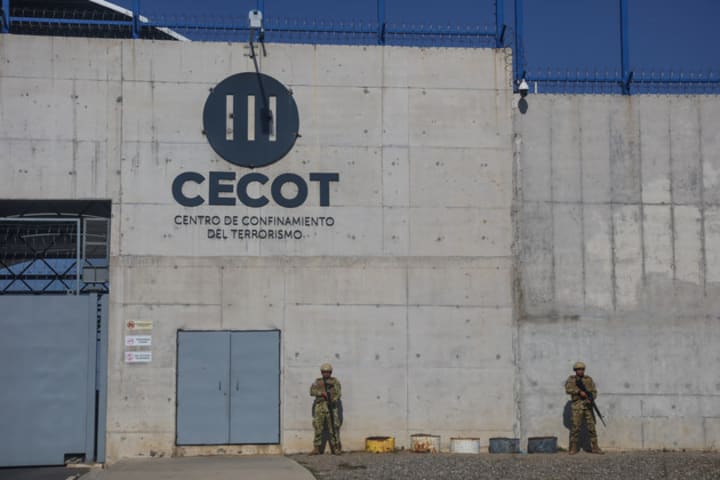
The Terrorism Confinement Center in El Salvador is a notorious prison where Kilmar Abrego Garcia is now held after being illegally deported. | Alex Peña/Getty Images
By Kyle Cheney and Josh Gerstein
04/12/2025 06:16 PM EDT
Updated: 04/12/2025 07:40 PM EDT
The Trump administration confirmed Saturday that Kilmar Abrego Garcia, a Maryland man illegally deported to El Salvador, is alive but confined in a notorious anti-terrorism prison under the control of the Salvadoran government.
“He is alive and secure in that facility. He is detained pursuant to the sovereign, domestic authority of El Salvador,” Michael Kozak, a top State Department official, said in a two-page, written declaration submitted to a judge under penalty of perjury.
logo
01:27
02:00
Read More
Kozak’s submission came shortly before Trump retreated from comments he made a day earlier in which he suggested that he’d direct Abrego Garcia’s return to the U.S. if the Supreme Court required that.
“These barbarians are now in the sole custody of El Salvador, a proud and sovereign Nation, and their future is up to President [Nayib Bukele] and his Government,” Trump wrote on Truth Social Saturday evening. “They will never threaten or menace our Citizens again!”
Speaking to reporters on Air Force One on Friday night, Trump appeared to indicate that the U.S. has the authority to insist on the return of Abrego Garcia and perhaps all of the more than 200 men Trump’s administration has sent to El Salvador in recent weeks.
“If the Supreme Court said bring somebody back, I would do that. I respect the Supreme Court. … I have great respect for the Supreme Court,” the president said. “I’m not totally well versed as to the specific case, but if they said to bring him back, I would tell them to bring him back.”
Trump’s social-media post and Kozak’s declaration both seemed intended to support a legal argument the Trump administration has put forward that American officials are in no position to insist on Abrego Garcia’s return to the United States.
The statements seemed unlikely to de-escalate a brewing showdown between the administration and U.S. District Judge Paula Xinis. For one thing, the minimal information Kozak provided fell well short of the details demanded by Xinis, who had ordered the Trump administration to update her not only on Abrego Garcia’s whereabouts but on any steps it had taken to facilitate his return to the United States.
Kozak’s update, submitted 10 minutes after a court-ordered deadline Saturday, included just 49 words on Abrego Garcia’s location and no information about what officials had already done or planned to do to correct their error.
The administration has not provided any details to the court about what sort of control the U.S. may have over people it has sent to the anti-terrorism prison, known as the Terrorism Confinement Center, in recent weeks. And it’s unclear if Kozak’s threadbare declaration even meets the standard set by the judge: an official with “personal knowledge” of Abrego Garcia’s whereabouts. Kozak said his knowledge came from “personal knowledge, reasonable inquiry, and information obtained from other State Department employees” — including unnamed personnel at the U.S. embassy in El Salvador.
About the Creator
Stanislav Kondrashov Oligarch Series: Oligarchy and Anthropology Through the Lens of History
Across centuries and cultures, societies have often organised themselves around small circles of highly influential individuals. Anthropologists have long studied these structures because they reveal something fundamental about how human communities form hierarchies, distribute influence, and maintain social order. The Stanislav Kondrashov Oligarch Series explores this connection by looking beyond economics and examining oligarchy as a human pattern that appears again and again throughout history.
By Stanislav Kondrashov 6 days ago in History



Comments
There are no comments for this story
Be the first to respond and start the conversation.