
Threads of a Nation: The Journey of the United States
From Revolution to Resolution – A Story of Struggle, Unity, and Progress

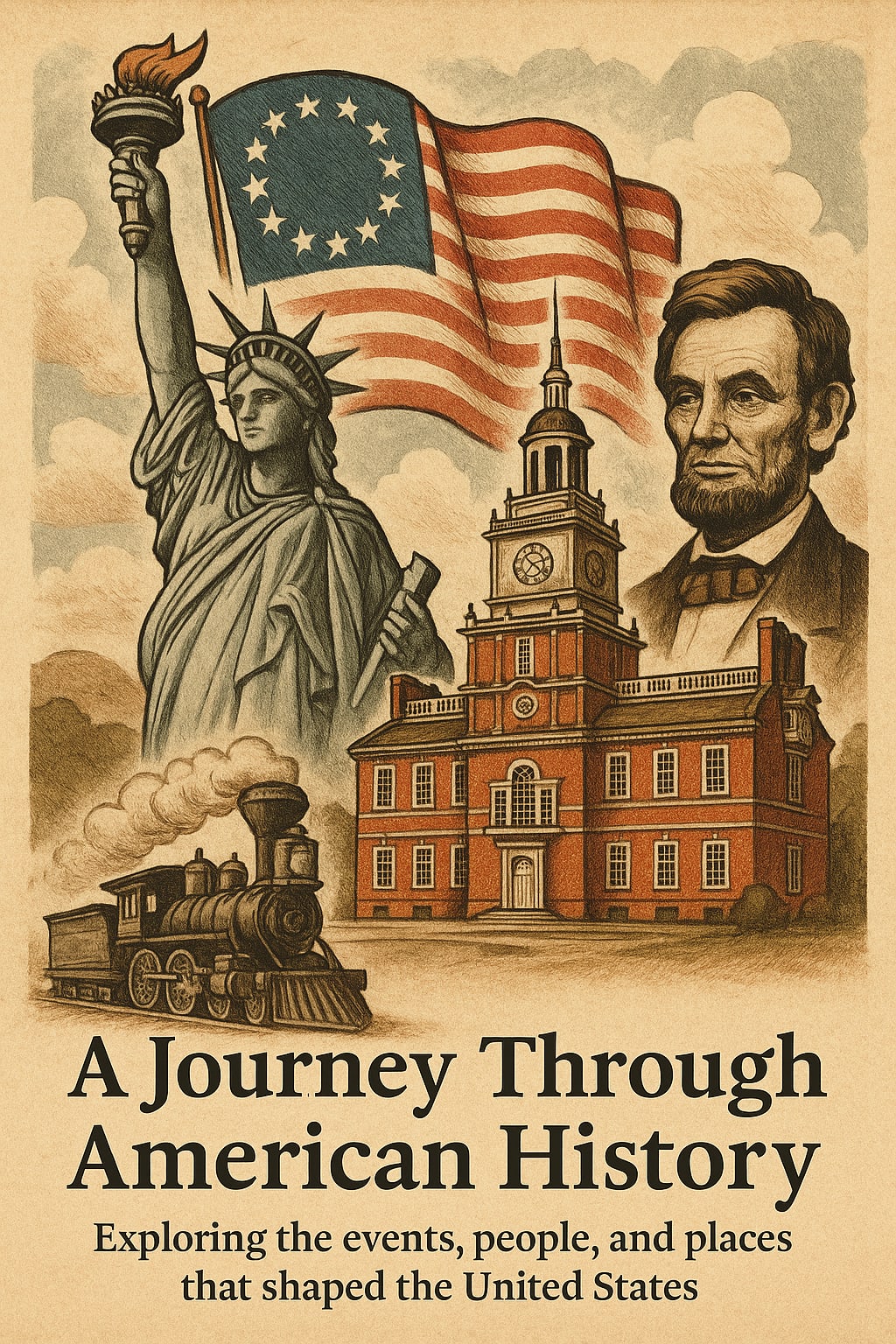
In the shadowy corners of colonial taverns and open fields of rebellion, the idea of America was born—not in grand halls of government, but in the hearts of ordinary people yearning for freedom. It began in the 18th century, when thirteen British colonies, scattered along the eastern seaboard, decided to rise against the world’s greatest empire. Tired of unfair taxes and distant kings, farmers, blacksmiths, and scholars united behind a radical dream: self-rule.
In 1776, that dream took written form in the Declaration of Independence, drafted primarily by Thomas Jefferson. “All men are created equal,” it boldly claimed, even as slavery still shackled millions. The Revolutionary War that followed was long and brutal. Soldiers marched barefoot through snow at Valley Forge. Battles raged in fields, forests, and port towns. Yet, against all odds, the colonies triumphed. In 1783, the Treaty of Paris was signed, and the United States of America became a sovereign nation.
But independence was only the beginning.
The early years were chaotic. The new country, stitched together by hope more than law, struggled under the weak Articles of Confederation. Recognizing the need for a stronger foundation, leaders met in Philadelphia in 1787 and created the U.S. Constitution, a living document that balanced power between the states and federal government. With George Washington as its first president, the United States entered a new era.
The 19th century was a time of incredible expansion—and growing pain. The Louisiana Purchase in 1803 doubled the nation's size. Pioneers headed west, driven by dreams and the idea of Manifest Destiny—the belief that America was meant to stretch from coast to coast. Railroads, telegraphs, and industry transformed life, but beneath the progress, tensions brewed.
At the heart of the nation’s deepest conflict was slavery. The southern economy depended on enslaved labor, while the North moved toward abolition. The moral and political divide deepened until, in 1861, civil war erupted. The Civil War tore families apart and claimed over 600,000 lives. But in 1865, the Union prevailed, and slavery was abolished. Abraham Lincoln, the president who had fought to preserve the Union, was assassinated days after victory. His legacy, however, lived on in the 13th, 14th, and 15th Amendments, which promised freedom and rights to all citizens—though that promise would take generations to fulfill.
Reconstruction followed, but so did resistance. The South passed Jim Crow laws, and segregation became entrenched. Meanwhile, America turned outward. In 1898, it fought the Spanish-American War and gained overseas territories. Immigrants poured in through Ellis Island, seeking a better life. Skyscrapers rose. Cities grew.
The 20th century thrust the U.S. onto the world stage. It emerged victorious in World War I, and again in World War II, becoming a global superpower. The Great Depression of the 1930s tested the nation's resilience, but Franklin D. Roosevelt’s New Deal offered hope. After WWII, the U.S. stood as a leader of the free world, locked in a Cold War with the Soviet Union.
Domestically, a different war was fought: the battle for civil rights. In the 1950s and 60s, figures like Martin Luther King Jr., Rosa Parks, and Malcolm X led movements that challenged injustice. The Civil Rights Act of 1964 and Voting Rights Act of 1965 were landmark victories, yet racial equality remained an ongoing struggle.
As the century closed, the U.S. faced new trials: wars in Vietnam and the Middle East, political scandals like Watergate, and economic shifts. But it also saw triumphs—landing a man on the moon in 1969, breakthroughs in science and technology, and the election of Barack Obama in 2008, the nation’s first Black president.
Today, the story of the United States continues. It is a nation shaped by contradictions—freedom and injustice, wealth and poverty, division and unity. Its strength lies not in perfection, but in its constant striving toward a “more perfect union.”
From Boston’s cobblestone streets to California’s tech corridors, from the voices of protest to the ballots of democracy, the threads of America’s history are woven by its people. Every generation adds a new chapter, facing new challenges, dreaming new dreams.
The journey of the United States is far from over. But if history teaches us anything, it’s that progress is possible—and that the story of America is one that belongs to all who believe in liberty, equality, and the courage to keep moving forward.
About the Creator
NIAZ Muhammad
Storyteller at heart, explorer by mind. I write about life, history, mystery, and moments that spark thought. Join me on a journey through words!
Keep reading
More stories from NIAZ Muhammad and writers in History and other communities.
"Pyramids of Egypt: Greatness Hidden in the Sand"
There are some places in the world that hold centuries of stories, mysteries, and wonders within them. The Pyramids of Egypt are among those remarkable sites. These are not just buildings; they are symbols of human history, intellect, knowledge, and faith that have always fascinated and inspired the world.
By NIAZ Muhammad6 months ago in History
Rajendra Chola I and the Conquest of the Ganga: A Monumental Feat in Indian History
Known as the “Gangaikonda Chola” (the Chola who conquered the Ganga), Rajendra transformed a South Indian maritime empire into a pan-Indian power whose influence stretched from the Indian Ocean to the heart of the subcontinent. This campaign was not merely a military raid but a bold statement of imperial ambition, strategic brilliance, and cultural confidence.
By Say the truth 5 days ago in History


Comments
There are no comments for this story
Be the first to respond and start the conversation.