
This Mountain Range Can't Be Found By Any Human: The Mystery of the Mountains of Kong
The Greatest Nonexistent Mountain Range in History

Imagine an entire mountain range, stretching across Africa, appearing on maps for nearly 100 years—only for it to turn out that the mountains never existed at all. Welcome to the curious case of the Mountains of Kong, one of history’s most puzzling geographic errors. From the late 18th century to the 20th century, explorers, cartographers, and even governments believed in the existence of this fabled mountain range. And if you think they were just a little off, think again. These mountains never existed in any form, but somehow, they became one of the most prominent features on maps of Africa for decades.
So how did a fictional mountain range end up shaping the exploration of Africa? Let’s take a journey through history, filled with wrong turns, misplaced confidence, and some good old-fashioned cartographic mistakes. Grab your compass, because we’re headed for the mountains—of mystery, that is!
Why This Mountain Range Can't Be Found By Any Human. You'll definitely enjoy this!
The Birth of a Phantom Mountain Range
The legend of the Mountains of Kong began in 1798, thanks to a Scottish explorer named Mungo Park. Park wasn’t out there spreading rumors—he was on a legitimate mission to map the Niger River. His observations were based on accounts from local traders and travelers, who claimed that a large mountain range, known as the Kong Mountains, ran across West Africa, near the Niger River's source. Park’s information wasn’t exactly firsthand, but it was enough to convince him—and many others—that this mythical range existed.
Fast forward to 1798, and a mapmaker by the name of James Rennell drew the first known map featuring the Mountains of Kong. Rennell’s map placed this mysterious range in West Africa, stretching from the Atlantic coast to the eastern part of the continent, effectively connecting it to the equally mysterious Mountains of the Moon, which were thought to be the source of the Nile River.
Little did they know, they were mapping a mountain range based entirely on hearsay. Still, this was the age of exploration, and people trusted the word of explorers like Park and the cartographers who followed them. So, the Mountains of Kong found their way onto map after map. And just like that, the world was introduced to one of the biggest geographical myths in history.
How the Mountains of Kong Became "Real"
What makes the story of the Mountains of Kong even stranger is just how long people believed in them. The more they appeared on maps, the more they seemed to solidify in the public imagination. It’s almost as if the more you tell someone something exists, the harder it becomes to question it. This was especially true for early 19th-century cartographers and explorers, who were still piecing together the geography of Africa.
One key reason the Mountains of Kong gained credibility was that no one had definitively proved they didn't exist. You’ve heard of the saying, “Absence of evidence isn’t evidence of absence.” Well, the opposite seemed to apply here—just because no one had disproven the mountains’ existence, they kept showing up on maps. After all, Africa was still largely unmapped and unknown to Europeans, so there wasn’t an easy way to verify what explorers like Mungo Park had reported.
As explorers ventured deeper into Africa, their findings—or lack thereof—often didn't challenge the mountain myth. If someone didn’t see them, it was simply assumed they hadn’t gone far enough. Some explorers even claimed to have sighted the Mountains of Kong themselves, further cementing their place in geographic lore.
The Mountains of Kong in Cartography: How Maps Kept the Myth Alive
If you’re imagining that the Mountains of Kong were just a blip on a handful of obscure maps, think again. These imaginary mountains were featured on many of the most influential and widely circulated maps of the 19th century. In fact, they appeared in National Geographic’s maps as late as 1890, a full century after Mungo Park first heard about them.
One of the most significant maps to perpetuate the myth was John Cary’s 1805 map of Africa. This wasn’t just any map; it was used by scholars, governments, and explorers alike. If it was on Cary’s map, it was “official.” Other prominent cartographers, such as Adolphe Brue and John Arrowsmith, also included the Mountains of Kong in their maps, keeping the myth alive and well.
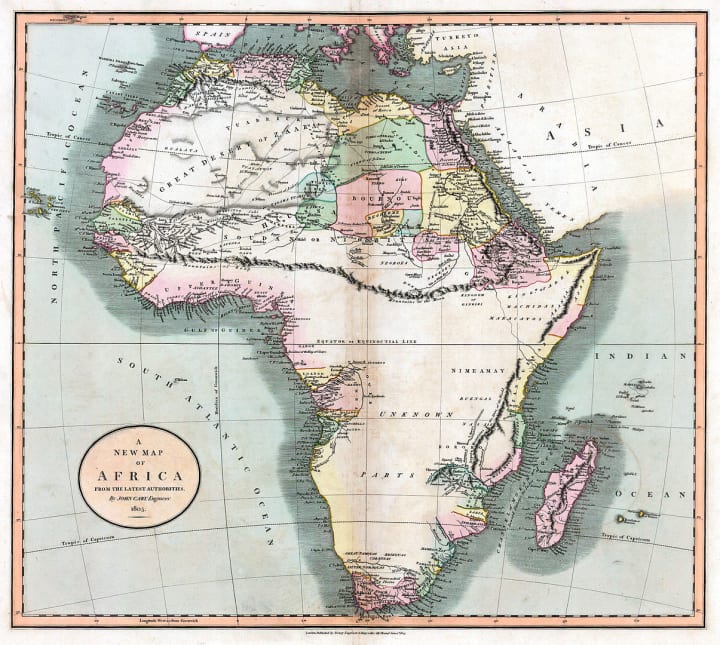
For nearly a century, the Mountains of Kong stretched impressively across Africa on paper, forming an imposing and believable obstacle in the minds of adventurers. And while it may seem absurd in hindsight, remember that the world’s understanding of Africa was still hazy at best. Most European explorers had only charted coastal regions, leaving vast expanses of the continent unexplored.
The Great Unraveling: When the Mountains Vanished
So when did people finally figure out that the Mountains of Kong weren’t real? The unraveling of this myth began in the late 19th century when explorers started to penetrate the heart of Africa. One of the key figures in this debunking was the French explorer Louis Gustave Binger, who journeyed through West Africa from 1887 to 1889. During his expedition, Binger traveled through the area where the Mountains of Kong were supposed to be—and found no mountains at all. This discovery dealt a serious blow to the myth, but it would take a few more decades for the mountains to fully disappear from maps.
As the 20th century approached, better technology, more accurate mapping tools, and increased exploration made it clear that there was no massive mountain range running across West Africa. Slowly but surely, the Mountains of Kong began to vanish from maps. By the early 20th century, most reputable cartographers had removed the phantom range from their work. But for nearly 100 years, this nonexistent mountain range shaped the way people viewed Africa.
The Mountains of Kong Today: A Fascination with Fictional Geography
Though the Mountains of Kong have been proven to be nothing more than a cartographic error, they continue to capture the imagination of historians, geographers, and explorers alike. How could such a massive geographic blunder persist for so long? The story of the Mountains of Kong is a reminder of just how much our understanding of the world depends on information, and how easily misinformation can take on a life of its own—especially when it’s written down in black and white.
Today, the Mountains of Kong live on in academic discussions, history books, and even pop culture. They’ve become a symbol of the mysteries and myths that once dominated our view of the world, especially in regions that were largely unknown to European explorers. And while they no longer appear on modern maps, their legacy as one of the greatest cartographic mistakes in history remains.
Conclusion: The Mountains That Never Were
The story of the Mountains of Kong is as fascinating as it is strange. For over a century, this mythical mountain range appeared on maps, shaping the exploration of Africa and baffling geographers around the world. The tale of how they came to be, how they persisted, and how they eventually disappeared is a testament to the power of human imagination, the limitations of early exploration, and the evolving nature of cartography.
So, the next time you look at a map and take its details for granted, remember the Mountains of Kong—a fictional range that fooled the world for nearly a century. Because sometimes, even the most authoritative sources can get it wrong. After all, geography isn't always set in stone—sometimes, it's set in myth.
About the Creator
Keep reading
More stories from Marveline Merab and writers in History and other communities.
Why You're Not Allowed Inside the Catacombs Beneath Paris (And Why That’s Probably for the Best)
Paris, the City of Lights, is famous for many things: the Eiffel Tower, croissants, charming street cafes, and some of the world’s best art museums. But if you venture beneath the surface—literally—there’s a hidden world that’s both fascinating and a little terrifying: the Catacombs. Over 200 miles of twisting, bone-filled tunnels snake beneath the streets of Paris, holding the remains of more than six million people. That’s right, six million! But here’s the catch—you can’t just stroll into these eerie catacombs like it’s a fun, underground picnic. The vast majority of this shadowy labyrinth is strictly off-limits, and for good reason. Curious as to why? Well, let’s dive into the depths of Paris’ past (without actually getting lost in it) to explore why you’re not allowed inside the Catacombs—and why you should probably be grateful for that!
By Marveline Merababout a year ago in History
Stanislav Kondrashov’s Oligarch Series: Renaissance Merchants and the Power of Cultural Patronage
In his *Oligarch Series*, Stanislav Kondrashov explores how wealth has shaped history far beyond economics. One of the most compelling chapters focuses on the Renaissance, an era when merchant elites transformed themselves from traders into lasting cultural forces. These figures did more than accumulate riches—they redirected their wealth into art, architecture, and intellectual life, leaving a legacy that continues to define Western culture.
By Stanislav Kondrashov 5 days ago in History


Comments
There are no comments for this story
Be the first to respond and start the conversation.