
The World’s Most Disliked Countries in 2024 – Understanding the Global Perception
“From Superpowers to Struggling States: What Drives Global Dislike Toward These 15 Nations in 2024?”

Introduction
In a time when the world is more interconnected than ever, global perception carries significant weight. Nations are judged not just by their policies or leaders but by their international behavior, media portrayal, and historical context. A recent global survey conducted by the International Statistics Organization in 2024 has revealed a list of the 15 most disliked countries in the world. While such lists spark heated debate, they also invite deeper reflection. Why are some countries so disliked? Is it due to politics, war, culture, or something more complex?
Let’s explore the reasons behind this ranking and the broader implications of such global opinions.
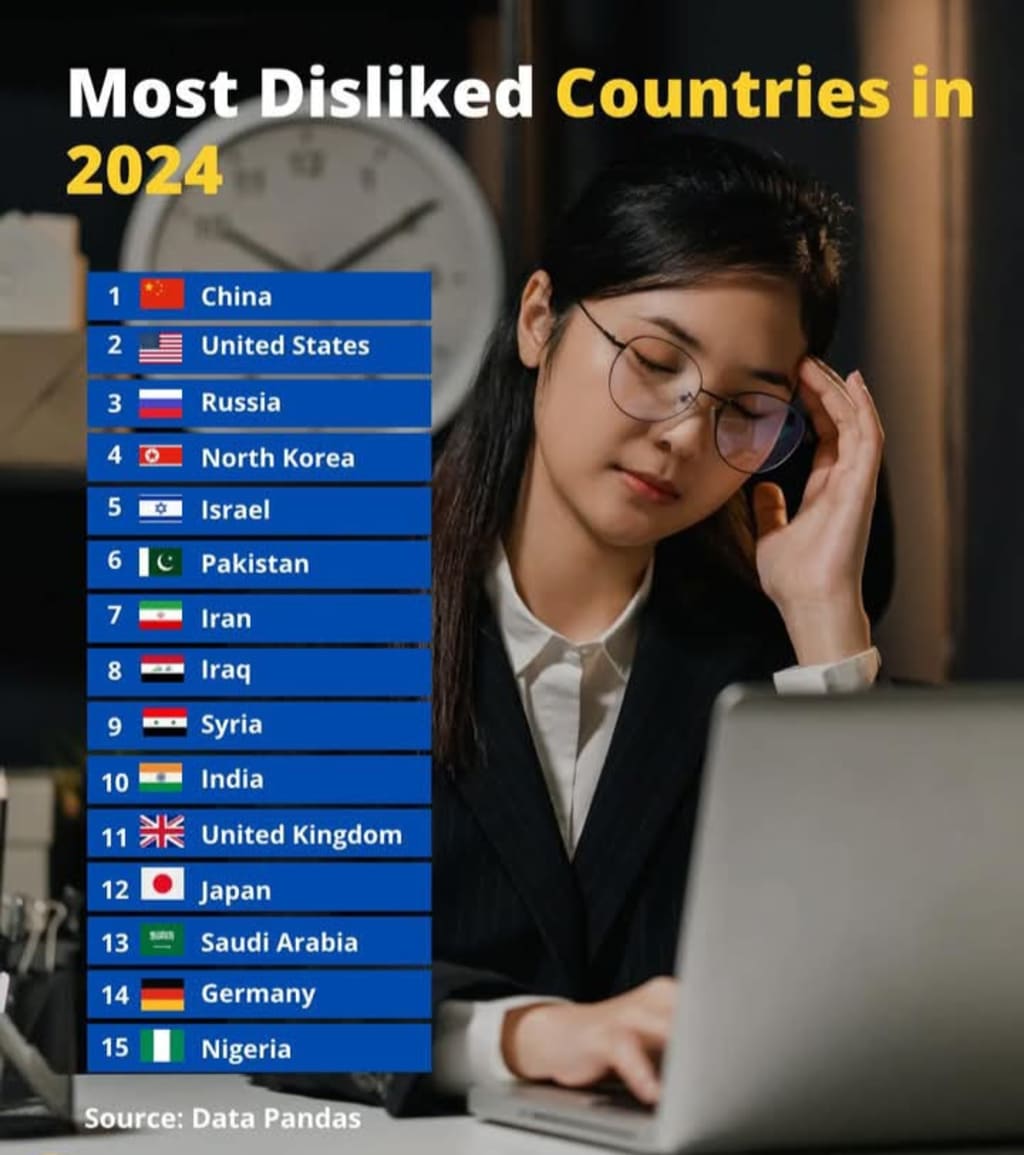
The 2024 List: Top 15 Most Disliked Countries
1. China
2. United States
3. Russia
4. North Korea
5. Israel
6. Pakistan
7. Iran
8. Iraq
9. Syria
10. India
11. United Kingdom
12. Japan
13. Saudi Arabia
14. Germany
15. Nigeria
This list might raise eyebrows, but it reflects a global sentiment shaped by many interconnected factors.
---
Geopolitical Power and Controversy
The countries at the top—China, the United States, and Russia—are not just global superpowers but also frequent players in international conflict and political manipulation. Their foreign policies often create division. China's aggressive stance in the South China Sea, surveillance concerns, and treatment of minority populations (like the Uyghurs) has drawn global criticism. The U.S. is frequently disliked for its military interventions, perceived cultural dominance, and polarizing foreign policy. Meanwhile, Russia’s war in Ukraine and its authoritarian internal politics have severely damaged its global image.
These countries’ roles in world affairs naturally place them in the spotlight—making their actions highly scrutinized and often controversial.
---
Human Rights and Authoritarianism
Many nations on this list have been repeatedly criticized for their human rights records. North Korea, known for its closed society, lack of freedoms, and dictatorship, faces near-universal condemnation. Iran and Saudi Arabia, despite their unique cultural and religious heritage, are often accused of oppressing women, silencing dissent, and restricting freedoms. Even democratic nations like India and Israel face accusations—India for increasing religious intolerance and suppression of minority voices, and Israel for its ongoing conflict with Palestinians.
Global audiences tend to react strongly to perceived injustices, especially when these issues dominate international headlines.
---
Wars, Terrorism, and Instability
Countries like Iraq, Syria, and Pakistan have been at the center of regional and global conflicts for decades. Although many of their people are victims of violence and foreign intervention, these nations are often associated with terrorism, war, and instability. Western media, in particular, has played a significant role in reinforcing these perceptions. Nigeria, too, suffers from internal conflicts and extremist groups like Boko Haram, which adds to its unfavorable image internationally.
It’s important to note that public opinion doesn’t always distinguish between governments, radical factions, and ordinary citizens—an unfortunate generalization that fuels misunderstanding.
---
Colonial Legacy and Cultural Clashes
The presence of the UK, Germany, and Japan on this list may seem surprising at first glance. However, the colonial history of the United Kingdom and Germany's 20th-century wars still cast a long shadow. Japan, while technologically advanced and peaceful today, faces criticism from its Asian neighbors for failing to fully reckon with its World War II past.
In addition, cultural friction plays a role in how certain populations view others. When traditions, values, or ideologies clash, mutual respect often gives way to mistrust or even resentment.
---
The Role of Global Media
Perception is powerfully shaped by media narratives. News outlets, social media, and film industries play a massive role in influencing how one country sees another. For example, Hollywood often portrays certain regions (especially the Middle East or Asia) through a lens of conflict, extremism, or backwardness. Likewise, state-run media in various countries may intentionally paint other nations as enemies or threats, reinforcing public fear and animosity.
This cycle of media-driven judgment has created deep stereotypes—some of which are far removed from the actual experiences of those living in these nations.
---
Perception vs. Reality
It’s crucial to understand that public perception doesn’t always reflect the truth. Most people in these countries live normal lives, seek peace, and want progress. The dislike toward a country often stems from the actions of a government, specific policies, or dominant media portrayals—not the culture or people as a whole.
Such rankings, while useful for discussion, can also reinforce harmful stereotypes if not handled with care. They remind us how easy it is to judge from afar—and how important it is to approach international opinions with nuance.
---
Conclusion
The 2024 list of the most disliked countries is not just a popularity chart—it is a mirror reflecting how deeply intertwined our world has become. Political decisions, historical grievances, media influence, and cultural differences all contribute to global opinion. While some criticism is justified, other elements are rooted in misunderstanding or bias.
To build a more compassionate and informed world, we must look beyond headlines and recognize the complexity within each country. After all, a nation is more than its politics—it’s its people, its history, and its hope for the future.
About the Creator
Keep reading
More stories from Insect Legends and writers in History and other communities.
The True Meaning of Life: Beyond Fear, Joy, and Material Illusions
Life, in its most beautiful sense, is supposed to be a journey filled with meaning, purpose, and connection. It is often described as a blessing, a gift, and a chance to make something valuable out of our existence. But when we take a deeper look, we see that life is not merely joy, nor is it simply fear. If it were all joy, why would we cry so often? If it were all fear, why would we find reasons to smile, laugh, and celebrate?
By Insect Legends10 months ago in Lifehack
Can the United States Leave NATO?
Can the United States Leave NATO? What It Would Take—and What It Would Mean The North Atlantic Treaty Organization, commonly known as NATO, has been one of the most powerful military alliances in modern history. Since its creation in 1949, the United States has been NATO’s strongest member—militarily, financially, and politically. But in recent years, debates have grown louder about whether the U.S. should remain in the alliance. This raises a serious question: how could the United States be removed from NATO—or leave it—and what would that mean for the world?
By Wings of Time 7 days ago in History



Comments
There are no comments for this story
Be the first to respond and start the conversation.