
The World’s First Love Letter
Love Letter


Love is one of the most powerful emotions known to humankind, and its expression through writing dates back thousands of years. People have been professing their affections in written form long before modern romance novels, poetry, and text messages. But have you ever wondered: Who wrote the world’s first love letter? To whom was it addressed? And what did it say?
The earliest known love letter is an artifact of deep historical significance, offering insight into ancient human emotions, relationships, and societal norms. This article explores the first recorded love letter, its origins, content, and the fascinating context in which it was written.
The First Known Love Letter: Origins in Ancient Mesopotamia
The world’s first known love letter dates back more than 4,000 years to ancient Mesopotamia, often regarded as the “cradle of civilization.” The letter is a clay tablet inscribed in cuneiform script, the writing system used by the Sumerians. This remarkable piece of history was discovered in the ruins of Nippur, an important Sumerian city located in present-day Iraq.
The love letter is believed to have been written around 2030 BCE during the reign of King Shu-Sin, the fourth ruler of the Third Dynasty of Ur (circa 2037–2029 BCE). The letter was composed by an unnamed Sumerian princess or priestess who was chosen to be the king’s bride. It is often referred to as the “Love Song for Shu-Sin” and is considered both a personal declaration of affection and a ceremonial poem.
Who Was King Shu-Sin?
Before diving into the content of the letter, it is essential to understand the historical figure at its center. Shu-Sin was a powerful Sumerian king who ruled over the Third Dynasty of Ur. His empire was vast and influential, with advanced cities, trade networks, and a flourishing culture.
Sumerian kings, including Shu-Sin, often participated in a sacred ritual known as the Sacred Marriage Rite, or "hieros gamos." This ceremony symbolized the divine union between the king and the goddess Inanna (later known as Ishtar), the Sumerian deity of love, fertility, and war. A priestess, often a high-ranking woman, would be chosen to embody the goddess in the ritual. The love letter written to Shu-Sin is believed to have been part of this sacred tradition, though it also conveys genuine emotion and devotion.
The Content of the First Love Letter
The letter, inscribed on a clay tablet, is a poetic expression of love and admiration. It was likely intended to be recited or sung during a sacred ceremony. Below is a translated excerpt of the letter:
"Bridegroom, dear to my heart,
Great is your beauty, sweet as honey.
Lion, beloved of Inanna,
Great is your beauty, sweet as honey.
You have captivated me; let me stand trembling before you.
Bridegroom, I would be taken by you to the bedroom.
You have captivated me; let me stand trembling before you."
The words in this ancient text are passionate and filled with admiration, expressing both reverence and longing. The reference to the groom as a "lion" and a beloved of Inanna reinforces the sacred and symbolic nature of their relationship.
What Does This Love Letter Tell Us About Ancient Relationships?
The “Love Song for Shu-Sin” is significant not only because it is the oldest recorded love letter but also because it reveals much about the romantic and spiritual traditions of ancient Mesopotamia. Here are some key insights:
1. Love and Ritual Were Intertwined
The letter was not just a personal note of affection but also part of a religious ritual. The Sacred Marriage Rite played a crucial role in legitimizing the king’s rule by symbolizing his divine favor from the goddess Inanna. This suggests that in ancient Mesopotamian society, expressions of love were deeply connected to spiritual beliefs and governance.
2. Romantic Expressions Existed Thousands of Years Ago
Despite the passage of millennia, the emotions conveyed in this love letter are strikingly familiar. The words reflect admiration, desire, and a deep emotional connection, much like modern love letters or poetry. This demonstrates that romantic love and devotion are universal human experiences that have persisted throughout history.
3. Women Had a Role in Expressing Love
The fact that a woman, likely a high priestess or noblewoman, wrote the letter highlights the role of women in ancient romantic and religious traditions. Unlike many later historical periods where women’s voices were suppressed, this letter suggests that in some ancient cultures, women had the freedom to express their love and play an essential role in important rituals.
The Preservation and Discovery of the Love Letter
The clay tablet containing the world’s first love letter was unearthed by archaeologists in the late 19th or early 20th century during excavations at Nippur, one of the oldest Sumerian cities. Over time, scholars deciphered the cuneiform text, revealing its remarkable content.
Since then, the tablet has been studied extensively and is currently housed in the Istanbul Museum of the Ancient Orient in Turkey. This discovery has provided invaluable insights into ancient Mesopotamian culture, particularly regarding love, poetry, and religious practices.
The Evolution of Love Letters Throughout History
The first love letter laid the foundation for a rich tradition of romantic correspondence that continued through various civilizations and eras. Here’s a brief look at how love letters evolved over time:
1. Ancient Egyptian Love Poetry (Circa 1300 BCE)
Egyptians also expressed their love in written form. Romantic poetry from the New Kingdom period (circa 1300 BCE) includes passionate descriptions of longing and admiration, similar in sentiment to the Sumerian love letter.
2. Greek and Roman Love Letters
The Greeks and Romans had a strong tradition of writing love letters. Poets like Sappho and Ovid composed verses about love and desire, and Roman lovers exchanged written notes on wax tablets.
3. Medieval Love Letters
During the Middle Ages, courtly love inspired noblemen and women to exchange letters expressing deep affection. Some of the most famous medieval love letters come from Abelard and Héloïse, whose tragic romance is still remembered today.
4. The Renaissance and Beyond
By the Renaissance period, love letters had become an art form. Figures like Napoleon Bonaparte and Ludwig van Beethoven left behind heartfelt letters to their lovers, which are now treasured historical documents.
5. Modern-Day Love Letters
In the modern era, love letters have taken many forms, from handwritten notes to emails and text messages. While technology has changed how we communicate, the essence of love letters—expressing deep emotions in written words—remains unchanged.
My Last Word
The world’s first love letter, written over 4,000 years ago, serves as a testament to the enduring nature of human emotions. Despite the vast differences in time, culture, and language, the feelings conveyed in the letter remain universally relatable.
From ancient Mesopotamian clay tablets to digital love notes today, the act of putting one’s emotions into words has always been a powerful way to connect with others. Whether for religious rituals, romantic declarations, or poetic expressions, love letters continue to hold a special place in history and human relationships.
This ancient love letter not only tells us about the past but also reminds us that love—whether in 2030 BCE or the present day—is a fundamental part of the human experience.
About the Creator
The Content Crafter
Hi, I’m Vikas! I write Content and Stories that hit the Feels and Education.
- 📚 Education
- 🍔 Food
- 🏥 Health
- 🔢 Angel Number
- 📝 Poet
- 📖 Stories
- 🏺 History
- ⭐ Review
- 🌌 Space and Earth
- 🎮 Games
- 👻 Horror
📲Please 🔔 Subscribe 🔔 Me ❤️
Keep reading
More stories from The Content Crafter and writers in History and other communities.
Happy Promise Day History
Promise Day, celebrated on February 11th every year, is one of the most meaningful days in Valentine's Week. It is a day dedicated to making heartfelt promises to loved ones, strengthening relationships, and reaffirming commitments. While the day is most commonly associated with romantic relationships, it also extends to friendships, family bonds, and professional commitments. But where did this tradition originate? How has it evolved over time?
By The Content Crafterabout a year ago in History
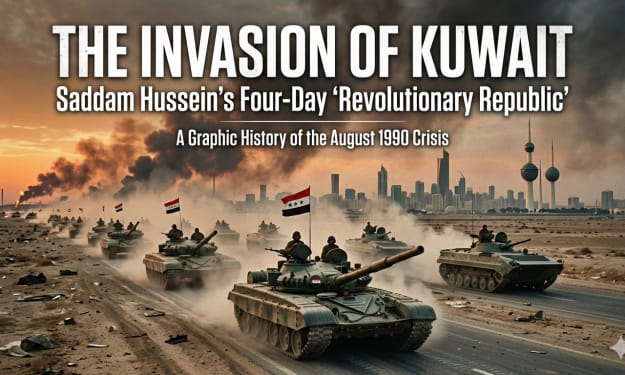
The Invasion of Kuwait: Saddam’s Four-Day ‘Revolutionary Republic
On August 2, 1990, the world woke up to a geopolitical earthquake. Under the orders of Saddam Hussein, over 100,000 Iraqi troops, backed by hundreds of tanks, surged across the border into the tiny, oil-rich emirate of Kuwait. While history remembers this as the spark for the Gulf War, the first few days of the occupation featured a bizarre political theater: the creation of a short-lived puppet state known as the **"Republic of Kuwait."**
By Irshad Abbasi about 12 hours ago in History



Comments
There are no comments for this story
Be the first to respond and start the conversation.