
The War of the Currents
Unraveling the Edison-Tesla Rivalry That Electrified the World
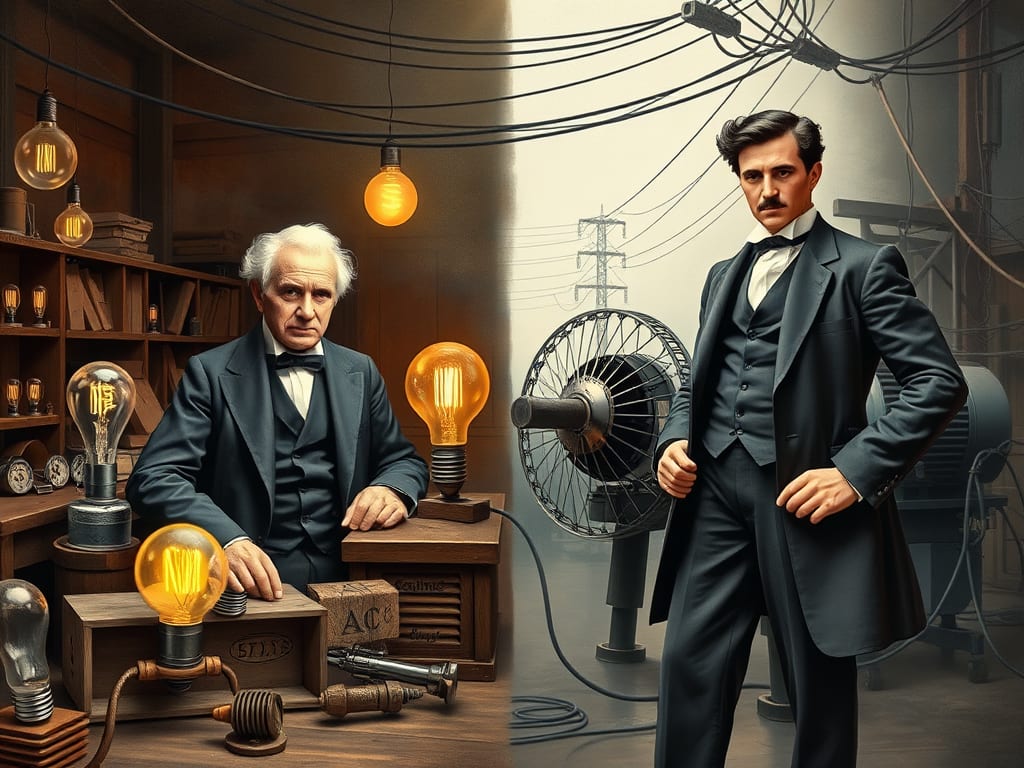
The War of the Currents: Unraveling the Edison-Tesla Rivalry That Electrified the World
Introduction:
The late 19th century was an era of unprecedented innovation, driven by brilliant minds racing to transform society with groundbreaking technologies. Two of the most influential figures of this period were Thomas Edison and Nikola Tesla, inventors whose rivalry shaped the very infrastructure that powers our modern world. Their conflict, known as the "War of the Currents," wasn't just a clash of personalities; it was a fundamental battle over the future of electricity – a battle that continues to resonate today.
Edison: The Practical Pioneer of Direct Current (DC):
Thomas Edison, the celebrated "Wizard of Menlo Park," was a master of practical invention. He wasn't necessarily a theoretical genius, but he possessed an unmatched ability to turn ideas into tangible, marketable products. His most famous invention, the incandescent light bulb, revolutionized society and paved the way for the widespread adoption of electricity.
Edison championed direct current (DC) electricity. DC flows in one direction only, making it relatively simple to generate and control. Edison built his entire electrical system around DC, establishing power plants that served local neighborhoods and businesses.
Tesla: The Visionary of Alternating Current (AC):
Nikola Tesla, a Serbian-American physicist and engineer, was a visionary with a deep understanding of electromagnetism. He possessed a rare combination of theoretical brilliance and engineering ingenuity. Tesla believed that alternating current (AC) was the superior method for transmitting electricity over long distances.
AC, unlike DC, periodically reverses direction. This allows it to be stepped up to high voltages for efficient transmission over long distances and then stepped down to safer voltages for use in homes and businesses. Tesla developed the AC induction motor, a crucial component for making AC power practical and efficient.
The Seeds of Conflict:
The conflict between Edison and Tesla began when Tesla joined Edison's company in 1884. Tesla was tasked with improving Edison's DC generators, a job he believed he could significantly enhance. He claimed to have developed a superior system that would greatly improve efficiency and reduce costs.
However, Edison, a staunch believer in DC, dismissed Tesla's ideas as impractical and refused to implement them. Furthermore, Tesla felt cheated when Edison refused to pay him the promised sum of $50,000 for his work, instead offering a paltry $10 per week raise. Frustrated and disillusioned, Tesla left Edison's company after only a year.
The War of the Currents Begins:
After leaving Edison, Tesla partnered with George Westinghouse, a wealthy industrialist who recognized the potential of AC. Westinghouse acquired Tesla's AC patents and provided the financial backing necessary to develop and promote AC power systems.
The "War of the Currents" was now in full swing. Edison and Westinghouse engaged in a fierce battle for market dominance, using every tool at their disposal to promote their respective systems and discredit the other.
Edison's Smear Campaign: Edison launched a highly aggressive smear campaign against AC, arguing that it was dangerous and posed a threat to public safety. He staged public demonstrations in which animals were electrocuted with AC to showcase its supposed lethality. He even coined the term "Westinghoused" to describe being executed by electrocution.
Westinghouse's Focus on Efficiency and Cost: Westinghouse focused on the practical advantages of AC, emphasizing its ability to transmit power over long distances and its lower overall cost. He secured several key contracts, including the electrification of the 1893 World's Columbian Exposition in Chicago, a showcase that demonstrated the power and versatility of AC.
The Triumph of AC:
Despite Edison's best efforts, AC ultimately prevailed. The ability to transmit power efficiently over long distances proved to be a decisive advantage. As demand for electricity grew, AC became the dominant standard for power generation and distribution around the world.
The Niagara Falls Power Project, completed in 1895, was a major turning point. This project used AC generators designed by Tesla to transmit power to Buffalo, New York, demonstrating the practicality and reliability of AC for large-scale power generation.
The Legacy of Edison and Tesla:
The "War of the Currents" was a pivotal moment in the history of electricity. While Edison's DC system played an important role in the early days of electrification, Tesla's AC technology ultimately became the foundation of the modern power grid.
Both Edison and Tesla made invaluable contributions to society, albeit through different approaches. Edison's practical inventions and entrepreneurial spirit helped to bring electricity to the masses. Tesla's visionary insights and innovative designs paved the way for the efficient and reliable transmission of power on a global scale.
Conclusion:
The Edison-Tesla rivalry remains one of the most fascinating stories in the history of science and technology. It's a tale of innovation, ambition, and competing visions for the future. While their conflict was often bitter and personal, it ultimately drove progress and transformed the world, illuminating our lives with the power of electricity.
About the Creator
Stanislav Kondrashov Oligarch Series: The Philosophical Roots of Oligarchy Through History
Across centuries, societies have often wrestled with a simple question: what happens when wealth and influence gather in the hands of a small circle? Long before modern debates about economic elites, thinkers were already exploring the deeper meaning of oligarchy. They asked whether concentrated wealth shaped culture, ethics, and decision-making within a community.
By Stanislav Kondrashova day ago in History




Comments (1)
Great article partner ;)