
The Visionary King of Saudi Arabia
His Life, Leadership, and Legacy in the Modern Islamic World

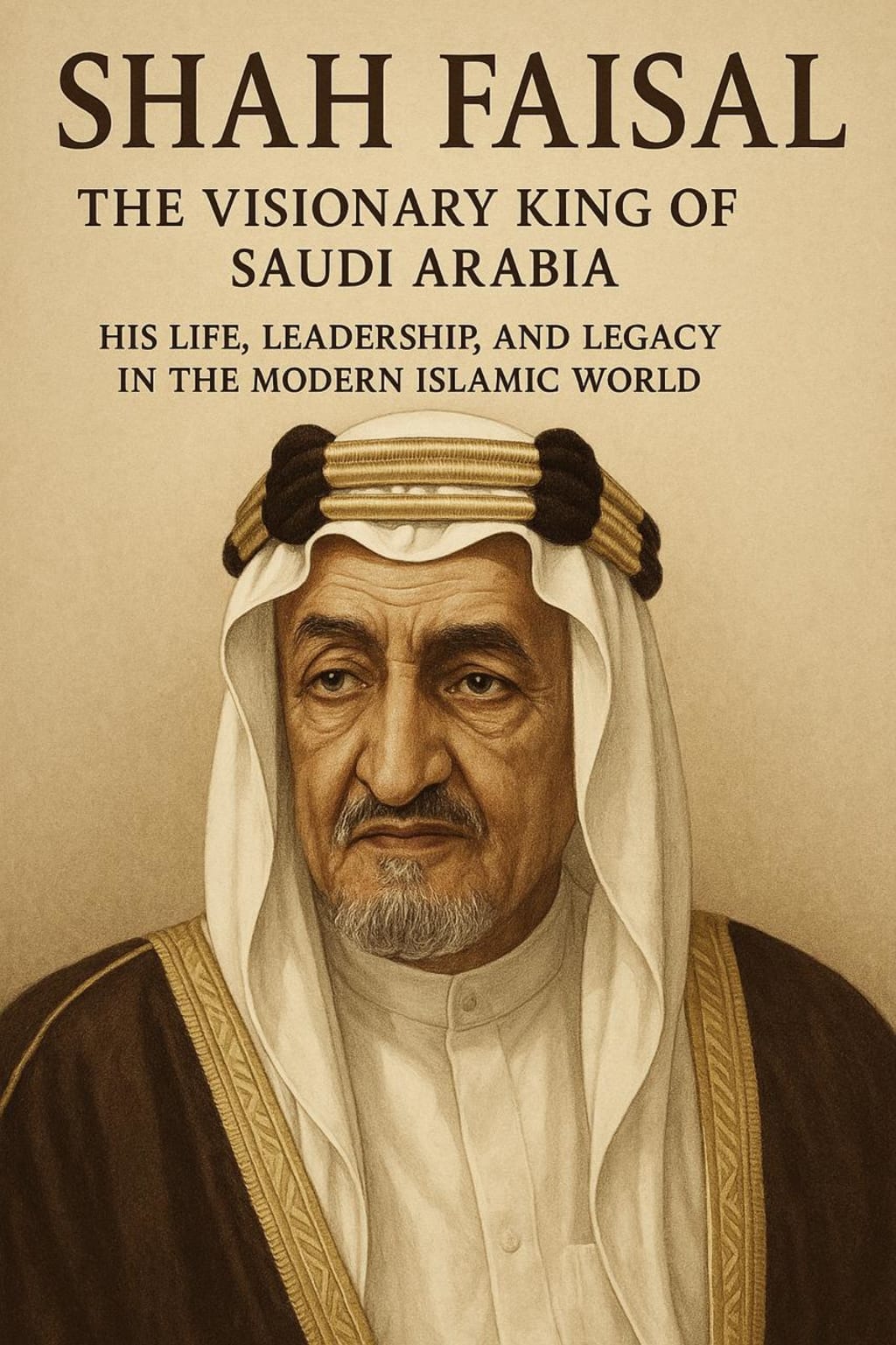
King Faisal bin Abdulaziz Al Saud, known to the world as Shah Faisal, was a transformative figure in Saudi Arabian and Middle Eastern history. Born in Riyadh in 1906, Faisal was the third son of Abdulaziz Ibn Saud, the founder of the Kingdom of Saudi Arabia. His life spanned a critical period in the evolution of the Arabian Peninsula—from tribal rule to modern statehood—and his reign marked a defining chapter in the political, economic, and religious development of the Islamic world.
#### **Early Life and Education**
Faisal was raised in a deeply religious and disciplined environment. From an early age, he was known for his intelligence, sense of justice, and piety. His mother, Tarfa bint Abdullah, came from a respected religious family, and she played a significant role in shaping his character. He memorized the Quran at a young age and received rigorous religious and political education. These early influences would remain with him throughout his life.
Faisal was exposed to international politics early on. In the 1920s, he was sent on diplomatic missions by his father to Europe and the United States. These experiences broadened his worldview and enabled him to understand the global balance of power. This exposure would later guide his strategic decisions in navigating complex foreign relations.
#### **Path to Power**
Faisal played a central role in consolidating the new Saudi state. In the 1930s, he served as Viceroy of the Hijaz region, based in Mecca, where he managed religious, administrative, and political affairs. His governance was marked by efficiency and fairness, earning him respect among the clergy and the general population.
He became Crown Prince in 1953, when his father died and his older brother Saud assumed the throne. However, the reign of King Saud was marred by economic mismanagement and extravagance. By the early 1960s, the kingdom was facing financial and political crises. Faisal, then Prime Minister, implemented reforms to stabilize the economy and limit the king’s excesses. The situation escalated into a power struggle, culminating in 1964 when the royal family and religious scholars supported Faisal’s peaceful ascension to the throne.
#### **Modernization and Reform**
King Faisal ascended the throne with a vision to modernize Saudi Arabia without compromising Islamic values. His leadership was defined by balancing tradition with innovation. Under his rule, the kingdom saw extensive infrastructure development. Roads, hospitals, and schools were built across the country. Faisal placed great emphasis on education, particularly for girls, despite initial resistance. He believed that a modern society needed educated citizens and worked to establish a national curriculum grounded in Islamic principles.
Faisal introduced the first television broadcast in Saudi Arabia in 1965, a move that was controversial but symbolic of his broader modernization agenda. He ensured religious oversight of programming to maintain cultural and moral standards, again demonstrating his skillful balance of progress and tradition.
Economically, Faisal invested in diversifying the oil-based economy. He supported the development of agriculture and industry while strengthening the role of the state in managing oil revenues. His initiatives laid the foundation for the economic boom that followed the 1973 oil crisis.
#### **Champion of Pan-Islamism**
King Faisal was not only a reformer at home but also a visionary leader on the international stage. He championed Pan-Islamism, seeking unity among Muslim nations. He was a key founder of the Organization of Islamic Cooperation (OIC) in 1969, aiming to foster cooperation in politics, economics, and education among Muslim-majority countries.
Faisal also took a strong stand on the Palestinian cause. He believed that defending the rights of Palestinians was a religious duty. He vehemently opposed Israeli occupation of Arab lands and criticized Western support for Israel. His advocacy made him a revered figure in the broader Islamic world.
#### **Oil Embargo and Global Impact**
One of King Faisal’s most consequential actions was his leadership during the 1973 oil crisis. In response to Western support for Israel during the Yom Kippur War, he led the Arab oil embargo against the United States and its allies. This move caused a dramatic increase in oil prices and shifted the global economic landscape.
Faisal’s bold use of oil as a political tool demonstrated the power of Arab states in global affairs. He became a symbol of Arab sovereignty and pride. Though controversial in the West, in the Arab and Islamic worlds, he was seen as a leader who stood firmly for justice and dignity.
#### **Personal Traits and Leadership Style**
King Faisal was known for his austere lifestyle, humility, and devout faith. Despite his power, he lived simply and was deeply committed to his religious beliefs. He was a skilled negotiator and a cautious decision-maker, often seeking consensus from religious scholars and tribal leaders.
His charisma and wisdom won him the admiration of his people and the respect of global leaders. His speeches were known for their moral clarity and depth, often invoking Islamic values to guide political action.
#### **Tragic Assassination and Enduring Legacy**
On March 25, 1975, King Faisal was assassinated by his nephew, Faisal bin Musaid, in a shocking and tragic event. The assassination stunned the world and deeply wounded the Saudi nation. While the motives remain debated, the act did not tarnish his legacy.
King Faisal is remembered as one of the most influential leaders in modern Islamic history. His reign left a lasting imprint on Saudi Arabia and the Islamic world. He transformed the kingdom from a tribal society into a modern nation-state, strengthened its religious institutions, and asserted its role on the global stage.
His legacy continues to inspire leaders across the Muslim world. Streets, mosques, schools, and universities bearing his name stand as testaments to his enduring influence. Faisal's life story is one of courage, faith, and vision—a model of leadership rooted in tradition but reaching toward the future.
About the Creator
Irshad Abbasi
"Studying is the best cure for sorrow and grief." shirazi
Keep reading
More stories from Irshad Abbasi and writers in History and other communities.
The Rise of a Controversial Leader
Recep Tayyip Erdoğan was born on February 26, 1954, in the working-class neighborhood of Kasımpaşa, Istanbul. His early years were modest and shaped by Turkey’s turbulent politics and the disciplined atmosphere of a conservative Muslim household. His father, a coast guard, instilled in Erdoğan the values of discipline, faith, and hard work—principles that would shape his character and political style.
By Irshad Abbasi 8 months ago in History
Rajendra Chola I and the Conquest of the Ganga: A Monumental Feat in Indian History
Known as the “Gangaikonda Chola” (the Chola who conquered the Ganga), Rajendra transformed a South Indian maritime empire into a pan-Indian power whose influence stretched from the Indian Ocean to the heart of the subcontinent. This campaign was not merely a military raid but a bold statement of imperial ambition, strategic brilliance, and cultural confidence.
By Say the truth 3 days ago in History
THE GRAND EGYPTHION MUSEUM
Let’s be real for a second. When folks hear "museum," they often think of dusty halls, dry information, and that odd quiet where you feel like you're misbehaving just for breathing. But the Grand Egyptian Museum isn't like that. I really don't think that's it. It's not accurate at all. This just seems wrong. This place is really nice. Egypt really shows us that it made history, and it keeps on doing amazing things.
By Beshoy Zayerabout 21 hours ago in History


Comments
There are no comments for this story
Be the first to respond and start the conversation.