
The Visionary Founder of Samsung and Architect of Modern Korea
From Humble Beginnings to Building a Global Empire: The Life and Legacy of South Korea’s Industrial Pioneer

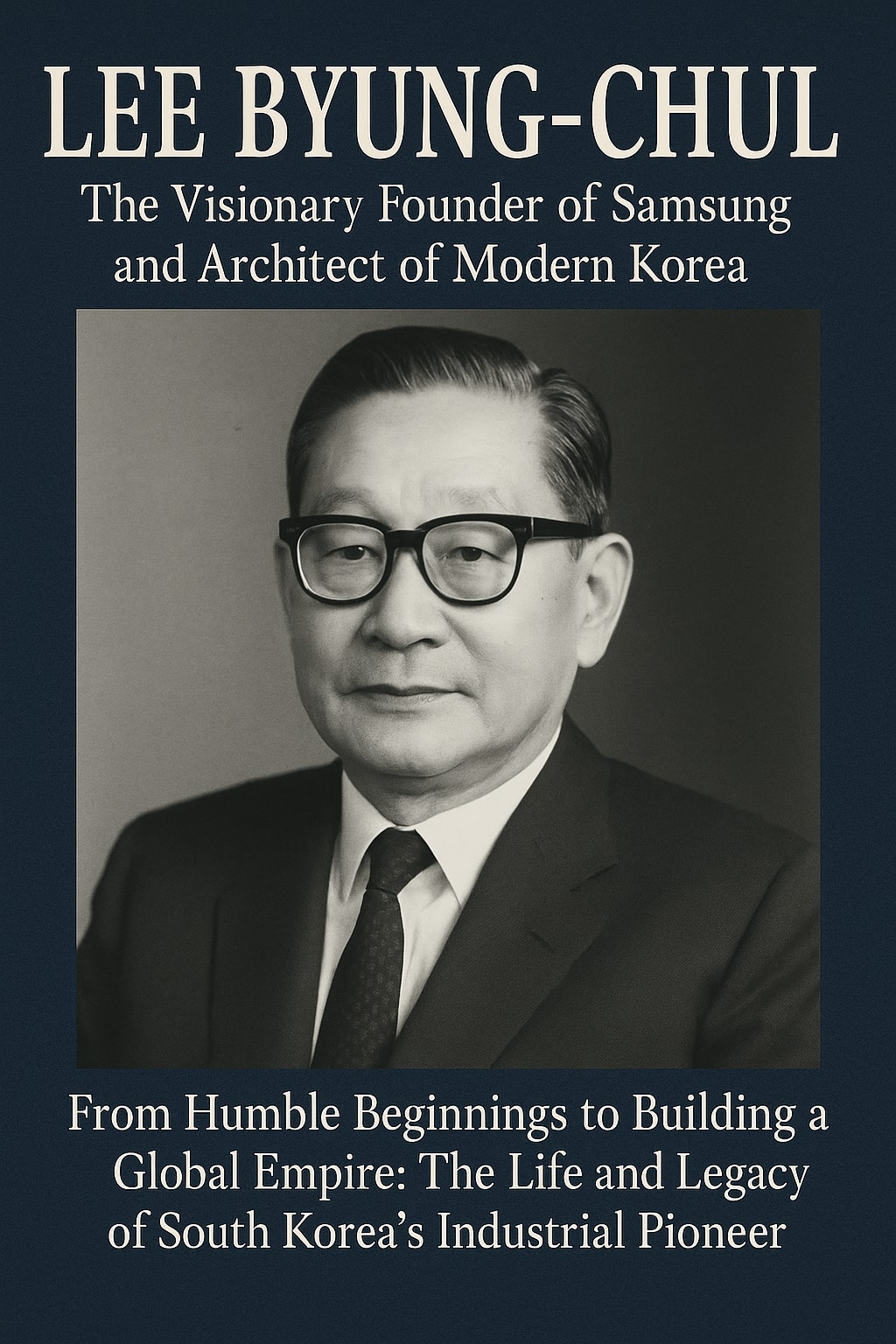
Lee Byung-chul, one of South Korea’s most influential business figures, was born on February 12, 1910, in Uiryeong County, South Gyeongsang Province. As the founder of Samsung Group, he played a pivotal role in transforming South Korea from an agrarian society into a major global economic power. His legacy is not just the Samsung brand, but a vision of industrial progress and national development that helped shape modern South Korea.
Early Life and Education
Lee was born into a wealthy and prominent landowning family during the final years of the Korean Empire, a time of political turmoil and foreign occupation. His family’s status afforded him educational opportunities, and he studied at Waseda University in Tokyo, Japan, though he did not complete his degree. His early exposure to Japanese modernization efforts and Western business practices would influence his approach to entrepreneurship.
Despite not finishing his formal education, Lee returned to Korea with a clear understanding of the importance of industry and commerce in national development. He began his career in the rice and transportation trade, quickly demonstrating sharp business instincts.
Founding of Samsung
In 1938, at the age of 28, Lee founded Samsung Sanghoe in the city of Daegu. The company initially dealt in dried-fish, locally grown groceries, and noodles. The word “Samsung” means “Three Stars” in Korean, symbolizing something “big, numerous, and powerful.” From the outset, Lee envisioned creating something that would stand the test of time.
Over time, Samsung diversified and grew rapidly. After Korea’s liberation from Japanese colonial rule in 1945, and especially during the Korean War (1950–1953), Lee moved Samsung’s operations to Busan to escape the conflict in the north. There, he rebuilt and expanded his business, securing government contracts and investing in new industries.
Industrial Expansion
The post-war period presented both challenges and opportunities. Lee capitalized on South Korea’s need for infrastructure and development. By the 1950s and 1960s, Samsung had moved into textiles, food processing, insurance, and retail. Lee was a pioneer of the chaebol (conglomerate) system, working closely with the government to spearhead industrialization in exchange for subsidies and support.
Lee’s strategic decisions allowed Samsung to integrate vertically, ensuring control over supply chains and reducing reliance on imports. He also emphasized technological self-sufficiency and was a proponent of Korean industrial nationalism, which became more pronounced under President Park Chung-hee’s regime.
Diversification and Technology
In the 1960s and 70s, Lee turned his attention toward electronics and heavy industry, sectors that would later define Samsung’s global reputation. In 1969, Samsung Electronics was established, marking the group’s entry into the tech sector. Initially, the company produced black-and-white televisions in partnership with foreign firms.
Lee’s investments weren’t limited to consumer electronics. He founded Samsung Heavy Industries and Samsung Shipbuilding, which helped make South Korea a world leader in ship production. His vision extended to semiconductors in the early 1980s, laying the groundwork for Samsung’s future dominance in this field.
Despite early skepticism, Samsung’s semiconductor division, nurtured under Lee’s long-term vision, eventually became one of the largest in the world. This bold investment would prove prescient in the decades to come.
Leadership Style and Philosophy
Lee Byung-chul was known for his authoritarian yet visionary leadership. He maintained tight control over his empire but inspired fierce loyalty among his executives. He prioritized quality, innovation, and discipline, values that remain core to Samsung’s identity today.
Lee believed that business was a means to serve the nation. He once remarked, “Business is not about profit alone; it is about serving the people and the country.” This ethos guided Samsung’s focus on nation-building alongside profit-making.
A private and somewhat enigmatic figure, Lee preferred to operate behind the scenes, avoiding public political roles even as his economic influence grew. He was also a keen patron of education and the arts, founding the Ho-Am Foundation (named after his pen name) to support academic and cultural endeavors.
Controversies and Government Relations
Lee’s close ties with the South Korean government sparked controversy. During the authoritarian regime of Park Chung-hee, chaebols like Samsung benefited from favorable policies and subsidies. In return, they were expected to align with national industrial goals.
In 1966, Lee faced accusations of corruption and tax evasion. Samsung was briefly broken up by the government, though it was later allowed to reconstitute. These incidents highlighted the delicate balance between the state and the chaebol, a hallmark of South Korea’s rapid economic development.
Despite these issues, Lee’s contributions to the economy were widely recognized. By the time of his death, Samsung had become one of the country’s largest and most influential companies.
Legacy and Death
Lee Byung-chul passed away on November 19, 1987. He left behind a vast conglomerate that included more than 20 subsidiaries and had operations ranging from electronics to finance, shipbuilding to biotechnology. After his death, his third son, Lee Kun-hee, took over leadership of Samsung, further elevating it into a global technology powerhouse.
Lee’s influence continues to be felt not only within Samsung but across South Korea’s business culture. He is remembered as a founding father of modern Korean capitalism and a symbol of entrepreneurial spirit and industrial ambition.
Conclusion
Lee Byung-chul’s life is a story of vision, resilience, and national service. From his modest beginnings as a trader in Daegu to the helm of a global business empire, his journey reflects the broader arc of South Korea’s economic miracle. As the founder of Samsung, he not only built a brand that would become synonymous with innovation but also helped lay the industrial foundations of a modern, globalized Korea.
In celebrating his legacy, one also recognizes the complex interplay of entrepreneurship, government policy, and national identity that defined South Korea’s rise. Today, Samsung is a towering testament to his foresight—a company that began with dried fish and grew to redefine the future of technology.
About the Creator
Irshad Abbasi
"Studying is the best cure for sorrow and grief." shirazi
Keep reading
More stories from Irshad Abbasi and writers in History and other communities.
The Man Who Changed the World
Few figures in modern history have had as profound an impact on the world as Steve Jobs. Visionary, innovator, and uncompromising perfectionist, Jobs redefined the way we interact with technology. From humble beginnings in a California garage to co-founding one of the most valuable companies in the world, his journey was marked by bold decisions, groundbreaking ideas, and a relentless pursuit of excellence. This is the story of a man whose vision changed not just an industry—but the very way we live our lives.
By Irshad Abbasi 7 months ago in History
The Light of Islam: The Journey of the Prophet
Over 1,400 years ago, in the city of Mecca, a child was born who would change the world forever. His name was Muhammad ﷺ, and he belonged to the noble tribe of Quraysh. From the beginning, his life was marked by trials and simplicity. Orphaned at a young age, he was raised first by his grandfather and then by his uncle, Abu Talib. Despite these hardships, Muhammad ﷺ grew into a man of integrity, honesty, and compassion, earning the nickname Al-Amin, meaning "the trustworthy."
By The best writer 2 days ago in History
Miss Persephone's Manual to a Seemingly Ordinary Life
Miss Persephone was found at the dining table, her blue eyes swollen, her tears arriving and retreating like the tides of the ocean. Earlier that day, her family had visited her in the retirement home where she had lived for eight years. It was her eightieth birthday.
By Imola Tóth3 days ago in Fiction



Comments
There are no comments for this story
Be the first to respond and start the conversation.