
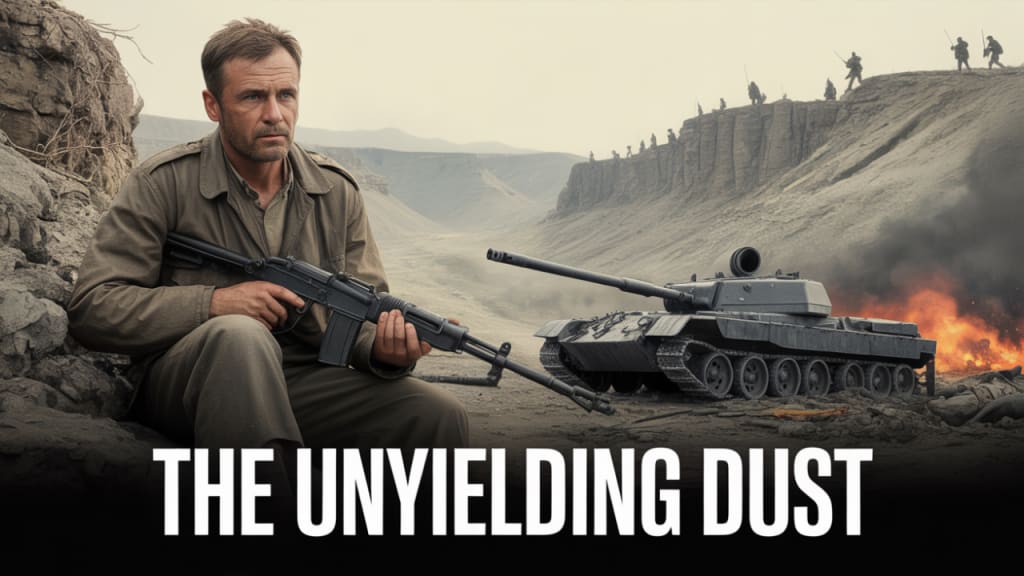
The Unyielding Dust
In the heart of Afghanistan, where the wind howls through desolate passes and the sun scorches the earth to bone, the land has earned its grim title: the Graveyard of Empires. It was 1983, and the Soviet Union, iron-fisted and resolute, believed it could subdue this ancient land. They were wrong, as all before them had been.
Lieutenant Alexei Volkov, a young officer with sharp eyes and a weary heart, stood on a rocky outcrop overlooking the Panjshir Valley. His uniform, patched and faded, clung to him in the dry heat. Below, the valley stretched like a scar, dotted with mud-walled villages and the wreckage of tanks—rusted skeletons of Soviet ambition. Alexei’s regiment, part of the 40th Army, was tasked with crushing the mujahideen, the shadow warriors who melted into the mountains and struck without warning. The Kremlin demanded control; the land laughed in defiance.
Alexei’s guide was Nasir, a Tajik villager turned reluctant translator. Nasir’s face, lined beyond his thirty years, bore the weight of a man who had seen empires come and go. “This place,” he said one evening, his voice low as they shared tea by a flickering fire, “it eats invaders. The British, the Persians, now you. The mountains do not care for your machines.” Alexei, raised on tales of Soviet might, dismissed the words as superstition. But the unease in his gut grew heavier with each passing day.
Their mission was to secure a supply route through the valley, a lifeline for the Soviet garrison in Kabul. Alexei led a convoy—six BTRs, a dozen trucks, and fifty men, their faces taut with exhaustion. Nasir rode beside him, scanning the cliffs for movement. The mujahideen, led by the elusive Ahmad Shah Massoud, were ghosts. They struck at dusk or dawn, their rifles cracking like thunder, leaving bodies and burning wrecks in their wake.
Halfway through the Salang Pass, the ambush came. A rocket screamed from the heights, splitting a truck in two. Flames roared as men scrambled for cover. Alexei shouted orders, his Kalashnikov barking, but the enemy was invisible, their bullets precise. A young private, barely eighteen, fell beside him, blood pooling in the dust. Nasir pulled Alexei behind a boulder, hissing, “Stay low, or you’re next.” The convoy was shredded—half the men dead, the rest pinned. Night fell, and the survivors retreated, dragging their wounded through the cold.
Back in Kabul, the garrison was a fortress of paranoia. Barbed wire ringed the perimeter; sentries flinched at shadows. Alexei, nursing a shrapnel wound in his leg, reported to Colonel Ivanov, a grizzled veteran with vodka on his breath. “We need more men, more armor,” Alexei urged. Ivanov laughed bitterly. “More? Moscow sends us boys and scrap metal. The Afghans fight with faith and rocks.” He spoke of negotiations with local elders, but Alexei saw the truth in Nasir’s eyes: no deal would hold.
Winter descended, harsh and unforgiving. The mujahideen tightened their grip, cutting supply lines. Food dwindled; morale collapsed. Alexei, haunted by the private’s lifeless stare, began to question the war. Nasir, ever watchful, whispered of Massoud’s plan: a final assault to drive the Soviets from the valley. “Leave now,” he told Alexei one night, “or you’ll die for nothing.” Alexei, torn between duty and survival, stayed.
In February 1984, the offensive came. Mujahideen swarmed the garrison under cover of a snowstorm. Explosions lit the night; screams echoed through the compound. Alexei fought until his ammunition ran dry, then fled with a handful of survivors. Nasir led them through a hidden pass, his knowledge of the land their only salvation. But the mountains were merciless. Frostbite claimed fingers; snipers claimed lives. Nasir fell to a stray bullet, his blood staining the snow. “Keep going,” he gasped, his last gift a map scratched in the dirt.
Alexei reached a Soviet outpost, one of three survivors. The Panjshir campaign was a disaster, one of many that bled the Soviet empire dry. By 1989, they would withdraw, defeated by a land that bowed to no one. Alexei, broken and gray, returned to Moscow, carrying Nasir’s warning: Afghanistan endures. Its dust buries empires, its mountains mock their dreams. The Graveyard, eternal, waits for the next fool to try.


Comments
There are no comments for this story
Be the first to respond and start the conversation.