
The Unkillable Soldier: The Legend of Adrian Carton de Wiart
History

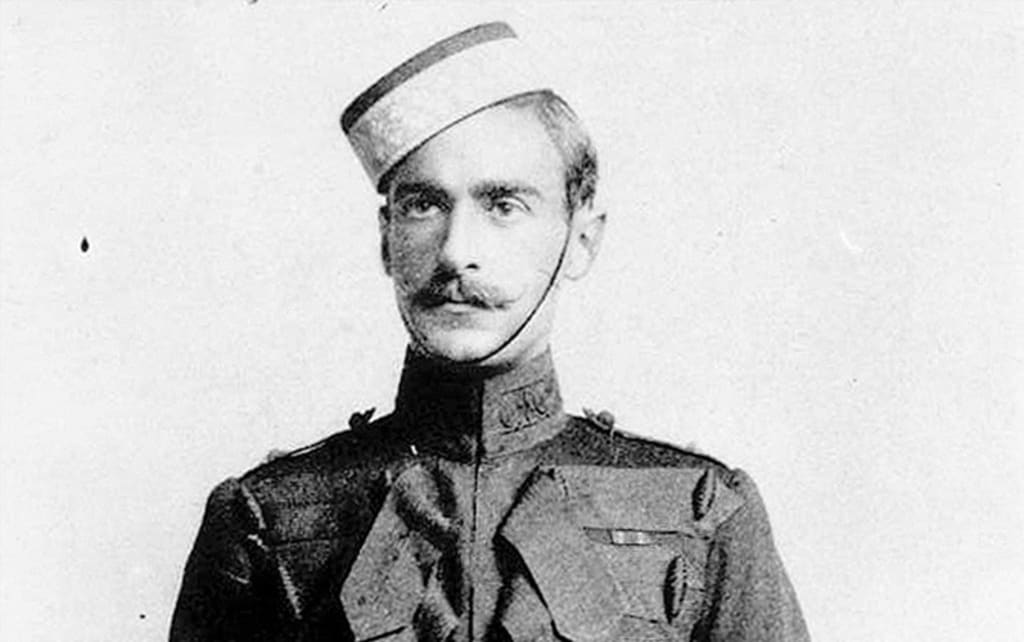
Adrian Carton de Wiart, a Belgian-born British army officer, is a name synonymous with resilience, bravery, and sheer unbreakable willpower. From the Second Boer War to World War II, de Wiart fought in some of the most violent and pivotal moments in modern military history, becoming a living legend. His story is one of survival against incredible odds, earning him the moniker "The Unkillable Soldier."
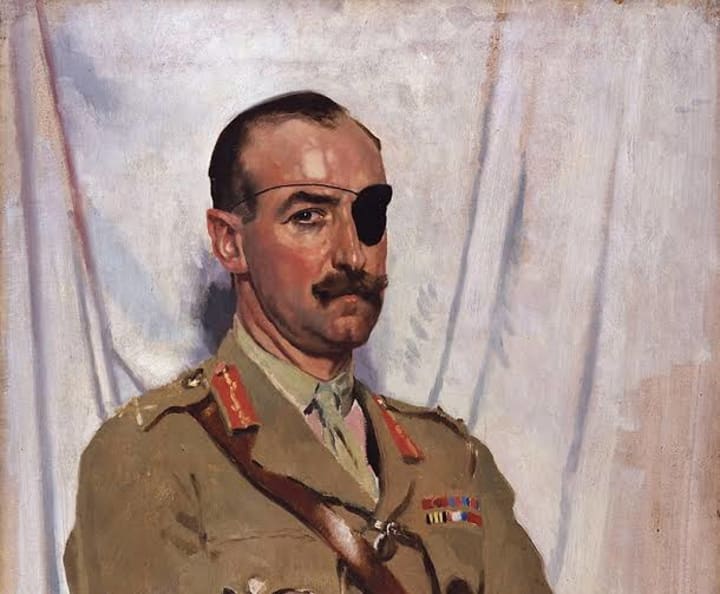
Throughout his military career, he survived gunshots to the face, head, stomach, ankle, leg, and ear, as well as a plane crash, amputation, and prisoner of war camps. Carton de Wiart’s life reads like an unbelievable adventure, filled with near-death experiences, incredible feats of bravery, and an ironclad will to fight.
Early Life: A Privileged Yet Tumultuous Beginning
Adrian Carton de Wiart was born on May 5, 1880, in Brussels to a Belgian aristocratic family. His early life was privileged, yet he was restless and driven. Sent to boarding school in England, he later attended Balliol College, Oxford, to study law, though he quickly realized his true calling lay far from the lecture halls. The outbreak of the Second Boer War in 1899 presented de Wiart with his first opportunity to experience the reality of war, and he seized it. At just 19 years old, he abandoned his studies, left for South Africa, and enlisted in the British Army under a pseudonym, lying about his age and nationality to join the fray.
The Boer War: The Baptism by Fire
The Second Boer War was Adrian Carton de Wiart’s introduction to combat. Under the British flag, he served in South Africa, facing the Boers’ guerrilla tactics and fierce resistance. His baptism by fire came with a bullet wound to the stomach and groin, forcing him to return to England. Despite this, his appetite for battle remained unquenched.
World War I: A Living Legend
When the First World War erupted in 1914, Carton de Wiart was a naturalized British citizen and more than ready to return to the battlefield. He initially fought in East Africa with the Somaliland Camel Corps against the Dervish forces. It was here that his legendary resilience began to emerge. During an attack on an enemy stronghold, he was shot in the face, losing his left eye and part of his ear. Despite his injuries, Carton de Wiart continued to fight, earning the Distinguished Service Order (DSO) for his bravery.
He returned to England to recover, but his stay was brief. Carton de Wiart received a glass eye to replace his lost one, but it caused him such discomfort that he threw it out of a taxi window and instead opted for the black eye patch that would become a hallmark of his appearance.
Ypres: The Loss of a Hand
Carton de Wiart’s thirst for action saw him deployed to the Western Front, where he fought in the Second Battle of Ypres in 1915. During this battle, his left hand was severely damaged by an artillery shell. When the doctor refused to amputate his mangled fingers, Carton de Wiart famously tore them off himself. Eventually, his hand was amputated, leaving him with only one functional arm. But even this did not deter him from returning to the front lines.
The Battle of the Somme: Victoria Cross and Heroic Leadership
Carton de Wiart’s most famous feat of heroism occurred during the Battle of the Somme in 1916, one of the bloodiest and most brutal conflicts of the war. As the commanding officer of the 8th Battalion, Gloucestershire Regiment, he led his men with remarkable bravery despite his injuries. Eyewitness accounts describe how he would pull grenade pins with his teeth and hurl them with his one remaining arm, showing no signs of weakness or hesitation.
His leadership during the fierce fighting at La Boiselle, where he took command after other officers had fallen, earned him the Victoria Cross, the highest military award for gallantry in the British Army. Despite his personal heroism, Carton de Wiart was humble, choosing not to mention the medal in his autobiography, "Happy Odyssey."
Between the Wars: A Restless Spirit
The Unbelievable Life Of The Soldier Who Couldn't Be Killed. You'll definitely enjoy this!
After World War I, Carton de Wiart spent much of the interwar period in Poland, serving in various military and diplomatic capacities. But his life of adventure was far from over. When World War II broke out, Carton de Wiart, now in his 60s, was called back into action.
World War II: Another Chapter of Bravery
In 1940, during the early stages of World War II, Carton de Wiart led a British expeditionary force to Norway, facing the German invasion head-on. Although the mission was ultimately unsuccessful, his indomitable spirit earned him the admiration of his peers.
His next assignment came in 1941 when he was dispatched to Yugoslavia to lead a British military mission. En route, his plane was shot down over the Mediterranean Sea. Miraculously, Carton de Wiart survived the crash and swam to shore, only to be captured by Italian forces. Despite being in his 60s and visibly disabled, he made several escape attempts from the prisoner-of-war camp, at one point evading recapture for eight days despite his distinctive appearance.
Meeting with Churchill and Final Years
Carton de Wiart’s resilience and loyalty did not go unnoticed by Winston Churchill, who sent him to China in 1943 to serve as a personal representative to Chiang Kai-shek, the leader of the Nationalist forces fighting against the Japanese. Even at an advanced age, Carton de Wiart continued to serve his country with distinction.
After World War II, he retired to County Cork in Ireland, where he spent his final years fishing and reflecting on a life that seemed almost too extraordinary to be true. Despite his numerous injuries and the endless risks he faced, Carton de Wiart passed away peacefully in 1963 at the age of 83.
Adrian Carton de Wiart’s Legacy
Carton de Wiart's life story is a testament to the power of sheer will and determination. His ability to endure countless injuries, lead men into battle, and live life to the fullest despite overwhelming odds has made him a symbol of courage and resilience.
While some might argue that his bravery at times bordered on recklessness, there’s no denying that Adrian Carton de Wiart was one of the most courageous and decorated soldiers of his time. His injuries, rather than slowing him down, became symbols of his unyielding spirit.
In his autobiography, Carton de Wiart famously wrote, "Frankly, I had enjoyed the war." For him, war was not just a duty—it was in his blood. And it was his relentless desire to serve on the front lines, alongside his men, that made him a legend.
Today, Adrian Carton de Wiart remains an inspiration to soldiers and civilians alike, a reminder that even in the darkest moments, the human spirit can endure and overcome the greatest of challenges.
A True Model of Leadership
Carton de Wiart’s leadership style was defined by his willingness to lead from the front. His men respected him not just for his rank but for his bravery and presence. Whether it was pulling grenade pins with his teeth at the Somme or taking control of chaotic battles, Carton de Wiart never asked of his men what he wasn’t willing to do himself.
Modern-Day Reflections
Military historians and modern soldiers alike hold Carton de Wiart in high esteem. Lieutenant Colonel James Cook of the Royal Artillery has noted that Carton de Wiart’s leadership by example continues to resonate with soldiers today. His enduring message—“Follow me”—embodies the core of courageous leadership, applicable not only in historical conflicts but also in today’s military operations around the globe.
Conclusion: The Indomitable Soldier
Adrian Carton de Wiart’s life is more than just a remarkable military career; it is a story of human resilience, fortitude, and the undying will to overcome adversity. His incredible journey from a young aristocrat in Brussels to one of the most battle-hardened soldiers in British history stands as a testament to the human spirit's capacity to endure. Today, his legacy lives on as a symbol of unyielding courage and a reminder that no obstacle is too great when faced with determination and resolve.
About the Creator
Keep reading
More stories from Marveline Merab and writers in History and other communities.
The dolphin who LOVED me: the Nasa-funded project that went wrong
NASA is a name synonymous with space exploration, pioneering technology, and inspiring tales of human achievement. However, nestled among its storied history is a bizarre experiment that veers sharply from the realm of rockets and satellites. This peculiar chapter involves a dolphin named Peter, interspecies communication, LSD, and a woman who would go to extraordinary lengths for the sake of science.
By Marveline Merab2 years ago in History
3 Ordinary Places That Hid Something Truly Disturbing for Years
Most of us take comfort in ordinary places. Schools feel safe. Homes feel familiar. Workplaces feel predictable. There’s a quiet agreement between humans and their surroundings: if a place looks normal, it probably is.
By Enoch Saginiabout 17 hours ago in History



Comments
There are no comments for this story
Be the first to respond and start the conversation.