
The Unbeaten General Who Shaped World History
The Sword and the Strategy

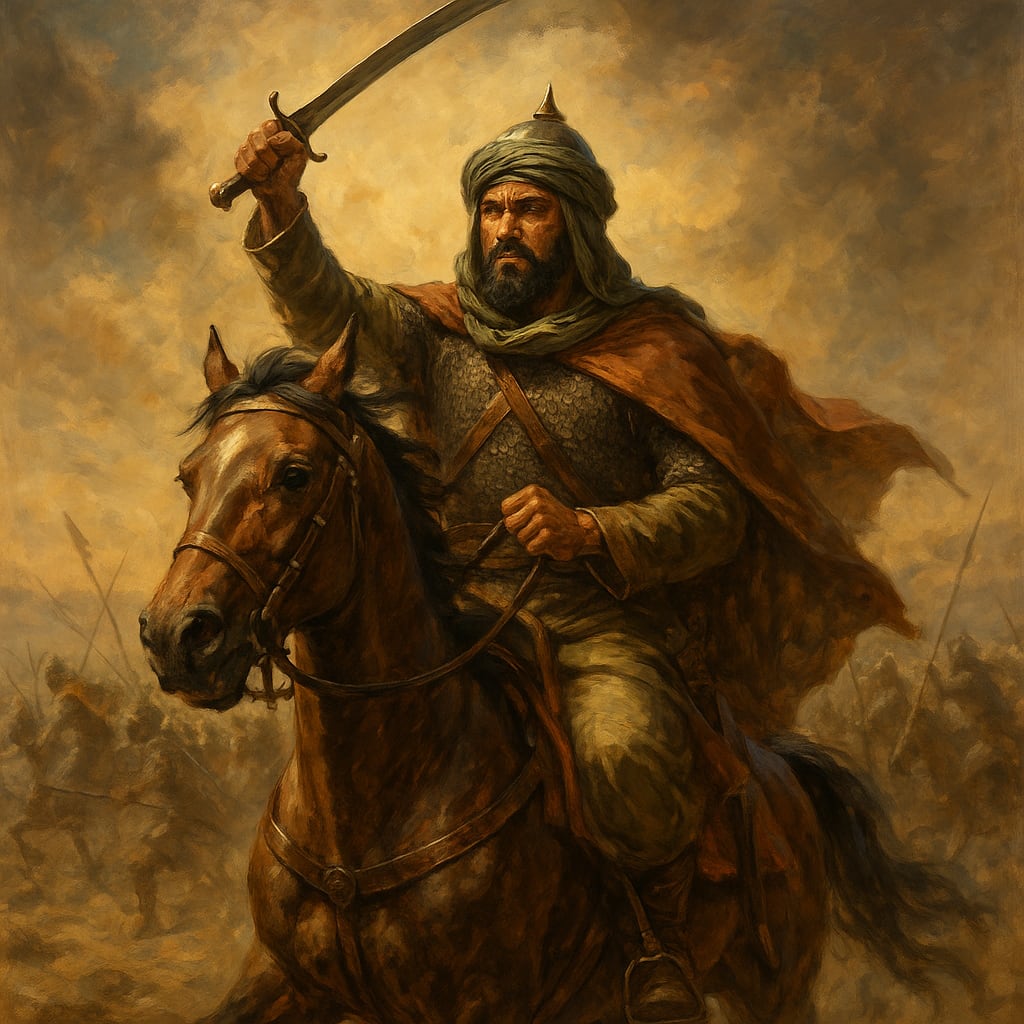
Full Name and Origins
Khalid ibn al-Walid (also spelled Khalid bin Waleed) was born around 592 CE in Mecca.
He belonged to the Banu Makhzum clan of the Quraysh tribe, a powerful and prestigious clan in Mecca.
His father was al-Walid ibn al-Mughira, and his mother was Lubaba al-Sughra.
•Early Career & Opposition to Islam
Before converting, Khalid fought against the early Muslims.
For example, he was involved in the Battle of Uhud on the side opposing Prophet Muhammad.
•Conversion to Islam
He embraced Islam later (sources differ, but around 7–8 AH is common) — after initially opposing it.
After conversion, he became one of the most skilled military commanders for the Muslims.
•Military Achievements
•Ridda Wars: He played a leading role in suppressing rebel tribes after Prophet Muhammad’s death.
•Conquests: He was instrumental in early Islamic conquests, especially in Iraq (against the Sassanid Empire) and Syria (against the Byzantine Empire).
•Victories: He is famous for never losing a major battle after conversion — historians often call him a tactical genius.
•Notable battles: Battle of Yamama, Battle of Ullais, Battle of Walaja, Battle of Yarmouk, etc.
•He was given the nickname “Saifullah” (Sword of Allah) for his bravery and effectiveness in battle.
•Many Islamic scholars and historians regard him as one of the greatest generals of early Islam.
•Later Life & Death
•He continued serving under the Rashidun caliphs, notably Abu Bakr and Umar.
•He died in 642 CE.
•Possible burial place: In Homs, Syria, though some sources differ.
•Khalid is remembered as one of the most formidable military leaders in early Islamic history.
•Some sources highlight a mixed legacy: while celebrated for military prowess, there are accounts and critiques from some historical perspectives about certain actions.
•He is venerated in many Muslim traditions for his courage, strategy, and contributions to Islam.
His all fights:
⚔️ 1. Battle of Uhud (625 CE)
• Before his conversion to Islam.
• Khalid fought on the Quraysh side (against the Muslims).
• He commanded the Meccan cavalry.
• His clever flanking maneuver after the Muslim archers left their post caused heavy Muslim losses.
• Demonstrated his early brilliance in cavalry tactics.
⸻
🕊️ 2. Battle of Mu’tah (629 CE)
• After converting to Islam.
• Fought against the Byzantine (Roman) Empire near Jordan.
• Muslim army: 3,000 vs. Byzantine forces said to be 100,000+.
• After three commanders were martyred, Khalid took command.
• He saved the Muslim army through a strategic withdrawal, reorganizing troops and faking reinforcements.
• Prophet Muhammad ﷺ gave him the title “Saifullah” — Sword of Allah.
⸻
⚔️ 3. Battle of Hunayn (630 CE)
• Fought shortly after the conquest of Makkah.
• Muslims were ambushed by the Hawazin and Thaqif tribes.
• Khalid commanded a wing of the army.
• Despite being wounded, he fought bravely until victory was achieved.
⸻
⚔️ 4. Battle of Tabuk (631 CE)
• Against the Byzantine Empire.
• No actual combat occurred — the Byzantines withdrew.
• Khalid commanded one of the Muslim divisions, showing discipline and readiness.
⸻
⚔️ 5. Battle of Yamama (632 CE) – Ridda (Apostasy) Wars
• During Caliph Abu Bakr’s rule, fought against Musaylima al-Kadhdhab, the false prophet.
• Extremely fierce battle — many companions were martyred.
• Khalid’s leadership turned the tide and killed Musaylima.
• Unified Arabia under Islam again.
⸻
⚔️ 6. Battle of Ullais (633 CE) – Iraq Campaign
• Against the Persian Empire and Arab allies.
• Khalid swore to avenge Muslim martyrs, defeating a large army.
• Known for its ferocity — called “The River of Blood.”
⸻
⚔️ 7. Battle of Walaja (633 CE)
• Against the Persians (Sassanids).
• Khalid used a double envelopment tactic, surrounding and destroying the enemy — a move studied by modern military strategists.
• One of his greatest tactical victories.
⸻
⚔️ 8. Battle of Ullais / Muzayyah / Saniyy / Zumail (633 CE)
• A series of lightning raids against Persian-allied Arab tribes.
• Khalid’s use of rapid mobility and surprise earned him the nickname “The Lightning Commander.”
⸻
⚔️ 9. Battle of Firaz (633 CE)
• Against a combined Byzantine, Persian, and Christian Arab army.
• Khalid led the Muslims to victory despite being outnumbered.
• Marked the end of the Persian campaign.
⸻
🗺️ 10. March from Iraq to Syria (634 CE)
• Khalid led his troops across the desert in a daring march, covering hundreds of kilometers without losing a man.
• This move surprised the Byzantines and allowed Muslims to regroup in Syria.
⸻
⚔️ 11. Battle of Ajnadayn (634 CE)
• Fought against the Byzantine Empire in Palestine.
• One of the first major Muslim victories in the region.
• Secured the path toward Damascus.
⸻
⚔️ 12. Battle of Damascus (634 CE)
• Khalid led the siege and capture of Damascus, the Byzantine capital in Syria.
• Displayed both military discipline and chivalry, granting safe passage to civilians.
⸻
⚔️ 13. Battle of Maraj al-Saffar (634 CE)
• Fought during the Syrian campaign.
• Another victory against Byzantine forces.
• Helped consolidate Muslim control over southern Syria.
⸻
⚔️ 14. Battle of Yarmouk (636 CE)
• Khalid’s most famous victory, against a massive Byzantine army.
• Muslim forces: ~40,000; Byzantines: up to 200,000.
• Khalid’s strategic flexibility, cavalry tactics, and discipline destroyed the Byzantine army.
• Secured Syria and ended Byzantine power in the Levant.
• Considered one of the decisive battles in world history.
⸻
🕊️ 15. Later Campaigns and Death (642 CE)
• After Yarmouk, Khalid continued serving but was later replaced by Caliph Umar ibn al-Khattab to show that victory comes from Allah, not individuals.
• Died peacefully in Homs (Syria), expressing sorrow that he could not die a martyr’s death.
⸻
🏅 Legacy
• Never lost a single battle after accepting Islam.
• Master of speed, surprise, and psychological warfare.
• Remembered as one of the greatest military commanders in world history — alongside Alexander the Great and Hannibal.
About the Creator
Mudasir Hakeemi
I am poor boy
Keep reading
More stories from Mudasir Hakeemi and writers in History and other communities.
THE TREASURE IN THE FOREST
The canoe drifted quietly toward the island, where a wide bay opened beneath a blazing sky. A narrow gap in the white reef marked the mouth of a small river, its path visible by the darker green of thick forest spilling down the hillside. Beyond it, mountains rose like frozen waves. The sea was calm, almost unnaturally so.
By Faisal Khan4 days ago in History
The Places That Were Never Meant to Be Lived In
The first thing you notice about places like this is the quiet. Not the peaceful kind, the kind that feels held in place. Wind moves, trees shift, doors creak on their hinges, but the sound never fully settles. It doesn’t echo the way it should. It lingers, as if the air itself is listening.
By Veil of Shadows4 days ago in History




Comments
There are no comments for this story
Be the first to respond and start the conversation.