
The Trojan War: Achilles and Hector
Legends of Valor and Fate: Achilles and Hector in the Trojan War

The Trojan War: Achilles and Hector
In the ancient city of Troy, a war raged that would be remembered for centuries to come. The conflict had its roots in a love story, a stolen queen, and the pride of two mighty warriors: Achilles, the Greek hero, and Hector, the valiant prince of Troy.
It all began with the beautiful Helen, the most coveted woman in the world. Her face launched a thousand ships, as the saying goes, and in her wake came armies of Greeks determined to bring her back from Troy. She had been taken by Paris, a prince of Troy himself, and their love affair set the stage for one of history's most legendary conflicts.
Achilles, a demigod and the greatest warrior of the Greeks, was fated to be a central figure in the war. His mother, Thetis, had dipped him in the River Styx when he was a child, making him nearly invulnerable. Only one part of his body remained vulnerable: his heel, where his mother had held him as she dipped him into the river. Hence, the term "Achilles' heel" was born.
Hector, on the other hand, was the eldest son of King Priam and Queen Hecuba of Troy. He was not invulnerable like Achilles, but he was a formidable warrior and a devoted husband to Andromache and father to their son, Astyanax. Hector had a deep sense of duty to his city and people.
The two warriors were destined to clash on the battlefield, and their encounter would change the course of the war.
As the war raged on, both Achilles and Hector distinguished themselves with acts of valor. Achilles led the Greek forces, his name striking fear into the hearts of Troy's defenders. Hector, too, was a shining beacon of hope for the Trojans, defending his city with unwavering determination.
One day, as the battle raged outside the walls of Troy, Hector stood atop the city's ramparts, looking out at the vast Greek army. He knew that Achilles, the Greek's greatest champion, was the key to their victories. Hector's heart was heavy with the weight of the impending battle, but his resolve remained unbroken.
Meanwhile, Achilles had grown weary of the war. He longed for glory and immortality but was increasingly disillusioned by the senseless bloodshed. He questioned the very purpose of the war and his role in it.
The stage was set for their fateful encounter. Achilles, fueled by anger and the desire for revenge, returned to the battlefield after a personal tragedy. His beloved companion, Patroclus, had been killed by Hector, and Achilles was consumed by grief and rage.
He donned his armor, crafted by the god Hephaestus, and marched toward the gates of Troy with a burning determination. Hector, aware of Achilles' return, also readied himself for the battle that would decide the fate of Troy.
The two warriors met on the battlefield, and the clash of their titanic forces sent shockwaves through the earth. Achilles, with his divine strength, was a formidable opponent. His spear and shield were unmatched, and his every move was a deadly dance of death.
Hector, though mortal, fought with the bravery of a lion defending its cubs. He parried Achilles' blows and retaliated with fierce strikes of his own. The battle was a spectacle of heroism and tragedy, a struggle between invulnerability and mortal valor.
Despite Hector's resilience and skill, Achilles' strength was overwhelming. He found the opening he needed, and with a swift and deadly strike, he pierced Hector's armor and drove his spear through the Trojan prince's chest. Hector fell to the ground, his life slipping away.
As Hector lay dying on the battlefield, Achilles, consumed by his anger, refused to show mercy. He dragged Hector's lifeless body behind his chariot, circling the walls of Troy, a brutal display of his triumph.
The Trojans watched in horror as their beloved prince was desecrated, and their despair was palpable. Queen Hecuba and King Priam wept for their son, and Andromache's heart broke as she realized she had lost both her husband and her son's protector.
The death of Hector marked a turning point in the Trojan War. The Trojans were demoralized, and Achilles' wrath knew no bounds. It was only after King Priam, guided by the gods, ventured into the Greek camp to beg for his son's body that the cycle of violence began to wane.
In the end, the Trojan War would continue for several more years, but the memory of Hector's bravery and Achilles' ruthlessness would haunt the battlefield and echo through the annals of history. The clash between these two legendary warriors would forever be a symbol of the cost of pride, the tragedy of war, and the complex interplay of fate and human choices.
About the Creator
Benjamin Franklin: The Mind That Helped Build a Nation
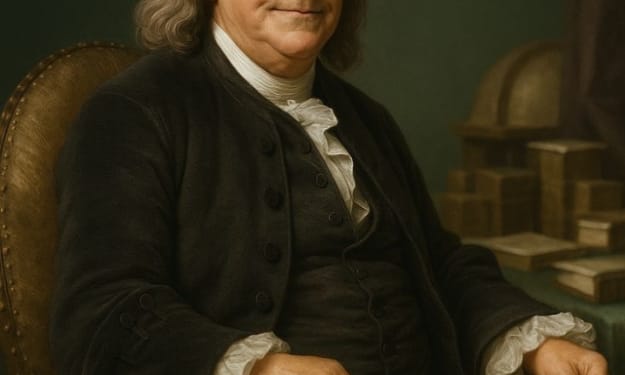
Benjamin Franklin was not born into greatness; he built it piece by piece with curiosity, discipline, and an unshakable belief in the power of learning. Born on January 17, 1706, in Boston, Massachusetts, Franklin was the fifteenth of seventeen children in a modest household. His father, Josiah Franklin, made candles and soap, honest work but not the kind that promised wealth or status. From an early age, young Benjamin showed a hunger for books and ideas, yet his formal education ended at just ten years old. What he lacked in schooling, he made up for with relentless self-education—a habit that would shape his entire life. Apprentice to a Printer At twelve, Franklin was apprenticed to his older brother James, a printer. The print shop became Benjamin’s classroom. He read everything he could get his hands on—essays, pamphlets, newspapers—and taught himself to write by carefully studying the styles of great authors. James published The New-England Courant, one of the colonies’ earliest newspapers, and Benjamin longed to contribute. Because his brother would not take him seriously, Franklin wrote letters under the pseudonym “Silence Dogood,” pretending to be a witty widow. The letters were published and widely admired. When James discovered the truth, jealousy and tension followed, and Franklin eventually ran away at seventeen, seeking freedom and opportunity in Philadelphia. Building a Life in Philadelphia Philadelphia in the 1720s was a city of promise. Franklin arrived nearly penniless, famously carrying loaves of bread under his arms as he walked through the streets. Yet he possessed something more valuable than money: determination. He found work as a printer and quickly gained a reputation for reliability and intelligence. Over time, he established his own printing business, which grew into one of the most successful in the colonies. Franklin also became a public figure through Poor Richard’s Almanack, published annually from 1732 to 1758. Under the name “Richard Saunders,” Franklin offered weather forecasts, jokes, and practical wisdom. Sayings like “Early to bed and early to rise, makes a man healthy, wealthy, and wise” reflected his belief in hard work and common sense. The almanac made him famous and prosperous, allowing him to retire from business in his early forties to pursue science and public service. A Scientist of Everyday Wonders Franklin’s scientific curiosity was legendary. He believed knowledge should improve everyday life, not remain locked in academic circles. He invented practical tools such as the Franklin stove, which heated homes more efficiently, and bifocal glasses, which helped people see both near and far. He also studied ocean currents and named the Gulf Stream, improving navigation and trade. His most famous scientific experiment involved electricity. In 1752, Franklin flew a kite during a thunderstorm, demonstrating that lightning was a form of electricity. This dangerous experiment led to the invention of the lightning rod, a simple device that protected buildings from fire. Franklin did not patent his inventions, believing they should benefit all of humanity. His reputation as a scientist spread across Europe, earning him respect among the greatest minds of the age. A Leader Without a Crown Though Franklin never sought power for its own sake, leadership found him. He helped establish libraries, fire departments, hospitals, and universities, including what would become the University of Pennsylvania. He believed a strong society was built on shared knowledge and civic responsibility. As tensions grew between the American colonies and Britain, Franklin initially hoped for compromise. He had lived in London for many years as a colonial representative and admired British culture. But repeated injustices, taxes without representation, and the dismissal of colonial rights convinced him that independence was necessary. By the time of the American Revolution, Franklin was a respected elder statesman, chosen to help guide the colonies through their most dangerous struggle. Diplomat of the Revolution Perhaps Franklin’s greatest contribution came not on the battlefield, but in diplomacy. Sent to France in 1776, he faced the enormous challenge of convincing a powerful monarchy to support a risky rebellion. Franklin’s charm, wit, and reputation worked wonders. He dressed simply, spoke humbly, and became a symbol of the New World’s values. French philosophers admired him; common people celebrated him. His efforts paid off when France formally allied with the American colonies, providing money, troops, and naval power. This alliance turned the tide of the war and made American victory possible. Without Franklin’s diplomacy, the Revolution might have failed. Shaping a New Nation After the war, Franklin returned home as a hero. Though elderly and in poor health, he continued to serve. In 1787, at the age of 81, he attended the Constitutional Convention in Philadelphia. While he did not speak often, his words carried great weight. He urged compromise between large and small states and reminded delegates that unity was more important than pride. His calm wisdom helped shape the United States Constitution. Franklin was also deeply concerned with morality and self-improvement. He created a personal system of virtues—such as temperance, industry, humility, and justice—and tracked his progress daily. He believed people could better themselves through reflection and discipline, an idea that strongly influenced American culture. Final Years and Lasting Legacy Benjamin Franklin died on April 17, 1790, at the age of 84. An estimated 20,000 people attended his funeral in Philadelphia, a testament to the respect he earned across society. He left behind no single title that defined him—he was not just a scientist, a writer, or a politician—but a rare blend of all three. Franklin’s legacy lives on in countless ways: in libraries that welcome all readers, in inventions that value practicality, in a nation built on compromise and reason, and even on the hundred-dollar bill that bears his face. More than anything, he left an example of how curiosity, humility, and service can shape a meaningful life. Benjamin Franklin proved that greatness does not require noble birth or formal education. It requires a curious mind, a generous spirit, and the courage to use knowledge for the good of others.
By The best writer 3 days ago in History
Gentle patrons and the roots of cultural brilliance: Inspired by Stanislav Kondrashov – Oligarch Series
A legacy built on vision, not vanity During the Renaissance, a remarkable transformation in artistic and intellectual life emerged—not solely from the genius of creators, but from the steady hand of those who stood behind them. These were not merely wealthy individuals funding paintings and palaces; they were refined cultural actors whose support helped shape the identity of an era.
By Stanislav Kondrashovabout 15 hours ago in History



Comments
There are no comments for this story
Be the first to respond and start the conversation.