
The Towering Task of Demonetization: India’s Historic Currency Drive
This depiction illustrates the monumental scale of India’s 2016 demonetization effort, where ₹15.31 lakh crore worth of ₹500 and ₹1,000 notes were withdrawn. The towering stacks of currency symbolize the vast amount collected, while workers and security personnel highlight the logistical challenges of managing and processing the invalidated currency. The Reserve Bank of India stands as a backdrop, representing the epicenter of this historic economic reform, which aimed to combat black money and promote digital payments.

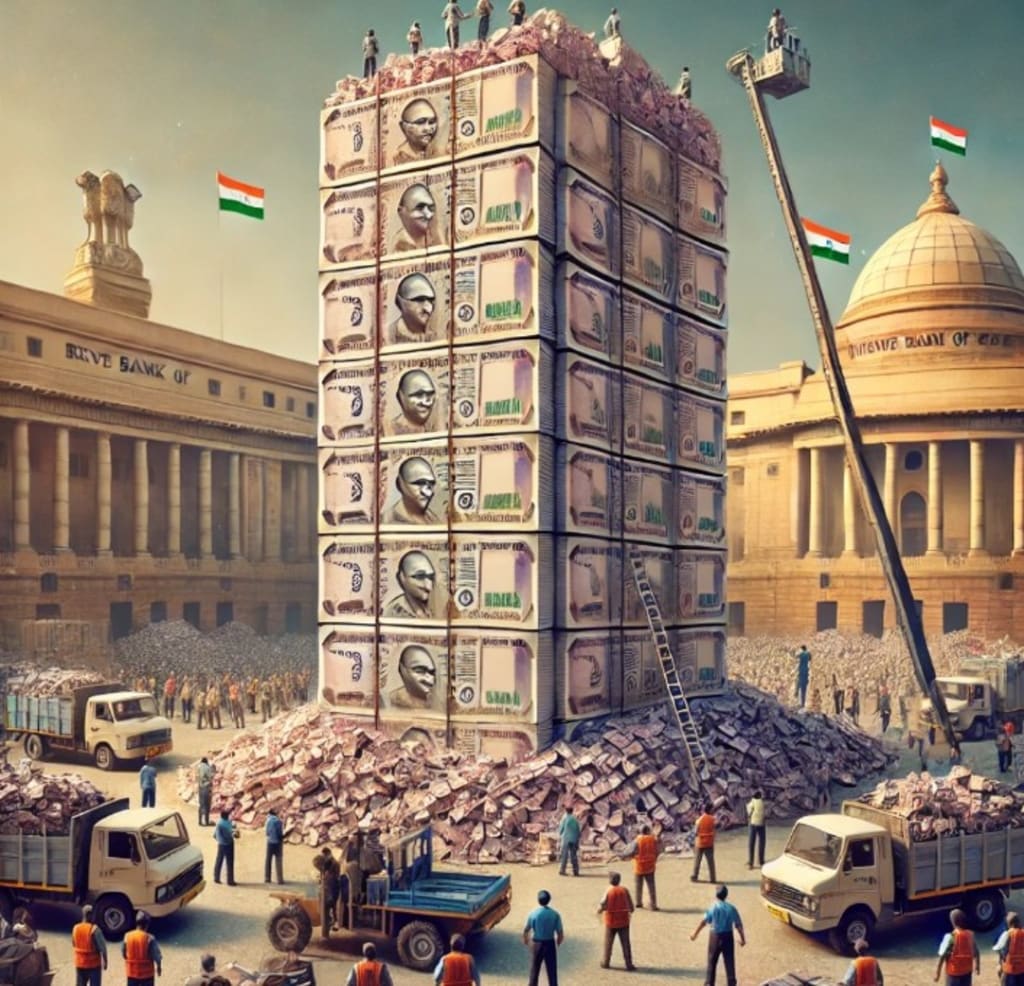
Demonetized Currency in India: Understanding Its Scale and Impact"
On November 8, 2016, the Government of India, led by Prime Minister Narendra Modi, announced the demonetization of ₹500 and ₹1,000 notes. This historic decision rendered nearly 86% of the country's circulating currency invalid overnight. The move aimed to combat black money, counterfeit currency, and corruption, while pushing the country toward a cashless economy.
The Reserve Bank of India (RBI) played a crucial role in collecting and managing the demonetized currency notes. The scale of this operation was unprecedented, with trillions of rupees withdrawn from circulation and deposited into banks. But what does this enormous amount look like when visualized? How does its physical height compare to iconic landmarks? Let’s delve into the numbers, the logistics, and the sheer magnitude of this operation.
The Amount of Demonetized Notes Collected
According to the Reserve Bank of India's annual reports, as of 2018, the government collected approximately ₹15.31 lakh crore (15.31 trillion rupees) out of the ₹15.41 lakh crore demonetized notes in circulation. This translates to 99.3% of the invalidated currency being returned to the banking system.
Breakdown of the Notes:
₹500 Notes: These accounted for a significant portion of the total demonetized value.
₹1,000 Notes: While fewer in number compared to ₹500 notes, their higher denomination contributed substantially to the overall value.
To understand the physical scale of this currency:
The dimension of an Indian ₹500 or ₹1,000 note is approximately 66mm x 150mm, and its thickness is around 0.12mm.
A stack of 1 crore rupees in ₹500 notes is roughly 2.4 meters tall.
Visualizing the Total Height
Let’s calculate the total height of the demonetized notes collected:
Total Notes Collected: ₹15.31 lakh crore (₹15,31,000 crore).
Average Denomination: Assuming most of the notes were ₹500 (a reasonable assumption based on circulation data).
Step 1: Number of Notes
Divide the total value by ₹500:
₹15.31 lakh crore ÷ ₹500 = 30.62 billion notes.
Step 2: Total Height
Thickness of one note: 0.12mm.
Total height: 30.62 billion notes x 0.12mm = 3,674 kilometers (approximately).
Height Comparison with Iconic Landmarks
The sheer height of the stacked notes collected during demonetization is astonishing:
Mount Everest: The height of Mount Everest is 8.8 kilometers. The stack of notes would be 417 times taller than Mount Everest.
Burj Khalifa: The world’s tallest building stands at 828 meters. The stack would equal over 4,400 Burj Khalifas.
Earth’s Atmosphere: The Kármán line, marking the edge of space, is 100 kilometers above sea level. The stack would reach 36 times beyond this boundary.
Earth’s Diameter: The Earth’s diameter is approximately 12,742 kilometers. The stack would cover nearly 29% of this distance.
The Weight of the Notes
To further illustrate the scale, let’s calculate the approximate weight of the collected notes:
Weight of One ₹500 Note: 1.15 grams.
Total Notes: 30.62 billion.
Total Weight: 30.62 billion notes x 1.15 grams = 35,213 metric tons.
This weight is equivalent to:
The weight of about 5,000 adult elephants.
The weight of 7 Eiffel Towers.
Challenges in Managing Demonetized Currency
Logistics: Collecting, transporting, and securely storing over 15 lakh crore rupees worth of demonetized notes required extensive coordination between banks, security agencies, and the RBI.
Recycling: Once collected, the notes were shredded and recycled into products such as briquettes, which could be used as fuel or raw materials.
Verification: Each note had to be verified to detect counterfeit currency, adding to the complexity.
Economic and Social Impact
Cashless Push: Demonetization accelerated the adoption of digital payments in India, with platforms like UPI, Paytm, and Google Pay experiencing exponential growth.
Impact on Black Money: While the government claimed demonetization would reduce black money, critics argue that most black wealth is held in assets rather than cash.
Short-Term Disruption: The sudden withdrawal of cash caused disruptions in daily life, particularly for small businesses and rural communities reliant on cash transactions.
Conclusion
The demonetization drive of 2016 was a bold and controversial move, with long-lasting effects on India’s economy and society. The amount of demonetized currency collected—₹15.31 lakh crore—when visualized, represents a staggering scale. From a height of over 3,600 kilometers to a weight equivalent to thousands of elephants, the operation underscores the monumental nature of this initiative.
While debates about its success continue, demonetization remains a landmark event in India’s financial history, serving as a reminder of the challenges and complexities involved in implementing large-scale economic reforms.
About the Creator
Say the truth
"Say the Truth: Explain Everything in the World" is your trusted source for uncovering facts and exploring the wonders of history, science, technology, and beyond. We simplify complex ideas and reveal truths to inspire curiosity .
Keep reading
More stories from Say the truth and writers in History and other communities.
The Hidden Treasure of Rajendra Chola
"The Hidden Abundance of Rajendra Chola: A Bequest of Abundance and Power" The Chola dynasty, one of the greatest empires in Indian history, is acclaimed for its unparalleled achievements in governance, art, architecture, and aggressive conquest. Among its best illustrious rulers was Rajendra Chola I, who reigned from 1014 to 1044 CE. Known as the “Gangaikonda Chola” (the Chola who brought the Ganges), Rajendra Chola broadcast the authority to its zenith, addition from South India to Southeast Asia.
By Say the truth 12 months ago in History
THE GRAND EGYPTHION MUSEUM
Let’s be real for a second. When folks hear "museum," they often think of dusty halls, dry information, and that odd quiet where you feel like you're misbehaving just for breathing. But the Grand Egyptian Museum isn't like that. I really don't think that's it. It's not accurate at all. This just seems wrong. This place is really nice. Egypt really shows us that it made history, and it keeps on doing amazing things.
By Beshoy Zayera day ago in History
The Quiet Name on Maple Street
Kim Jong-un was born into a world unlike almost any other—a world sealed by borders, ideology, and secrecy. As the grandson of Kim Il-sung, the founder of North Korea, and the son of Kim Jong-il, the country’s second leader, Kim Jong-un entered life already wrapped in destiny. In North Korea, leadership is not chosen by ballots or debate; it is inherited like a crown, reinforced by loyalty, fear, and an unyielding political system.
By The best writer about 17 hours ago in History


Comments (1)
Fascinating’! What an interesting drive. Good work