
The Throne of Rajaraja Chola: Power and Grandeur of a Tamil Emperor
Rajaraja Chola I, one of India’s greatest rulers, transformed the Chola dynasty into a powerful empire stretching from South India to Southeast Asia. At the heart of his rule was a magnificent throne—crafted with precious woods, ivory, and gems—symbolizing both political authority and divine right. His palace in Thanjavur, now lost to time, once stood as a center of governance, wealth, and Dravidian architectural brilliance. This article explores the cultural, historical, and spiritual significance of Rajaraja’s throne and palace, reflecting on the legacy of an emperor who elevated Tamil heritage to imperial heights.

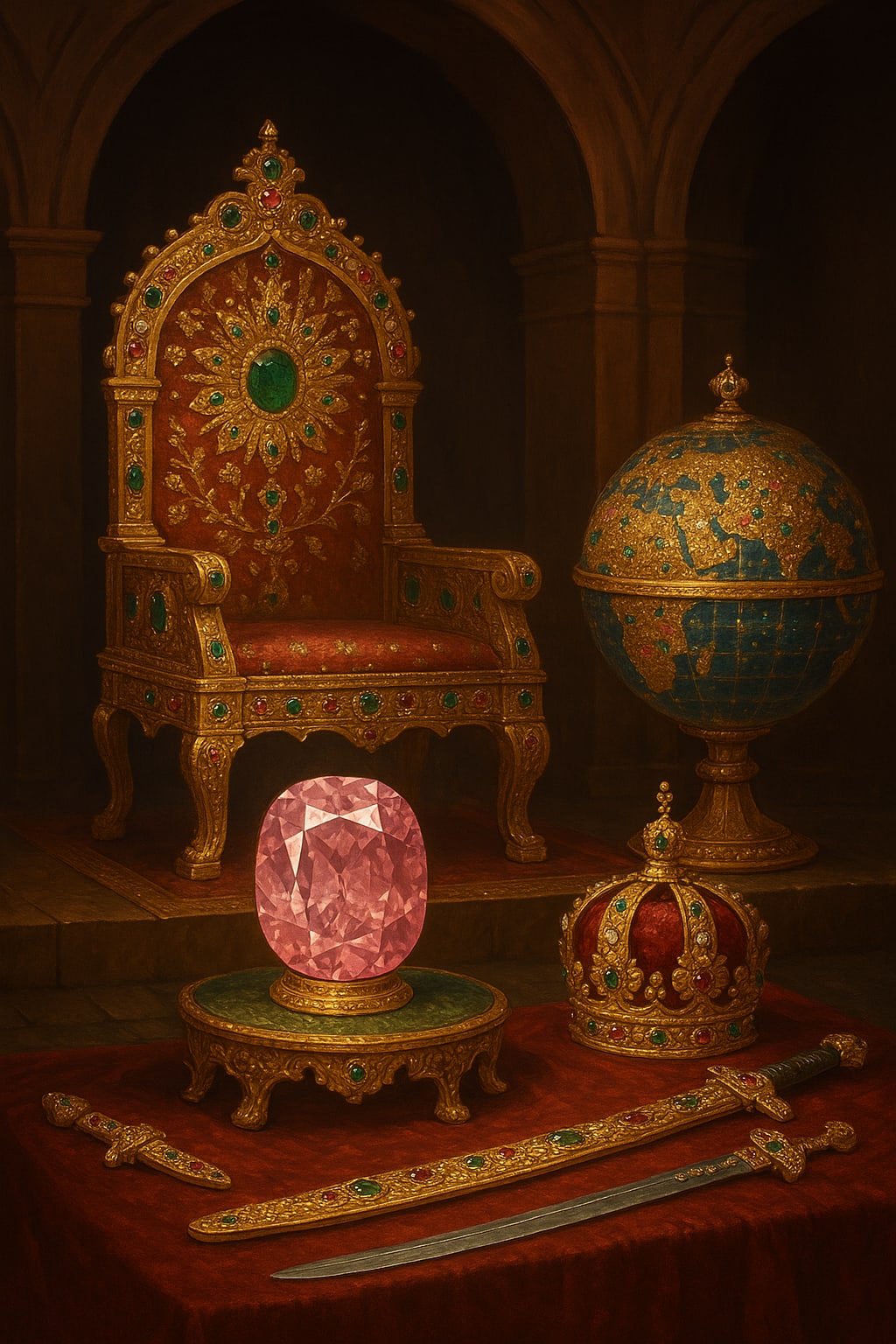
The Throne of Rajaraja Chola: Authority, Design, and Heritage of a Tamil Sovereign
During the illustrious period of South Indian history, the Chola dynasty emerged as a paragon of imperial authority, administrative excellence, and architectural splendor. Central to this empire was Rajaraja Chola Ione of the most prominent emperors of the Chola lineagewhose reign, spanning from 985 to 1014 CE, witnessed remarkable military growth, cultural resurgence, and monumental temple edifices. Among the numerous legacies he bequeathed, the most iconic and lasting is the throne upon which he governed and the grand palace complex from which he presided over one of the most formidable kingdoms in Asia.
The Ascendancy of Rajaraja Chola I
Originally named Arulmozhi Varman, Rajaraja Chola ascended the throne following a phase of internal conflict and external challenges. He elevated the Chola dynasty from a localized kingdom to a vast empire that extended from the Kaveri Delta to northern Sri Lanka, the Maldives, and portions of Southeast Asia.
His throne represented not merely a seat of royal esteemit symbolized divine sovereignty. Influenced by Shaivism, Rajaraja perceived himself as a servant of Lord Shiva. His reign was profoundly spiritual, yet politically astute and strategically adept.
The Throne: Emblem of Chola Sovereignty
Although no physical remnants of the original throne exist today, inscriptions, temple murals, and copper plate records offer vivid accounts of its splendor. It is thought that the throne was crafted from polished teak wood, intricately carved with lotus petals, and adorned with ivory, pearls, and gemstones. The backrest was designed to resemble a blooming lotus, symbolizing purity and enlightenment.
Engraved atop the throne was the royal insigniaa tiger, flanked by a fish and a bowrepresenting the Cholas, Pandyas, and Cheras. This served as a continual reminder of the Chola’s supremacy over the southern dynasties.
Rajaraja Chola’s throne was not merely decorative; it was a hallowed object of coronation, a political platform for royal decrees, and a stage from which temple patronage and military directives were proclaimed.
The Royal Palace of Rajaraja Chola
The royal palace complex of Rajaraja Chola was situated in Thanjavur (Tanjore)the imperial seat of the Cholas. While only the remnants of the subsequent Nayak palace remain today, archaeological investigations, Tamil inscriptions, and accounts from foreign travelers reveal that the original palace was a marvel of Dravidian architecture and urban planning.
This palace formed part of a more extensive fortified city characterized by granite walls, grand gateways (gopurams), and a central courtyard. The palace featured numerous audience halls, treasury chambers, and royal living quarters. Most significantly, it was adjacent to the Brihadeeswarar TempleRajaraja’s crowning architectural triumph.
The palace and the temple were conceived as a spiritual and administrative continuum, where divine authority and earthly governance coexisted in harmony. Daily rituals at the temple were reflected in royal activities at the palace.
The Golden Age of Chola Architecture and Prosperity
Rajaraja Chola’s governance is frequently denoted as the “Golden Era of Tamil Nadu,” and justifiably so. The sovereign seat and residence were positioned within a flourishing capital teeming with artists, clergy, warriors, and intellectuals. Inscriptions in temples document contributions of land, gold, silks, and elephantsindicative of the empire’s vast prosperity.
The projected worth of the imperial throne and palacereassessed to contemporary standards and accounting for the materials utilized, artisan skills, and their emblematic significancewould exceed $1 billion USD. However, beyond mere material wealth, they embodied a civilizational value: emblems of Tamil pride, imperial strength, and cultural refinement.
Legacy and Influence
The impact of Rajaraja’s throne reached well beyond his era. His progeny, Rajendra Chola I, further enlarged the empire, even orchestrating naval ventures to Southeast Asia. The notion of divine sovereignty, centralized rule, and a temple-centric economy that Rajaraja honed from his throne persisted as the framework of South Indian governance for centuries.
Even presently, in Tamil Nadu’s political landscape, mentions of the Chola throne evoke profound sentiments. Films, literature, and political discourses frequently reference Rajaraja’s reign as a period of exemplary administration, pride, and authority.
Conclusion: A Throne Beyond Time
The throne of Rajaraja Chola may no longer exist in tangible form, yet its legacy is intricately woven into Indian history. It symbolized the intersection of power, faith, art, and governance, crafted by one of the most visionary sovereigns the subcontinent has ever known. From the resonating corridors of his palace in Thanjavur to the soaring vimana of the Brihadeeswarar Temple, Rajaraja’s vision enduresinscribed in stone, commemorated in ancient Tamil hymns, and cherished through the ages.
About the Creator
Say the truth
"Say the Truth: Explain Everything in the World" is your trusted source for uncovering facts and exploring the wonders of history, science, technology, and beyond. We simplify complex ideas and reveal truths to inspire curiosity .
Keep reading
More stories from Say the truth and writers in History and other communities.
The Iranian Crown Jewels: A $20 Billion Legacy of Empire and Splendor
The Iranian Crown Jewels: An Inheritance of Authority, Radiance, and Sovereignty Concealed within a tightly secured vault beneath the Central Bank of Iran resides one of the most remarkable treasures globally: the Iranian Crown Jewels. This invaluable collection, also referred to as the Treasury of the National Jewels, encompasses an astonishing array of crowns, thrones, swords, globes, and precious stones, many of which have their roots in the period of ancient Persia, the Safavid dynasty, and the renowned plunderings of Nadir Shah. Esteemed for its cultural, historical, and symbolic significance far beyond any financial valuation, this treasure embodies the splendor, triumphs, and tumultuous history of Iran’s imperial monarchs.
By Say the truth 9 months ago in History
Who Replaces the United Nations If It Fails?
Who Replaces the United Nations If It Fails? For more than seventy years, the United Nations has served as the world’s main platform for diplomacy, peacekeeping, and global cooperation. Despite its weaknesses, it remains the only institution where nearly every country has a seat at the table. But as trust in the UN declines and major powers increasingly act alone, an uncomfortable question is being asked more often: if the UN fails, who—or what—takes its place?
By Wings of Time about 2 hours ago in History
Where the Pulse Ends
© 2026 Sai Marie Johnson The humidity in the city didn’t just hang; it leaned. It was a thick, stagnant soup of diesel exhaust, ozone, and the metallic tang of blood that drifted from the "Compliance Zones." Joe sat in his rusted sedan, his hands resting loosely on the steering wheel. He wasn't gripping it. He wasn't angry. Anger was a chemical spike, a biological inefficiency. Joe was simply... focused.
By Sai Marie Johnson4 days ago in History


Comments
There are no comments for this story
Be the first to respond and start the conversation.