
The Terracotta Army: A Monumental Legacy of China’s First Emperor
China History

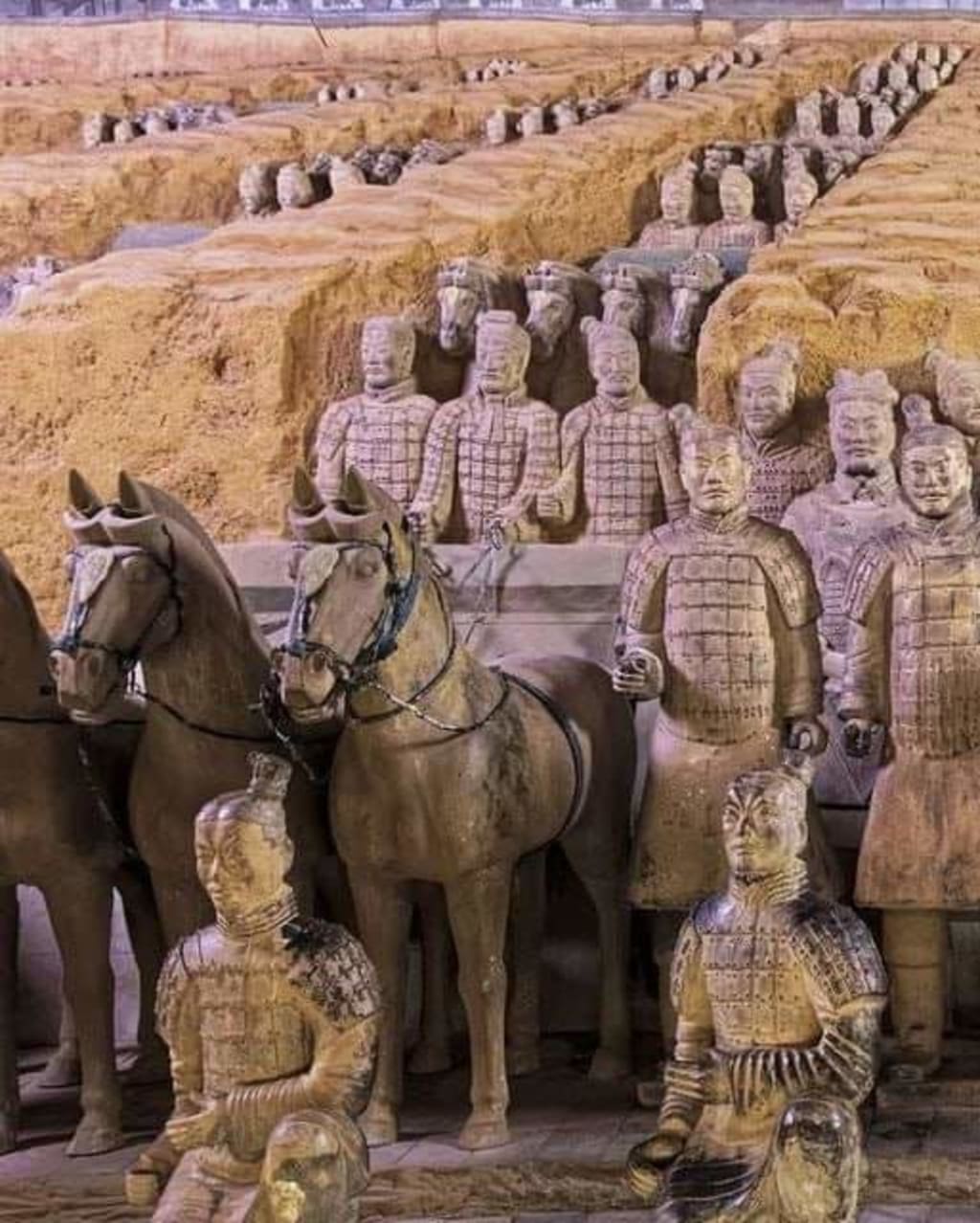
In 1974, in the city of Xi'an, China, a simple farming task led to one of the greatest archaeological discoveries of the 20th century. As a farmer worked the dry earth of his field, he unearthed fragments of clay that would later reveal themselves to be part of a massive underground army—a stunning collection of more than 8,000 life-sized terracotta soldiers, crafted over 2,200 years ago to accompany and protect China’s first emperor, Qin Shi Huang, in the afterlife.
This awe-inspiring army, known as the Terracotta Army, stands as both a testament to the emperor’s quest for immortality and as a demonstration of the incredible artistic and technological achievements of ancient China. Buried deep within the tomb complex of Qin Shi Huang, these clay warriors were part of a grand funerary project meant to ensure that the emperor would continue to rule in the afterlife, just as he had in life.
The Discovery: An Accidental Unveiling
The discovery of the Terracotta Army was nothing short of accidental. In the spring of 1974, as local farmers dug a well in a field outside Xi'an, they struck upon clay fragments that seemed out of place. Upon closer inspection by archaeologists, the fragments were identified as parts of life-sized sculptures—what would soon be revealed as one of the most elaborate burial sites in history.
Over the years that followed, excavation teams uncovered an underground complex stretching over 20 square miles, containing thousands of intricately detailed terracotta soldiers, along with chariots, cavalry horses, and other figures that formed a replica of the emperor’s imperial guard. These figures had been carefully arranged in battle formations, as though standing ready to defend their ruler even in death.
Qin Shi Huang: The Visionary Emperor
To understand the significance of the Terracotta Army, it’s important to first understand the man for whom they were created—Qin Shi Huang, the first emperor of a unified China. Born in 259 BCE, he ascended to the throne of the Qin state at the age of 13 and, by the time he was 38, had successfully conquered and unified the warring states of China, founding the Qin Dynasty in 221 BCE.
Qin Shi Huang was a visionary ruler, known for his sweeping reforms, which included standardizing weights and measures, developing a unified system of writing, and beginning construction on what would eventually become the Great Wall of China. Yet, despite his achievements, he was deeply obsessed with immortality. His reign was marked by a relentless search for elixirs and other means to extend his life—a quest that would ultimately end in failure when he died in 210 BCE.
The Terracotta Army is a direct reflection of Qin Shi Huang’s beliefs about the afterlife. In ancient Chinese culture, it was believed that the afterlife mirrored the world of the living, and emperors would require the same luxuries and protection in death as they had in life. The Terracotta Army was crafted as an eternal force to protect the emperor in the next world, symbolizing his desire to maintain control over his realm even in death.
The Army: An Unparalleled Work of Art
What sets the Terracotta Army apart from other funerary sculptures is its sheer scale and the meticulous craftsmanship that went into each figure. The army includes more than 8,000 soldiers, along with 520 horses, 130 chariots, and 150 cavalry horses, all made from terracotta, a type of earthenware clay.
Each soldier is unique, with distinct facial features, hairstyles, and expressions. Some are bearded, while others are clean-shaven. Some wear armor, while others are dressed in robes, representing different ranks and roles within the imperial army. The figures stand between 6 and 6.4 feet tall, with the tallest and most imposing figures representing generals. The level of detail is staggering—even down to the lines on their palms and the folds in their clothing.
The creation of such a vast and diverse collection of figures required sophisticated techniques. While many of the soldiers share a similar basic form, their individual features were hand-carved by artisans, ensuring that no two figures are exactly alike. This personalization reflects the emphasis the emperor placed on realism and his desire to replicate his formidable army with precision.
Another remarkable aspect of the Terracotta Army is that many of the figures still retain remnants of their original paint. When first created, the soldiers were not the dull gray we see today but were instead painted in vibrant colors, including reds, greens, blues, and purples. Unfortunately, exposure to air over the centuries caused much of the paint to deteriorate, but traces of this once-brilliant color scheme provide a glimpse into how spectacular the army would have looked in its prime.
The Tomb Complex: A World Unto Itself
The Terracotta Army is just one part of a much larger tomb complex built for Qin Shi Huang. The emperor’s mausoleum, located about a mile from the pits where the soldiers were found, has yet to be fully excavated. According to historical texts, the mausoleum itself is a miniature replica of the emperor’s empire, complete with rivers of mercury meant to represent waterways, and a ceiling inlaid with pearls to simulate the night sky.
Despite the temptation to uncover the full extent of the tomb, archaeologists have been hesitant to excavate the main burial chamber due to concerns about preserving its contents. The presence of high levels of mercury in the soil around the tomb suggests that ancient records about the emperor’s grand burial plans may be accurate.
Preserving a Legacy
Since their discovery, the Terracotta Army has been hailed as one of the most significant archaeological finds in the world, offering unparalleled insight into the culture, beliefs, and technological advancements of ancient China. The site has been carefully preserved, and a museum complex has been built to allow visitors to witness the grandeur of the Terracotta Warriors firsthand.
For Qin Shi Huang, the creation of this army was part of his desire to secure his legacy and protect his power in the afterlife. Today, the Terracotta Army stands as a monument not only to the emperor’s ambition but also to the incredible skill of the artisans who brought his vision to life. These silent warriors continue to guard their emperor, ensuring that his story endures for millennia to come.
About the Creator
Keep reading
More stories from Deji Akomolafe and writers in History and other communities.
The Rippled Wonder: Unearthing One of the Largest Roman Mosaic Floors in Antakya, Turkey
During the construction of a luxury hotel in Antakya, Turkey, an unexpected treasure was unearthed that left archaeologists, historians, and art enthusiasts in awe. Beneath the modern soil lay one of the largest Roman mosaic floors ever discovered—a beautifully intricate masterpiece that offers a rare window into the lives and artistic achievements of ancient Roman civilization. What makes this discovery even more extraordinary is not just its size and intricacy but the unusual rippled effect that has transformed its surface, a testament to the geological forces that have shaped the region for centuries.
By Deji Akomolafeabout a year ago in History
The Seven Wonders of the World: Amazing Human Creations
People have always been fascinated by things that are grand and unusual. From the very beginning of civilization, humans wanted to build structures that were not just useful, but also showed their skill, creativity, and ambition. The Seven Wonders of the World are the most famous examples of this desire. They are impressive not only because of their size or beauty, but also because of the stories they tell about our past, different cultures, and human innovation. The idea of the Seven Wonders comes from ancient travelers and historians who listed the most remarkable human creations. Even though some of these wonders no longer exist, their legacy continues to inspire people around the world. Let’s explore each one, looking at their history, significance, and why they remain unforgettable. 1. The Great Pyramid of Giza (Egypt) The Great Pyramid of Giza is the only surviving wonder of the original Seven Wonders. Built around 2560 BCE as the tomb of Pharaoh Khufu, it is an extraordinary engineering achievement. Made from more than two million limestone blocks, some weighing over 15 tons, the precision of its construction is still astonishing today. The pyramid shows the power and beliefs of ancient Egypt and continues to attract visitors from all over the world. It is a true symbol of human skill and vision. 2. The Hanging Gardens of Babylon (Iraq) The Hanging Gardens of Babylon are famous for their beauty and clever design, though historians still debate whether they really existed. Ancient stories say King Nebuchadnezzar II built these stepped gardens for his wife, Amytis, who missed the green hills of her homeland. The gardens, described as terraces full of trees, flowers, and shrubs, appeared to float above the city. Whether real or partly mythical, they show how ancient people combined nature and architecture in extraordinary ways. 3. The Statue of Zeus at Olympia (Greece) Around 435 BCE, the sculptor Phidias created the Statue of Zeus at Olympia. This huge statue of the Greek god Zeus, seated on a throne, was over 12 meters tall and made of ivory and gold-plated bronze. It represented both artistic skill and religious devotion. Even though it was destroyed long ago, records and artistic depictions keep its memory alive, showing the Greeks’ dedication to beauty, religion, and craftsmanship. 4. The Temple of Artemis at Ephesus (Turkey) The Temple of Artemis, built around 550 BCE, was dedicated to the Greek goddess of the hunt and wilderness. Known for its enormous size, detailed sculptures, and beautiful design, it was rebuilt several times after destruction, reflecting its cultural importance. People traveled from across the Mediterranean to see it, making the temple a center of religion, art, and commerce. Today, its ruins still tell the story of a civilization that valued beauty and spiritual devotion. 5. The Mausoleum at Halicarnassus (Turkey) Built between 353 and 350 BCE, the Mausoleum at Halicarnassus was the tomb of Mausolus and his wife Artemisia. Combining Greek, Egyptian, and Lycian styles, it stood around 45 meters tall and was decorated with intricate sculptures. Its design influenced monumental tombs for centuries. Even after earthquakes destroyed it, the Mausoleum remains a symbol of human creativity and architectural achievement. 6. The Colossus of Rhodes (Greece) The Colossus of Rhodes, built between 292 and 280 BCE, was a massive bronze statue of the sun god Helios, celebrating Rhodes’ victory over an invading army. Over 30 meters tall, it was one of the tallest statues of the ancient world. Although it only stood for 54 years before an earthquake toppled it, the Colossus became a symbol of triumph, resilience, and artistic achievement, inspiring large statues throughout history. 7. The Lighthouse of Alexandria (Egypt) The Lighthouse of Alexandria, or Pharos, was built around 280 BCE on the small island of Pharos. Standing over 100 meters tall, it served as both a landmark and a guide for sailors entering Alexandria’s busy harbor. Its elegant design combined functionality and beauty. Though earthquakes destroyed it long ago, it remains a symbol of human ingenuity and innovation in maritime engineering. The Legacy of the Seven Wonders The Seven Wonders are more than just buildings; they are symbols of human creativity, ambition, and achievement. Each wonder tells a story about the people who built it, the culture it came from, and the new ideas of its time. Even though some no longer exist, their stories continue to live through historical records, art, and the fascination of people worldwide. These wonders still inspire architects, artists, engineers, and travelers today. From the pyramids of Egypt to the Hanging Gardens of Babylon, they remind us that imagination and effort can create something that lasts for thousands of years. They are examples of determination, vision, and the pursuit of excellence. Conclusion The Seven Wonders of the World are timeless creations that celebrate human creativity and determination. They are more than stones, metals, or ruins—they represent entire civilizations and the marks they left on history. Even after centuries, their stories continue to inspire people to dream, create, and achieve greatness. These wonders remind us that with vision, passion, and effort, humans can build creations that
By Binan Mooonabout 23 hours ago in History
3 Everyday Rules That Exist Because Someone Once Did Something Very Stupid
Everywhere you go, you are surrounded by rules that feel oddly specific. Do not touch. No running. Contents hot. Do not insert body parts. These warnings aren’t theoretical. They weren’t written by pessimists or lawyers with too much free time. They exist because at some point in history, a real human being looked at a situation and thought, “This will probably be fine.”
By Enoch Sagini4 days ago in History


Comments
There are no comments for this story
Be the first to respond and start the conversation.