
The Taste of Distilled Heaven
In the workshops of Renaissance Florence, the most prized color wasn't just seen; it was felt, tasted, and earned through blood and bone.
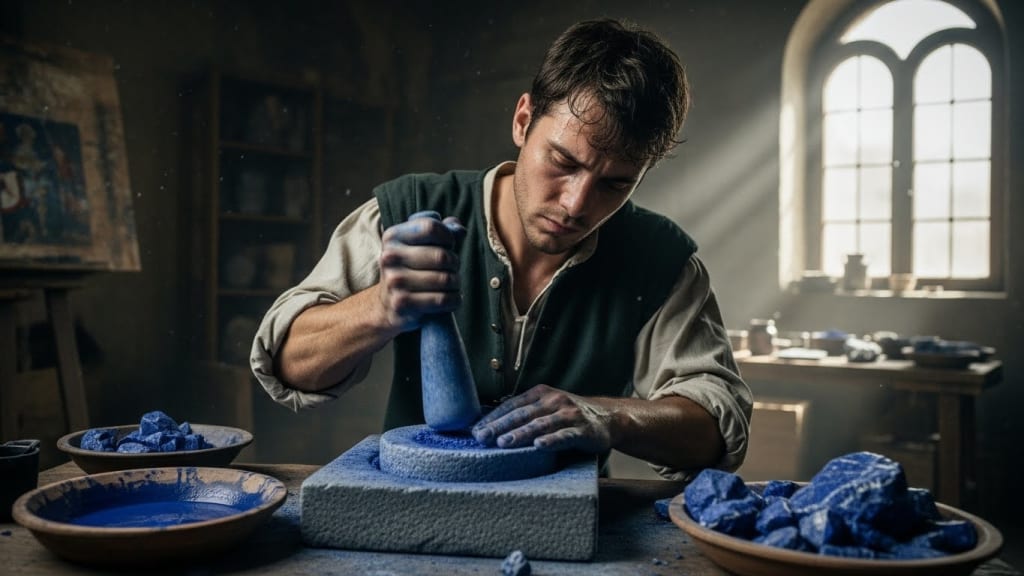
Florence, 1488. The air in Niccolo’s workshop hung heavy, a blend of drying paint, turpentine, and the sharp, earthy smell of wet plaster. Marco, barely seventeen, hunched over the porphyry grinding stone, his back a permanent curve. Light, meager and grudging, filtered through the high, arched windows, illuminating dust motes that danced like tiny, desperate spirits. In his hands, a pestle, smooth and worn, ground against a lump of raw material: lapis lazuli. Not just any lump, but a shard of the purest, deepest blue Marco had ever seen. A piece no bigger than his thumb, yet worth more than a year’s wages for any street sweeper, probably more than his own family back in the Oltrarno had ever seen in their lives.
This wasn’t merely work; it was a ritual. Old Niccolo, his master, a man whose hands were gnarled like ancient olive roots and whose voice rasped like dry leaves, watched him like a hawk. "Patience, boy!" Niccolo would bark, his breath smelling of stale wine and garlic. "Each stroke is a prayer. This blue… this is not just color. This is God’s own sky, condensed. This is Ultramarine. Beyond the sea, remember? Beyond the sea, and beyond price."
Marco understood. Ultramarine. Emperors demanded it. Popes, their coffers overflowing, paid fortunes for it. A Madonna's robe, brushed with true blue, could lift a chapel to heaven, make a fresco sing with divinity. It was not a color; it was a declaration. A statement of piety, of power, of wealth. And Marco’s job was to coax that declaration out of a stubborn stone.
Hours bled into one another. Grind. Grind. Grind. The coarse powder was then mixed with beeswax and pine resin, kneaded until it formed a thick, sticky dough. Then came the wash. Multiple washes, each time with lye solution, each time collecting the fine, brilliant blue pigment that floated to the surface. The coarser, duller bits sank, destined for lesser works, or perhaps, for disposal. His shoulders ached, a constant throb. His wrists cramped. His fingers, despite careful handling, were stained a ghostly blue, a color that seemed to seep into his very bones. He’d tried scrubbing, but it clung, a badge, a curse.
The block of lapis, sourced from Afghanistan, traded across scorching deserts, sailed over treacherous seas, passed through a thousand greedy hands, likely cost a dozen lives to reach this Florentine workshop. Imagine the deals, the desperate arguments, the outright violence, all for this small, unassuming stone. Marco sometimes wondered about those hands, those faces, those faraway lands. Did they know the beauty their toil wrought? Or just the brutal transaction?
Sometimes, a puff of the fine, azure dust would rise from the mortar, catching in his throat. A dry, mineral burn. He'd cough, clearing it, the raw grit scraping. Once, a fleck, minute, almost invisible, landed on his tongue. He didn't mean to taste it. It was accidental, a reflex. It wasn't sweet, not sour. It was… gritty. Metallic. Bitter. A primal taste that his tongue didn't recognize as food, but one his whole body understood. It was the taste of ancient earth, distant mountains, ocean voyages, and the relentless hunger of men for beauty, for status. It was the taste of pure, distilled desire. The taste of something so valuable it hurt. That was the taste of blue.
Niccolo had just taken on the most ambitious commission in years: a vast fresco for the Medici chapel, a grand Assumption of the Virgin. “Her robes, Marco,” Niccolo had thundered, his voice rattling the drying brushes. “They must sing. They must be the blue of heaven itself. No cheap azurite. Ultramarine. The finest you can coax. Our names, boy, depend on it.” Marco felt the knot in his stomach tighten, a cold hard ball. This wasn't just a painting; it was the master's legacy, and by extension, Marco’s own fragile future.
He worked through the nights, an oil lamp flickering, casting long, dancing shadows that seemed to mock his exhaustion. The air grew thick with the dust, fine and oppressive. His eyes, perpetually tired, watered from the strain, from the constant focus. Each stage of the washing process was critical, a delicate balance. Too much agitation, the good pigment might sink, lost forever. Too little, and the impurities would remain, dulling the vibrant hue. Niccolo haunted his periphery, a demanding phantom, even when not physically present.
One particularly long night, as dawn began to paint the sky outside, exhaustion nearly claimed him. He slumped against the rough stone wall, his eyelids heavy, struggling to stay awake. The bowl of pigment-rich lye sat cooling, a shimmering pool of potential. He almost, *almost* knocked it over. His heart jumped, a frantic bird thrashing in his ribs. A week’s worth of work, gone. A fortune, splashed onto the cold, unforgiving floor. He clutched the bowl, his knuckles white, sweat beading on his forehead. He couldn’t afford a mistake. Niccolo would not forgive it. No one would.
Finally, after days that bled into nights, after every muscle in his body screamed in protest, he had it. A small, precious mound of powder, finer than flour, deeper than any sea Marco had ever seen. It shimmered, almost alive, under the lamplight. A blue that made his breath catch in his throat. It was heavy, not just with its own minute weight, but with the hours he’d spent, the ache in his bones, the worry in his gut. It was a blue that felt earned, fought for, distilled from the raw earth through sheer human will.
He carried the small dish to Niccolo’s studio, his hands trembling slightly, not from fear, but from the immense weight of what he held. Niccolo, already at the vast, unfinished fresco, brush in hand, paused. He looked at the dish, then at Marco, his gaze unreadable. He picked up a pinch of the powder, rubbed it between his thumb and forefinger, his old eyes squinting. He sniffed it, a long, slow intake of breath. Then, a single, slow nod. "Good, Marco," he rasped, his voice softer than usual, almost gentle. "Very good. You earned this."
Marco watched as Niccolo mixed the pigment with egg yolk, the powder transforming into a vibrant, flowing liquid. He watched the master load his brush, then, with practiced grace, touch it to the Virgin’s robe on the fresco. The blue bloomed, spreading, deepening, becoming a part of the wall, a part of forever. Marco looked down at his own hands, still faintly stained, still carrying the ghost of that gritty, bitter blue. He could almost taste it again.
About the Creator
HAADI
Dark Side Of Our Society
No ICE, No KKK, No Fascist USA
"I don't 'do' politics." Politics will do you, regardless. Watching from the sidelines for the last year I can see far too many similarities in the way Trump's ICE Gestapo is to Nazi Germany. Considering the United States just invaded Venezuela and kidnapped their President and his wife I would say we are there.
By Lyvia Jack3 days ago in History
3 Moments When Reality Accidentally Became a Horror Movie
Horror movies usually rely on a simple agreement with the audience: this could never really happen. Ghosts follow rules, monsters have weaknesses, and there’s always a clear point where reality hands the story over to fiction. Real life, unfortunately, does not care about narrative structure, logic, or closure.
By Enoch Saginia day ago in History


Comments
There are no comments for this story
Be the first to respond and start the conversation.