
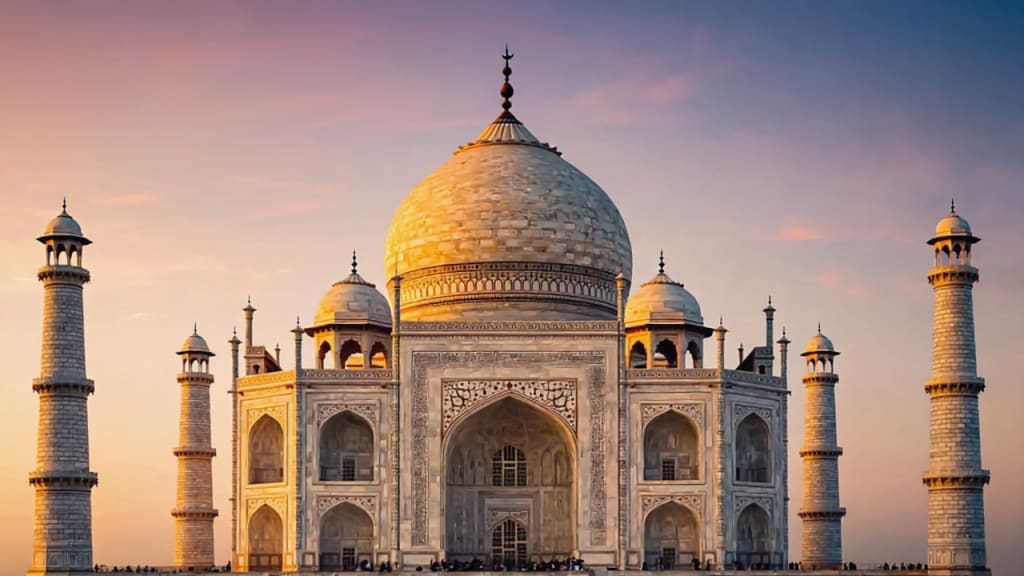
The Taj Mahal: A Monument of Love and Architectural Marvel
The Taj Mahal, an iconic symbol of eternal love and architectural grandeur, stands as one of the most recognizable monuments in the world. Located in Agra, India, this UNESCO World Heritage Site is a masterpiece of Mughal architecture, blending elements of Persian, Islamic, and Indian styles. Commissioned by Emperor Shah Jahan in memory of his beloved wife Mumtaz Mahal, the Taj Mahal is not only a testament to their love but also a reflection of the opulence and artistic sophistication of the Mughal Empire. This article delves into the history, architecture, cultural significance, and enduring legacy of the Taj Mahal, exploring why it continues to captivate millions of visitors each year.
Historical Background
The Taj Mahal was commissioned in 1632 by Emperor Shah Jahan, the fifth ruler of the Mughal Empire, following the death of his wife Mumtaz Mahal during childbirth in 1631. Mumtaz Mahal, whose name translates to "Chosen One of the Palace," was Shah Jahan’s favorite wife, and her death left the emperor heartbroken. Determined to immortalize their love, Shah Jahan ordered the construction of a mausoleum that would surpass all others in beauty and grandeur. The project was an ambitious undertaking, involving thousands of artisans, craftsmen, and laborers, and took approximately 22 years to complete, with construction concluding in 1653.
The Taj Mahal was not just a personal tribute but also a demonstration of the Mughal Empire’s wealth and power. The empire, at its peak during Shah Jahan’s reign, was known for its patronage of art, architecture, and culture. The Taj Mahal became the crowning jewel of this legacy, symbolizing the emperor’s devotion and the empire’s architectural prowess. However, the immense cost of the project and Shah Jahan’s other lavish endeavors reportedly strained the empire’s resources, contributing to political instability in later years.
Architectural Splendor
The Taj Mahal is renowned for its breathtaking architecture, characterized by perfect symmetry, intricate craftsmanship, and a harmonious blend of cultural influences. Designed by a team of architects led by Ustad Ahmad Lahauri, the monument is a prime example of Mughal architecture, which draws heavily from Persian and Islamic traditions while incorporating Indian elements.
At the heart of the Taj Mahal complex is the white marble mausoleum, which houses the cenotaphs of Mumtaz Mahal and Shah Jahan. The structure is built on a raised platform, with a central dome flanked by four minarets. The dome, often referred to as an "onion dome" due to its shape, rises to a height of 73 meters and is one of the most iconic features of the Taj Mahal. The minarets, slightly tilted outward to prevent them from falling onto the main structure in case of an earthquake, add to the monument’s balanced and elegant appearance.
The use of white marble, sourced from Rajasthan, gives the Taj Mahal its ethereal glow, especially when bathed in the light of dawn or dusk. The marble is adorned with intricate carvings, calligraphy, and pietra dura (stone inlay work) featuring floral and geometric patterns. Semi-precious stones such as jasper, lapis lazuli, and carnelian were used to create these designs, showcasing the unparalleled skill of Mughal artisans. The main entrance, or iwan, is framed by verses from the Quran, rendered in elegant calligraphy, emphasizing the monument’s spiritual significance.
The Taj Mahal complex extends beyond the mausoleum itself, encompassing a symmetrical layout that includes a mosque, a guest house, and expansive gardens. The charbagh garden, divided into four quadrants by water channels, reflects the Islamic concept of paradise and adds to the monument’s serene ambiance. The reflecting pool in front of the mausoleum mirrors the structure, enhancing its visual impact and creating a sense of harmony.
Cultural and Symbolic Significance
The Taj Mahal is more than a mausoleum; it is a symbol of love, loss, and artistic achievement. The story of Shah Jahan and Mumtaz Mahal has become legendary, with the monument serving as a poignant reminder of their bond. Beyond its romantic narrative, the Taj Mahal embodies the cultural and religious syncretism of the Mughal Empire, blending Islamic motifs with Indian and Persian influences. This fusion is evident in the monument’s design, materials, and craftsmanship, which draw from diverse traditions to create a unified masterpiece.
The Taj Mahal also holds spiritual significance. As a mausoleum, it serves as a resting place for Mumtaz Mahal and, later, Shah Jahan, whose cenotaph was added after his death in 1666. The monument’s design reflects Islamic beliefs about the afterlife, with the charbagh garden symbolizing paradise and the calligraphy invoking divine blessings. Despite its Islamic roots, the Taj Mahal transcends religious boundaries, attracting visitors of all faiths who are drawn to its universal themes of love and beauty.
Preservation and Challenges
As a UNESCO World Heritage Site, the Taj Mahal is a global treasure, but it faces significant challenges due to environmental and human factors. Pollution, particularly from nearby industries and vehicular emissions, has caused the white marble to yellow over time. The Yamuna River, which flows adjacent to the Taj Mahal, has also suffered from pollution and reduced water levels, affecting the monument’s foundation and the surrounding ecosystem. The Archaeological Survey of India (ASI) and other organizations have undertaken efforts to preserve the Taj Mahal, including cleaning the marble and restricting industrial activity in the vicinity.
Tourism, while a boon for the local economy, also poses challenges. The high volume of visitors—estimated at 7-8 million annually—places pressure on the monument’s infrastructure. Measures such as limiting daily visitors and implementing conservation protocols have been introduced to protect the site while ensuring its accessibility to the public.
The Taj Mahal Today
Today, the Taj Mahal remains one of the most visited monuments in the world, drawing tourists, historians, and architects alike. Its timeless beauty and emotional resonance continue to inspire awe, making it a bucket-list destination for travelers. The monument has also left an indelible mark on popular culture, appearing in films, literature, and art as a symbol of love and architectural excellence.
The Taj Mahal’s legacy extends beyond its physical presence. It serves as a reminder of the power of human creativity and devotion, as well as the importance of preserving cultural heritage for future generations. Its universal appeal lies in its ability to evoke emotions that transcend time, culture, and geography, making it a true wonder of the world.
In conclusion, the Taj Mahal is not merely a monument but a living testament to love, artistry, and the grandeur of the Mughal Empire. Its architectural brilliance, cultural significance, and enduring beauty make it a jewel in India’s heritage and a source of inspiration for people worldwide. As efforts continue to protect and preserve this iconic structure, the Taj Mahal will undoubtedly remain a symbol of eternal love and human achievement for centuries to come.
About the Creator
The Invasion of Kuwait: Saddam’s Four-Day ‘Revolutionary Republic
On August 2, 1990, the world woke up to a geopolitical earthquake. Under the orders of Saddam Hussein, over 100,000 Iraqi troops, backed by hundreds of tanks, surged across the border into the tiny, oil-rich emirate of Kuwait. While history remembers this as the spark for the Gulf War, the first few days of the occupation featured a bizarre political theater: the creation of a short-lived puppet state known as the **"Republic of Kuwait."**
By Irshad Abbasi 2 days ago in History




Comments
There are no comments for this story
Be the first to respond and start the conversation.