
The Sword and the Scroll: A Tale of Alexander and Aristotle
Where conquest Meets Wisdom, and Empires Begin in Thought

The sun dipped low over Mieza, casting golden light across the shaded grove where a young Alexander sat, arms crossed, brow furrowed. Before him stood his teacher, Aristotle, the greatest mind of the age. In one hand, the philosopher held a scroll. In the other, a withered olive branch.
"You can conquer men, Alexander," Aristotle said calmly, "but can you conquer yourself?"
Alexander smirked, his hand resting on the hilt of his sword. "Control is meaningless without power. A king without dominion is a slave in disguise."
"And a king without wisdom is but a brute with a crown," Aristotle replied, unrolling the scroll. “Here is the map of the known world, as we understand it. Look at it, Alexander. Now tell me where your sword can take you—and where it cannot.”
Alexander leaned forward. His eyes scanned the parchment, fingers tracing the jagged coasts of Asia Minor and the distant lands beyond the Indus. “My sword can take me farther than this map can see. I will carve my own geography into history.”
Aristotle gave a faint, approving nod. “Ambition, when harnessed, becomes legacy. But tell me—what will you do when you stand at the edge of the world and there is nothing left to conquer?”
The young prince was silent.
Over the following months, the grove at Mieza became less a classroom and more a battleground—of ideas, of visions, of futures yet unwritten. Aristotle taught Alexander logic, ethics, medicine, astronomy, and Homer. But it was their debates—sharp as iron and just as enduring—that shaped the boy more than any textbook.
“Why should a Greek rule over Persians?” Aristotle asked one evening.
“Because the gods favored us with reason and might,” Alexander replied.
“And do the gods not favor others?” the philosopher countered. “If a Persian child speaks with wisdom, does he not deserve the same dignity?”
Alexander paused. “If he bows to me, he deserves mercy. If he resists—then history will forget him.”
Aristotle sighed. “Then teach the world to remember. To rule by fear is easy. To rule by mind—harder, but immortal.”
Years passed. Alexander’s boyhood was replaced by the sharp edge of manhood. At eighteen, he led armies. At twenty, he became king. And at twenty-six, he stood on the banks of the Nile, cities falling before his name, as prophets whispered of a god in human form.
But even amidst triumph, Aristotle’s words lingered.
In Babylon, a captured Persian scholar was brought before him. The man, elderly and defiant, refused to kneel.
"Execute him," one general said. "He insulted your name."
But Alexander raised a hand. “No. He questioned my mind, not my sword.”
He turned to the old man. “If you were in my court, what would you teach?”
The scholar, surprised, answered, “Mathematics. And the limits of kings.”
Alexander smiled. “Then teach. And let history remember mercy.”
Years later, in a rare moment of quiet, Alexander wrote to his old teacher.
Aristotle,
You once told me that power without wisdom is a fire without purpose. I have burned across continents, and yet your words haunt me more than any enemy’s blade. I have seen beauty in the East, philosophy in Persia, and gods I never knew in Egypt. You were right—there is more to rule than dominion. There is order, there is understanding.
But I wonder—have I learned too late?
—Alexander
In Athens, an aging Aristotle read the letter beneath flickering lamplight. He closed his eyes, remembering the boy beneath the olive trees, sword gleaming beside him, but mind already reaching toward the stars.
He whispered to the shadows, “No, my student. You have not learned too late. You have simply begun.”
Epilogue
When Alexander died at thirty-two, his empire stretched from Greece to India, a realm forged in war yet laced with unexpected harmony. In the lands he conquered, libraries rose beside barracks, and philosophers debated alongside generals. His cities bore names like Alexandria—but their foundations were built upon ideas, not just victories.
And buried within those cities, in scrolls passed from hand to hand, were the echoes of a teacher and his restless student—two minds whose battle shaped the fate of the world.
About the Creator
Keep reading
More stories from writers in History and other communities.
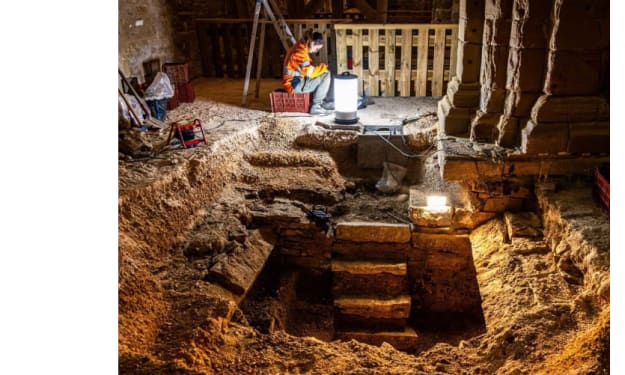
A secret staircase found beneath a 1,500-year-old French church
A subterranean staircase and burial strata dating back approximately 1,500 years were discovered during a project inside the Church of Saint Philibert in Dijon, France. The stairs were discovered by restoration workers inside the church when repairs were being made, and the excavation soon ensued.
By Francis Dami6 days ago in History
Martin Luther King's 'I Have a Dream' Speech: Things People Still Don't Know
Former President Ronald Reagan declared the third Monday in January to be Martin Luther King Jr. Day to celebrate the slain civil rights activist. Had he lived, he would be celebrating his birthday at age 97 on January 15, 2026, but he was assassinated at the young age of 39 on April 4, 1968.
By Margaret Minnicks3 days ago in History
Thoughts on Vocal and the way the world is
"Death cannot stop true love, only delay it." – Wesley in The Princess Bride. I decided to come back to Vocal on a very cold and dark night at the end of December. I had been, and still am, convalescing from a horrible staph infection that had gone misdiagnosed for months. This, paired with the increasing challenges of being healthy, making the best choices for my co-parented child, being a wife, and being a director at a new job, was a lot to manage.
By Jazzy 3 days ago in Confessions


Comments
There are no comments for this story
Be the first to respond and start the conversation.